
In this guide
- The short answer
- What the research says about fewer toys
- How many toys to leave out
- How to set up a toy rotation, step by step
- How often to rotate toys
- Toy rotation by age
- Safety checks while you sort
- Where to store the rest
- Common mistakes
- Does it really work?
- How we researched this
- Sources
- Questions parents ask
Reader-supported: SproutPicks may earn a commission from qualifying affiliate links, at no extra cost to you. Full disclosure.
A toy rotation means keeping only a small set of toys out and storing the rest, then swapping some of them every week or two. Setting up a toy rotation takes an afternoon and no special gear, and it can make a cluttered playroom calmer and old toys feel new again. This guide explains what the research on fewer toys found, how many toys to leave out, how to set up a toy rotation step by step, how often to swap and where to store the rest, plus the toy safety checks to do while you sort.
The short answer
- Put out fewer toys than you think. Many families start with about 6 to 10, covering different kinds of play.
- Store the rest out of sight, in bins your child can't reach.
- Swap a few toys every week or two, or when interest fades.
- Watch what your child actually plays with, and adjust.
- Check every toy for safety as you sort: small parts, button batteries, magnets and broken pieces.
What the research says about fewer toys
The study most often cited for toy rotation is Dauch, Imwalle, Ocasio and Metz, "The influence of the number of toys in the environment on toddlers' play," published in Infant Behavior and Development in 2018 (volume 50, pages 78 to 87). Researchers at the University of Toledo watched 36 toddlers aged 18 to 30 months play in a lab playroom twice: once with 4 toys and once with 16.
With 4 toys, the toddlers played with each toy for longer and used toys in more varied ways. The university's summary said they played about twice as long with each toy and used them more creatively, for example hammering, feeding or hiding a toy instead of just tipping or stacking it. With 16 toys, many children touched 10 or more toys in the first 15 minutes, moving quickly from one to the next. The lead researcher, Alexia Metz, suggested that families who receive lots of gifts save some toys for later and swap them out.
Keep the limits in mind. It was a small lab study of toddlers, over short sessions, and it compared 4 toys with 16. It didn't test rotation over weeks or measure long-term development. Still, it fits a simple, low-cost idea: fewer toys at once can mean deeper play, and rotation lets you keep fewer toys out without getting rid of any.
The American Academy of Pediatrics (AAP) points in a similar direction. Its clinical report on choosing toys for young children says the most valuable toys are often simple ones, such as blocks, puzzles, art supplies and pretend-play items, that encourage imagination and play with a caregiver. Our best Montessori toys for toddlers guide covers open-ended toys that work well in a rotation.
How many toys to leave out
How many toys should a toddler have out at once? There's no official number. In a 2018 study, toddlers given 4 toys played longer and in more ways than when they had 16. Many families start with about 6 to 10 toys across different kinds of play, then add or remove a few based on what their child actually uses.
The right number depends on age and space. A young baby may need only three or four toys within reach, while a preschooler with a long attention span may happily use more, especially open-ended sets like blocks. Count a set as one toy: a basket of blocks or a puzzle with its pieces is one item, not twenty.
A balanced set might include one item from several of these groups:
- Building: blocks, stacking cups or magnetic tiles for older children
- Problem solving: a simple puzzle, shape sorter or nesting toy
- Pretend play: a doll, play food, a toy phone or animals
- Movement: a push toy, ball or ride-on
- Books: two or three, front-facing so they're easy to grab
- Art or sensory: crayons, a drum or a shaker, with supervision as needed
How to set up a toy rotation, step by step
- Gather every toy in one place. Include the toys in the car, the bedroom and grandma's bag. You can't rotate what you can't see.
- Sort out what goes. Remove broken toys, toys with missing pieces and toys your child has clearly outgrown. Donate or recycle what's safe to pass on.
- Do a safety check. Set aside anything with small parts for a child under 3, loose button batteries, loose magnets, long cords or sharp edges. Check recalled toys at CPSC.gov. The safety section below has more detail.
- Group the rest by type of play. Make piles for building, pretend, puzzles, movement, books and so on. This makes it easy to put together balanced sets.
- Build your first set. Choose about 6 to 10 toys, mixing types, and include one or two current favorites so the change doesn't feel like a loss.
- Divide the rest into future sets. Put each set in its own bin. Three or four bins is plenty to start, and a photo or label on each bin helps.
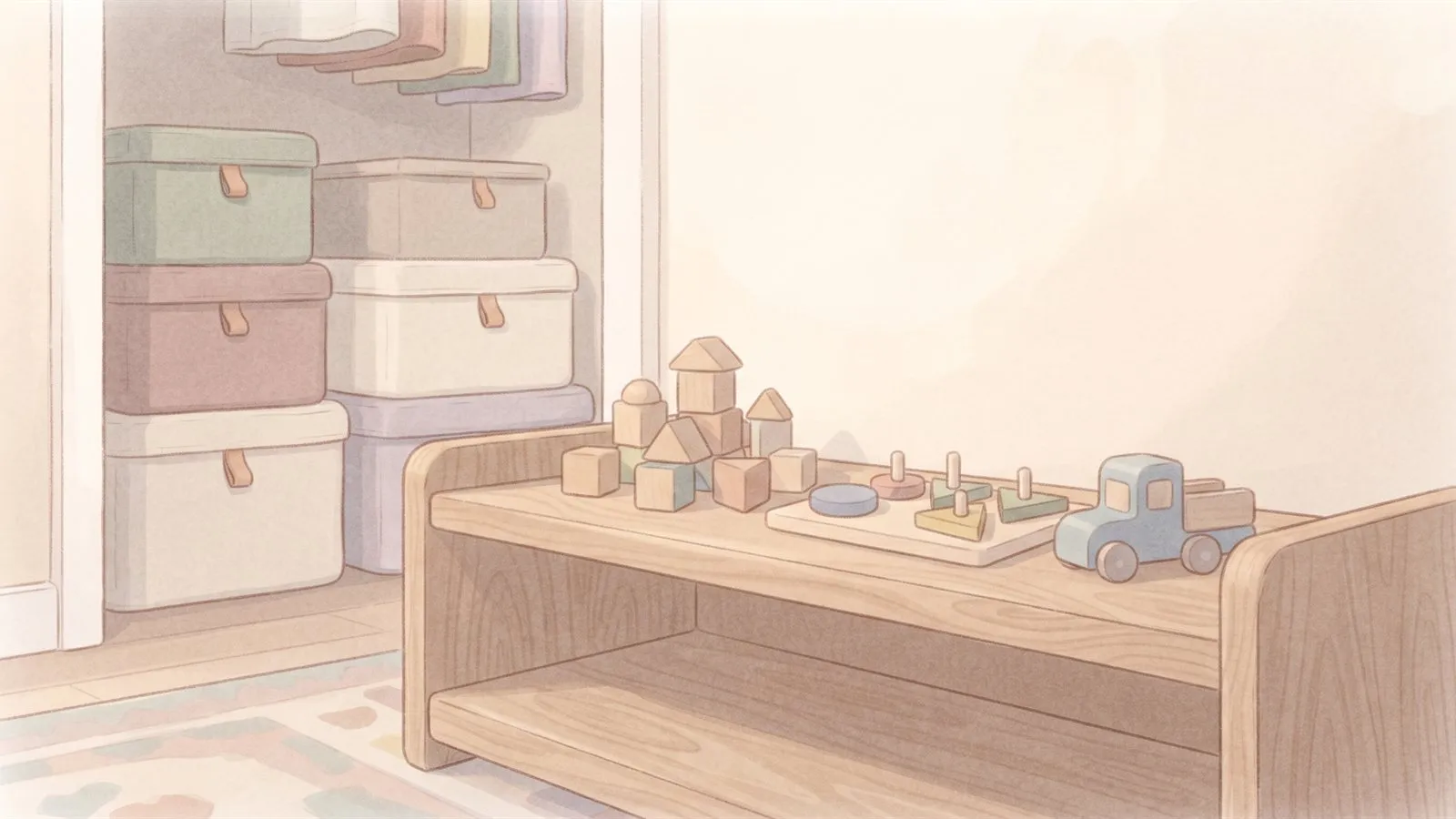
- Store the bins out of sight and reach. A closet shelf, under a bed or a high cabinet works. Toys that are out of sight feel new when they come back.
- Display the current set simply. A low, open shelf with space between items lets your child see every choice and put things back. Avoid dumping everything in one deep bin.
- Swap on a loose schedule. Every week or two, trade a few toys, or the whole set, for the next bin.
- Watch and adjust. Note which toys get used and which sit untouched, and move them around in the next round.
How often to rotate toys
How often should you rotate toys? Every week or two works for many families, but there's no fixed rule. Rotate sooner if your child seems bored or the toys go untouched, and keep a favorite out longer if your child is still deep in it. Comfort items and a few favorites can stay out all the time.
You don't have to swap everything at once. Many parents find a partial swap easier, trading two or three toys at a time. Signs it's time to rotate include toys left untouched for several days, more throwing or dumping than playing, and a child who wanders away from the play space. Signs to wait: your child is still discovering new ways to use a toy, or is working hard to master a puzzle.
Toy rotation by age
What age should you start toy rotation? You can start any time your child has more toys than fit on a low shelf, often around 6 to 12 months. Babies need only a few safe toys at a time. The study on fewer toys looked at toddlers 18 to 30 months old, the age when rotation tends to help most.
- Babies: a few toys to grasp, mouth, shake and look at, all big enough not to be a choking risk. Swap often, since babies change quickly. Our best toys for 1-year-olds guide suggests options for the next stage.
- Toddlers: a mix of building, pretend and movement toys, with simple puzzles and books. This is where fewer choices tends to make the biggest difference.
- Preschoolers: longer projects, bigger building sets and pretend-play setups. Let them help choose the next bin, which builds buy-in.
- Siblings: keep shared toys in the rotation and give each child a small set that stays theirs.
Safety checks while you sort
A rotation is a good moment to look at every toy closely. Federal rules at 16 CFR part 1501 ban toys with small parts for children under 3, because small parts are a choking hazard, but hand-me-downs, older siblings' toys and party favors can still end up in a toddler's reach. Store small-part toys in bins a younger child can't open.
- Button batteries and magnets. Make sure battery compartments are screwed shut, and remove toys with loose magnets. Our button battery and magnet safety guide explains why these are so dangerous if swallowed.
- Cords and strings. Remove long strings from pull toys for young children.
- Wear and tear. Look for cracks, sharp edges, loose eyes or seams, and peeling paint.
- Recalls. Check older toys at CPSC.gov.
Our how to choose safe toys guide covers age labels and what to look for when you buy.
Where to store the rest
You don't need special products for a toy rotation. Use what you have: lidded bins, cardboard boxes or a closet shelf. A few things help:
- Lidded, labeled bins keep sets together and make swaps quick.
- A low, open shelf for the current set, so your child can see and reach every toy.
- Anchored furniture. Any shelf or dresser that holds toys should be anchored to the wall, because children climb for toys they can see.
- No toy chests with heavy, hinged lids that can drop on a child's head or trap them inside.
Our best toy storage organizers guide compares shelves, bins and toy boxes, along with the tip-over and toy chest safety rules to follow.
Common mistakes
- Too many toys out. If the shelf is crowded, take a few away.
- Storing the rest in sight. A visible bin of other toys becomes the most interesting thing in the room.
- Removing every favorite at once. Leave a beloved toy out; rotation shouldn't feel like punishment.
- Rotating too rigidly. A schedule is a guide, not a rule. Follow your child's interest.
- Skipping the safety check. Sorting is the best time to catch a broken toy or a loose battery.
Does it really work?
Does toy rotation really work? The evidence is promising but small. A 2018 study of 36 toddlers found they played about twice as long with each toy, and in more varied ways, when 4 toys were out instead of 16. It didn't test rotation over weeks, but rotating is a practical way to keep fewer toys out without getting rid of any.
For most families, the clearest benefits are practical: less clutter, faster cleanup and fewer new toys to buy, because stored toys feel new when they come back. If your child plays happily with a crowded shelf, there's no need to force it. Try it for a few weeks and see.
More on montessori and classic toys: see Bilibo Review: Open-Ended Rocking Shell for Active Play and Best Toddler Puzzles (2026).
Also useful: our holiday gift guide by age.
Part of our Toys & Learning section. Our main guide covers best toys by age.
How we researched this
This guide is research-based. We didn't run our own study. In November 2026 we read the abstract and record of Dauch and colleagues' 2018 study in Infant Behavior and Development on PubMed, the University of Toledo's news release about it, HealthyChildren.org's summary of the AAP's clinical report on choosing toys, and the federal small parts rule at 16 CFR part 1501. The number of toys to start with and the rotation schedule are practical suggestions, not findings from the study. We say where the research is limited.
Sources
- PubMed, Dauch C, Imwalle M, Ocasio B, Metz AE. The influence of the number of toys in the environment on toddlers' play. Infant Behav Dev. 2018;50:78-87
- University of Toledo, Fewer toys lead to richer play experiences
- HealthyChildren.org (AAP), Best Toys Go Back to the Basics
- eCFR, 16 CFR part 1501, small parts rule for children under 3
- CPSC, Recalls
Questions parents ask
How many toys should a toddler have out at once?
There's no official number. In a 2018 study, toddlers given 4 toys played longer and in more ways than when they had 16. Many families start with about 6 to 10 toys across different kinds of play, then add or remove a few based on what their child actually uses.
How often should you rotate toys?
Every week or two works for many families, but there's no fixed rule. Rotate sooner if your child seems bored or the toys go untouched, and keep a favorite out longer if your child is still deep in it. Comfort items and a few favorites can stay out all the time.
Does toy rotation really work?
The evidence is promising but small. A 2018 study of 36 toddlers found they played about twice as long with each toy, and in more varied ways, when 4 toys were out instead of 16. It didn't test rotation over weeks, but rotating is a practical way to keep fewer toys out without getting rid of any.
What age should you start toy rotation?
You can start any time your child has more toys than fit on a low shelf, often around 6 to 12 months. Babies need only a few safe toys at a time. The study on fewer toys looked at toddlers 18 to 30 months old, the age when rotation tends to help most.
More in Toys & Learning

Fisher-Price Chatter Telephone Review: Pull-Along Since 1961
Fisher-Price Chatter Telephone review: the pull-along toy since 1961. Pretend talk, walking practice and value. Research-based, not tested.

Fisher-Price Corn Popper Review: The 1957 Push Toy
Fisher-Price Corn Popper review: the noisy 1957 push toy for cruisers and new walkers, and why it is not a walker. Research-based, not…
Fisher-Price Rock-a-Stack Review: Classic Stacking Rings
Fisher-Price Rock-a-Stack review: the classic stacking rings. A cheap, durable first toy, with honest limits. Research-based, not tested.