
In this guide
- Quick picks
- Push walkers for babies compared
- Push walkers vs sit-in baby walkers
- Tip-over and speed: what to look for
- When to start
- VTech Sit-to-Stand Learning Walker
- Hape My First Musical Walker
- LeapFrog Nature Walk Touch & Learn Wooden Walker
- Radio Flyer Classic Walker Wagon
- Hape Wonder Walker
- Melissa & Doug Chomp & Clack Alligator
- Safety tips for push walkers
- How we researched this
- Sources
- Questions parents ask
Reader-supported: SproutPicks may earn a commission from qualifying affiliate links, at no extra cost to you. Full disclosure.
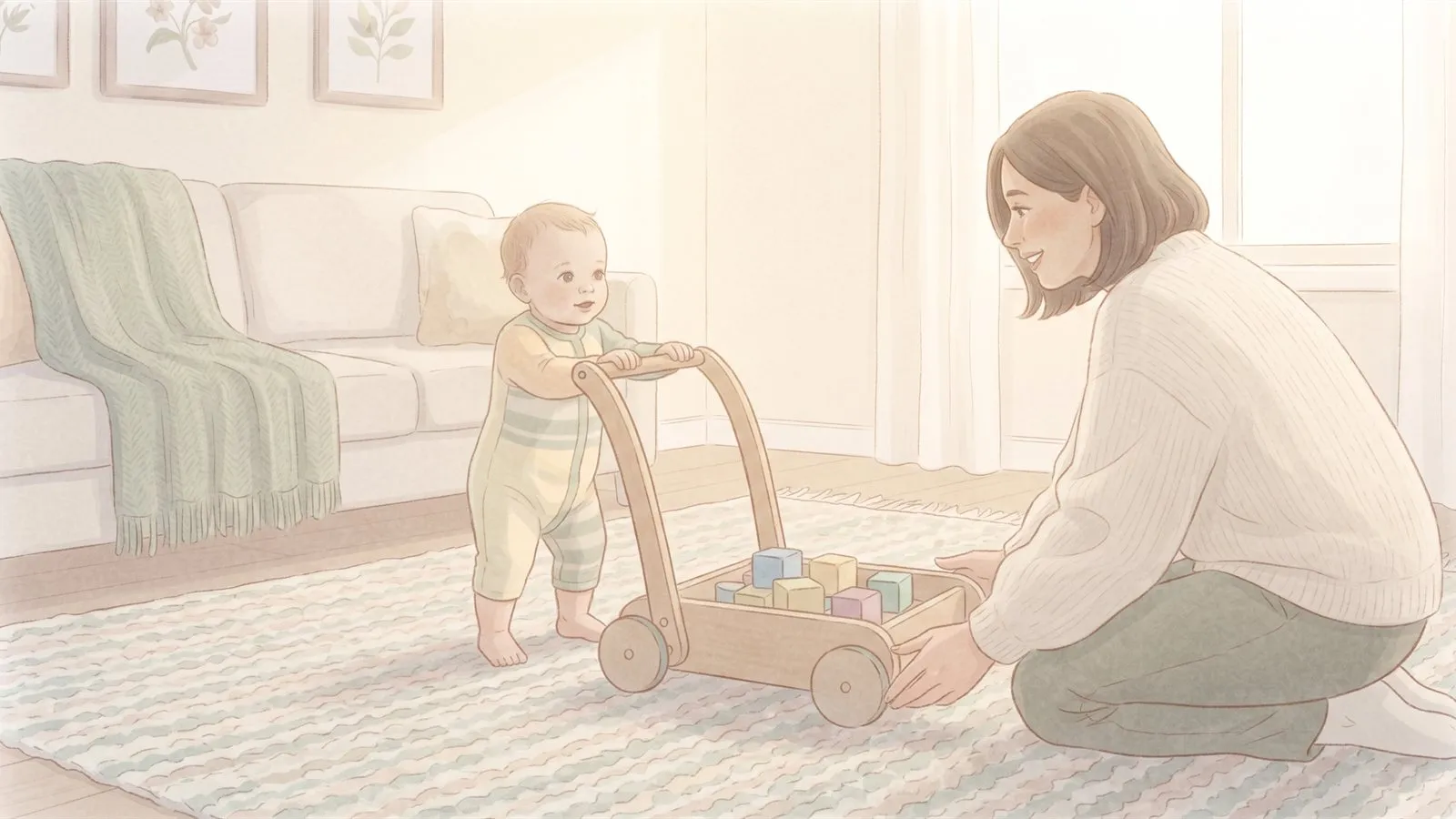
Push walkers for babies, also called walk-behind toys, give a baby who is pulling up and cruising along the couch something steady to push across the room. They are not the same as sit-in baby walkers, which the American Academy of Pediatrics (AAP) urges parents to avoid. Below are six push walkers for babies sold in the US in November 2026, compared on speed control, tip resistance, age labels, batteries and price, plus the difference between a push toy and a sit-in walker, how to keep a fast walker from running away from a wobbly baby, and when to start.
Quick picks
VTech Sit-to-Stand Learning Walker
Hape My First Musical Walker
LeapFrog Nature Walk Touch & Learn Wooden Walker
Radio Flyer Classic Walker Wagon
Hape Wonder Walker
Melissa & Doug Chomp & Clack Alligator
How we score: SproutPicks Scores are our own editorial ratings out of 10. For push walkers they weigh stability and tip resistance, speed control on hard floors, clear age labels, how long a baby will use the toy, battery and noise trade-offs, and value. They are based on maker and retailer listings, AAP and CPSC guidance, and patterns in owner reviews. They are editorial ratings from research, not lab tests, and we did not test these walkers.
Push walkers for babies compared
| Walker | Age on label | Speed control | Batteries | Typical price (Nov 2026) |
|---|---|---|---|---|
| VTech Sit-to-Stand Learning Walker | 9 to 36 months | None listed | 2 AA | About $30 to $50 |
| Hape My First Musical Walker | 10 months and up | Adjustable speed, per Hape | None | About $75 to $85 |
| LeapFrog Nature Walk Touch & Learn | 1 to 3 years | Two speeds, beginner and faster | 3 AA | About $60 |
| Radio Flyer Classic Walker Wagon | 1 to 4 years | Built-in resistance, not adjustable | None | About $80 to $90 |
| Hape Wonder Walker | 12 months and up | None listed | None | About $75 to $100 |
| Melissa & Doug Chomp & Clack | 1 year and up | None | None | About $60 to $95 |
Push walkers vs sit-in baby walkers
Is a push walker the same as a baby walker? No. A push walker is a toy your baby stands behind and pushes while walking on their own feet. A sit-in baby walker has a seat in a wheeled frame that lets a baby who can't walk yet roll around fast. The AAP urges parents not to use sit-in walkers and has called for a ban on them, but it suggests a sturdy push toy for babies learning to walk.
The AAP's concern is backed by injury data. A 2018 study in Pediatrics found that 230,676 children under 15 months were treated in US emergency departments for infant walker injuries from 1990 to 2014. About 74% of those injuries came from falls down stairs, and about 91% were to the head or neck. HealthyChildren.org notes that a baby in a sit-in walker can move more than 3 feet per second, too fast for a parent to react. Injuries fell after a federal standard took effect in 2010, which requires sit-in walkers to be too wide for a standard doorway or to stop at the edge of a step, but the AAP still says not to use them.
A push walker is different because the child is outside the toy, standing on their own feet, and can only go as fast as they can walk. The AAP's milestone guidance for 8 to 12 months suggests a sturdy push toy with a bar to push, weighted so it won't tip when a baby pulls up on it. We used that standard for this list. The CPSC has issued several warnings since 2024 about sit-in infant walkers sold online that failed the mandatory standard; we found no recent CPSC recall for tip-over of a walk-behind push toy.
Tip-over and speed: what to look for
The two most common complaints about push walkers are that they roll away too fast on hard floors and that they tip when a baby pulls up on the handle. Look for:
- Speed control. Some walkers let you tighten the wheels so they roll slowly at first. Hape lists adjustable speed on the My First Musical Walker, and LeapFrog's Nature Walk has a beginner speed and a faster setting. Radio Flyer's wagon has built-in wheel resistance that you can't adjust.
- A wide, heavy base. A walker that is wide at the floor and has some weight low down is harder to tip forward or backward. Wooden walkers tend to be heavier than plastic ones.
- A handle at the right height. The handle should sit around your baby's chest or waist when they stand. A handle that's too high makes a baby lean back and pull the walker over.
- No small parts. Toys for children under 3 can't contain parts small enough to choke on under the federal small parts rule, and toys must meet the ASTM F963 toy standard. Check the age label, and check that blocks and beads stay attached.
Are push walkers safe on hardwood floors? They can roll too fast on hardwood or tile, which is the most common complaint about them. Choose a walker with adjustable wheel tension or a speed-control setting, or a heavier one, start on a rug or carpet, and stay within arm's reach until your baby is steady.
Gate the top and bottom of every staircase; our best baby gates for stairs guide covers hardware-mounted gates for the top of stairs, and our babyproofing checklist covers the rest.
When to start
What age can a baby use a push walker? Most push walkers are labeled from about 9 to 12 months, and they make the most sense once a baby can pull up to stand and cruise along furniture. Go by the age on the box and by your baby's readiness, not the calendar. Some walkers, like the VTech Sit-to-Stand, have a play panel for sitting babies before they're ready to push.
Do push walkers help babies learn to walk? They give a baby who is already pulling up and cruising something to practice with, but there's no good evidence that any walker makes a baby walk sooner. Babies learn to walk when they're ready, and plenty of time on the floor, cruising along furniture and holding your hands does the same job.
The CDC's milestone checklists list walking while holding on to furniture by about 12 months and taking a few steps alone by about 15 months. If you're worried, ask your pediatrician.
VTech Sit-to-Stand Learning Walker
The Sit-to-Stand is the push walker we pick in our best toys for 1-year-olds guide, and it's one of the cheapest walkers on this list. VTech lists it for 9 to 36 months. Its front activity panel, with buttons, spinners and sounds, detaches for floor play, so a baby can use it sitting down before they're ready to push. It runs on 2 AA batteries, and VTech says the included ones are for demo only. Prices were about $30 to $50 in November 2026, often less on sale.
- ✓Low price
- ✓Detachable activity panel for floor play
- ✓Long age range on the label
- ✕No speed control listed; can roll fast on hard floors
- ✕Lots of lights and sounds
- ✕Needs batteries
Hape My First Musical Walker
Hape's My First Musical Walker (E0383) is a wooden walker with a front panel of musical activities, and Hape's US store says it has adjustable speed settings for babies at different stages of walking. Hape lists it for 10 months and up and at about 4.2 kilograms (about 9 pounds), made from plywood and MDF. It needs no batteries. US retailers listed it at about $75 to $85 in November 2026.
- ✓Adjustable speed, per Hape
- ✓No batteries needed
- ✓Heavier wooden build
- ✕More than twice the price of the VTech
- ✕Stock varies by retailer
- ✕Bulkier than plastic walkers
LeapFrog Nature Walk Touch & Learn Wooden Walker
The Nature Walk is a wooden walker with electronic touch-and-learn panels, and its standout feature is the wheels: LeapFrog says they start at a beginner speed and can then be switched to a faster pace as your child gets steadier. LeapFrog lists it for 1 to 3 years, made with FSC-certified wood, with a sit-down play mode. It takes 3 AA batteries. Target and Kohl's listed it at $59.99 in November 2026.
- ✓Two-speed wheels
- ✓Wood frame with electronic learning panels
- ✓Sit-down play mode
- ✕Needs 3 AA batteries
- ✕Labeled from 1 year, later than the VTech
- ✕Electronic sounds, unlike the other wooden picks
Radio Flyer Classic Walker Wagon
Radio Flyer's walker wagon is a wooden wagon with a push handle, and toddlers use it for years to haul blocks and stuffed animals after they've learned to walk. Babylist lists it for 1 to 4 years with a 35-pound maximum weight, a solid wood body with removable stake sides, molded wheels with grip tread, a furniture-friendly bumper and a resist-push feature meant to keep it from rolling too fast. The resistance isn't adjustable, and there's no brake. It weighs about 10 pounds. Prices were about $80 to $90 in November 2026, and it was out of stock at some stores.
- ✓Built-in wheel resistance
- ✓Long age range, 1 to 4 years
- ✓No batteries
- ✕Resistance can't be adjusted
- ✕Bulky to store
- ✕Stock comes and goes
Hape Wonder Walker
The Wonder Walker (E0370) is a wooden busy box on wheels, with knobs, gears, beads and other activities on its front panel. Hape lists it for 12 months and up, at about 3.55 kilograms (about 7.8 pounds), made from MDF, beech and other woods with some plastic parts, and tested to the European EN 71 toy standard. It needs no batteries. Hape's listing doesn't mention speed control, and one owner review says the speed isn't adjustable, so use it on a rug at first. Hape's US store listed it at $74.99 on sale, down from $99.99, in November 2026.
- ✓Lots of hands-on activities
- ✓No batteries or electronic sounds
- ✓Attractive wooden design
- ✕No speed control listed
- ✕Labeled from 12 months
- ✕Pricey at full price
Melissa & Doug Chomp & Clack Alligator
The Chomp & Clack is a different kind of push toy: a wooden stick with a wheeled base, where three alligators clack their jaws as it rolls, plus bead sliders. Melissa & Doug lists it for ages 1 and up, with no batteries, and adult assembly is required. Because it's a long-handled push toy rather than a frame, it doesn't give a baby anything to pull up on or lean against, so it suits babies who are already walking on their own. Melissa & Doug's site listed it at $81.99 in November 2026, with retailers from about $60 to $95. If you want a cheaper classic in the same spirit, see our Fisher-Price Corn Popper review.
- ✓Fun clacking action with no batteries
- ✓Wooden build
- ✓Encourages walking without support
- ✕No support for pulling up or leaning
- ✕Needs assembly
- ✕Pricey for a stick-style push toy
Safety tips for push walkers
- Start on carpet or a rug, and stay within arm's reach for the first few weeks.
- If the walker has a speed setting, start on the slowest one.
- Keep the walker away from stairs, pools and kitchens, and never use it near a step or a deck edge.
- Don't let a toddler ride in or stand on a walker unless the maker says it's designed for that.
- Stop using the toy if any wheel, handle or bead comes loose.
Not quite ready for a walker? Our best toys for 6-month-olds guide covers toys for sitting and crawling babies.
More on toys by age: see Best Holiday Gifts for Babies (2026) and Best Toys for 3-Year-Olds (2026).
Also useful: our holiday gift guide by age.
How we researched this
This guide is research-based. We did not test these walkers. In November 2026 we checked maker and retailer listings from VTech, Hape, LeapFrog, Radio Flyer, Melissa & Doug, Babylist, Target, Kohl's and Walmart for ages, materials, batteries, speed features and prices. Hape's and Melissa & Doug's sites limited our automated access, so some details come from retailer listings, and we couldn't confirm from VTech whether its walker has any wheel-speed adjustment, so we don't claim one. For safety we read the AAP's HealthyChildren.org pages on baby walkers and movement milestones, the 2018 Pediatrics study of infant walker injuries, the CPSC's infant walker rule (16 CFR part 1216) and recent CPSC walker warnings, and the federal toy safety and small parts rules. Prices change often.
Sources
- HealthyChildren.org (AAP), Baby Walkers: A Dangerous Choice
- HealthyChildren.org (AAP), Movement: 8 to 12 Months
- Sims A et al., Infant Walker-Related Injuries in the United States, Pediatrics (2018)
- 16 CFR 1216.2, Requirements for infant walkers
- CPSC, Warning on TreeCute infant walkers (2026)
- CPSC, Toy Safety FAQ
- CDC, Milestone Checklists by Age
- VTech, Sit-to-Stand Learning Walker
- Hape, My First Musical Walker (E0383)
- Hape, Wonder Walker (E0370)
- LeapFrog, Nature Walk Touch & Learn Wooden Walker
- Babylist, Radio Flyer Classic Walker Wagon
- Melissa & Doug, Chomp & Clack Alligator Push Toy
Questions parents ask
Is a push walker the same as a baby walker?
No. A push walker is a toy your baby stands behind and pushes while walking on their own feet. A sit-in baby walker has a seat in a wheeled frame that lets a baby who can't walk yet roll around fast. The AAP urges parents not to use sit-in walkers and has called for a ban on them, but it suggests a sturdy push toy for babies learning to walk.
What age can a baby use a push walker?
Most push walkers are labeled from about 9 to 12 months, and they make the most sense once a baby can pull up to stand and cruise along furniture. Go by the age on the box and by your baby's readiness, not the calendar. Some walkers, like the VTech Sit-to-Stand, have a play panel for sitting babies before they're ready to push.
Do push walkers help babies learn to walk?
They give a baby who is already pulling up and cruising something to practice with, but there's no good evidence that any walker makes a baby walk sooner. Babies learn to walk when they're ready, and plenty of time on the floor, cruising along furniture and holding your hands does the same job.
Are push walkers safe on hardwood floors?
They can roll too fast on hardwood or tile, which is the most common complaint about them. Choose a walker with adjustable wheel tension or a speed-control setting, or a heavier one, start on a rug or carpet, and stay within arm's reach until your baby is steady.
More in Toys & Learning
Best Toys for 5-Year-Olds (2026)
Six toys for 5-year-olds compared, from LEGO and a co-op game to a coding robot and a scooter, matched to CDC milestones, with magnet and…

How to Choose Safe, Age-Appropriate Toys
How to read toy age labels, spot choking hazards, avoid batteries, magnets, balloons and water beads, and pick safe toys for each age, per…
Plus-Plus Learn to Build Review: One-Shape Building Pieces
Plus-Plus Learn to Build review: a compact, one-shape building set for fine motor play, with small-piece cautions. Research-based, not…