
In this guide
Reader-supported: SproutPicks may earn a commission from qualifying affiliate links, at no extra cost to you. Full disclosure.
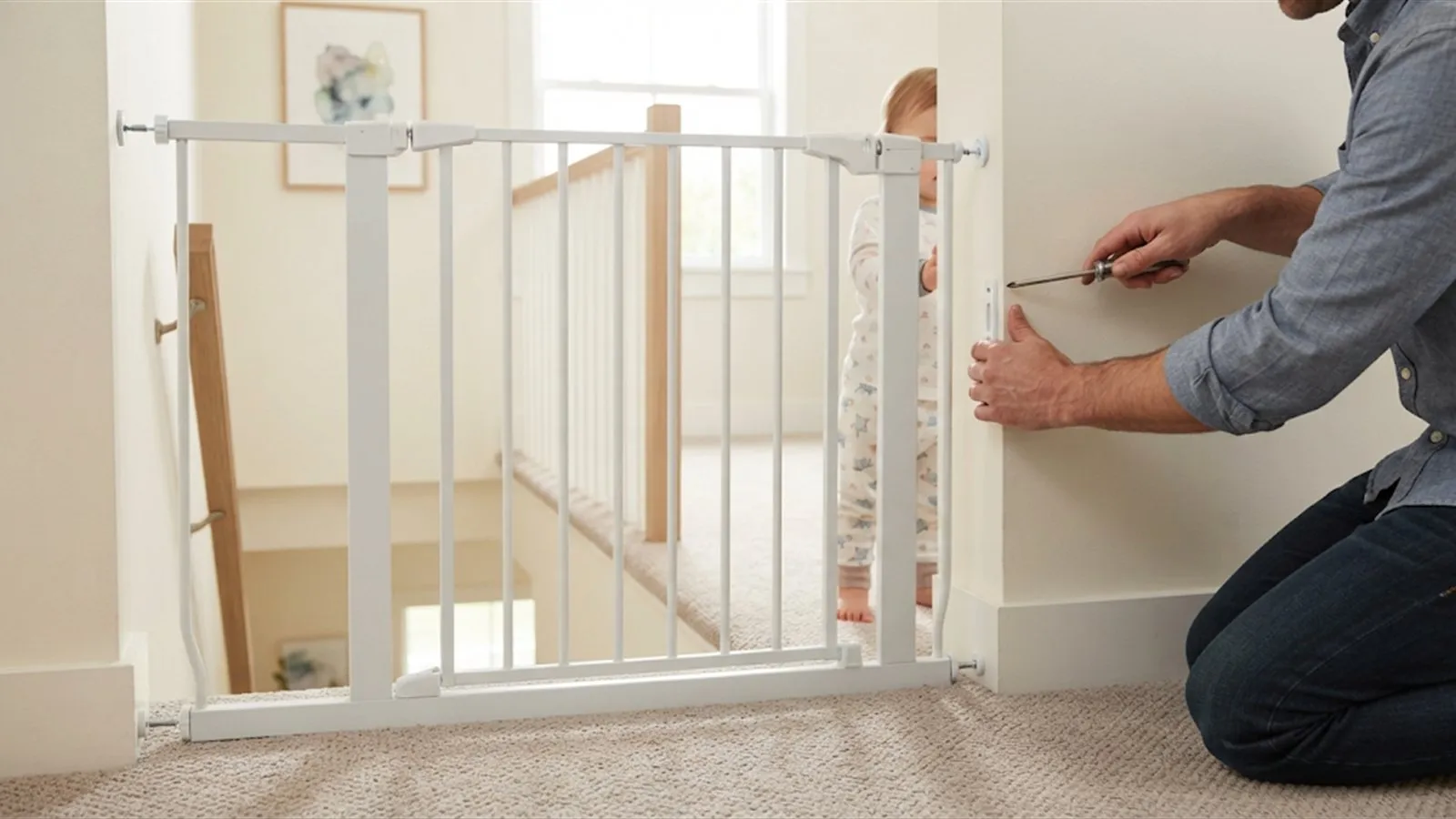
The top of a staircase is the one spot in the house where the type of gate matters more than its looks or price. A gate there has to be screwed into the wall or banister, it must not swing out over the steps, and it should not have a bottom bar for you to trip on while carrying a baby. Below are six hardware-mounted gates rated for stair tops, plus banister kits and the safety rules behind them.
Quick picks
Cardinal Gates Stairway Special (SS-30)
KidCo Safeway Top of Stair Gate
KidCo Angle Mount Safeway
Qdos Extending SafeGate
Regalo Top of Stairs Gate
Evenflo Walk-Thru Top of Stairs Gate
How we score: SproutPicks Scores are our own editorial ratings out of 10. They weigh stair-top suitability, fit range, mounting flexibility and value, using maker specifications, safety standards and patterns in owner feedback. They are not Amazon ratings, and we did not install these gates.
Hardware-mounted vs pressure-mounted: the rule that matters
A pressure-mounted gate holds itself in place by pushing outward against the walls. It is quick to put up, but a determined toddler can push it loose, and most pressure gates have a bar across the floor. KidsHealth, the pediatric site run by Nemours, says to use pressure gates only in doorways between rooms or at the bottom of stairs. Makers say the same thing. Qdos, for example, warns never to use a pressure gate at the top of stairs because of the trip hazard.
A hardware-mounted gate is screwed into the wall, door frame or banister. That is the only kind to use at the top of a staircase. A good stair-top gate also has:
- A one-way stop so it can't swing out over the steps. KidsHealth puts it plainly: never use a gate that swings out at the top of stairs.
- No bottom threshold bar to trip on.
- Solid anchoring. Screw into studs or solid wood where you can. Cardinal Gates sells a drywall anchor kit separately for spots without a stud, which tells you how much the anchor point matters.
If you already own a pressure gate like the one in our Regalo Easy Step review, keep it for a doorway or the bottom step and buy a hardware gate for the top.
ASTM F1004 and JPMA: what the labels mean
Baby gates sold in the US must meet a federal rule, 16 CFR part 1239, which adopts the ASTM F1004 standard for expansion gates and expandable enclosures. According to the CPSC, gates made after January 21, 2023 must meet ASTM F1004-22, and the standard covers gates meant for children 6 to 24 months old.
The JPMA certification seal is voluntary. It means the maker paid for independent lab testing to the ASTM standard. The program has been renamed the Baby Safety Alliance Verification Program, so newer packaging may say "Baby Safety Alliance Verified" instead. Cardinal Gates says the Stairway Special is JPMA certified, and Target's listing for the Regalo Top of Stairs gate says it is Baby Safety Alliance Verified.
Recent CPSC recalls show why this matters. In February 2026, about 10,400 Vevor retractable baby gates were recalled because a child's torso could fit through the gap under the gate. In 2025, HabiLife retractable gates sold only on Amazon were recalled for the same hazard. Both recalls said the gates violated the mandatory gate standard. We found no current CPSC recalls for the six gates below. If you buy used, check the model against cpsc.gov first. Evenflo, for example, recalled older Top-of-Stair Plus wood gates (models 10502 and 10512) in 2010 because slats could break.
The picks
1. Cardinal Gates Stairway Special (SS-30): best overall
Cardinal Gates lists the aluminum version for openings of 27 to 42.5 inches (the wood version fits 29 to 49.5 inches). It stands 29.5 inches tall with 2.5-inch bar spacing. It can mount at angles up to 30 degrees, so you can reach a stud or a banister that isn't straight across from the wall. An optional one-way stop bracket keeps it from opening over the stairs. Aluminum extensions (10.5 and 21.75 inches) cover wider openings.
Trade-offs: banister clamps are sold separately, and it costs more than the budget picks. Cardinal Gates listed it at $99.95 at the time of writing. Skip it if your opening is narrower than 27 inches.
2. KidCo Safeway Top of Stair Gate: best value straight-across install
KidCo designed the Safeway specifically for stair tops. It adjusts from 24.75 to 42.5 inches, stands 30.5 inches tall, and has a stop pin that keeps it from swinging out over the steps. Quick-release hardware lets you lift it off its brackets, and a mounting template is included. KidCo listed it at $69.95 at the time of writing, in white (G2000) or black (G2001).
Trade-offs: the standard Safeway is meant for mounting points that face each other. Banister kits are separate purchases. Skip it if one side is a banister that sits forward of or behind the wall. That's what the Angle Mount version is for.
3. KidCo Angle Mount Safeway: best for misaligned openings
Many stair tops run from a wall on one side to a newel post on the other, and the two are rarely lined up. KidCo says the Angle Mount Safeway is built for exactly that: mounting points that are not directly aligned, such as wall-to-banister installs. It adjusts from 28 to 42.5 inches, and optional extensions take it up to 63 inches. KidCo listed it at $89.95 (G2100 white, G2101 black).
Trade-offs: KidCo's page doesn't publish an angle limit, so measure your offset and check the manual before you buy. Skip it if your opening is a simple wall-to-wall gap. The regular Safeway costs less.
4. Qdos Extending SafeGate: best for narrower openings
Qdos gates are sold in the US through Cardinal Gates, which lists the Extending SafeGate as safe for the top and bottom of stairs. It fits openings from 25.6 to 40.9 inches, stands 29.9 inches tall, and has a one-way stop. It can mount inside or outside a door frame, or at an angle of up to 180 degrees. There's no bottom rail to trip on. It was listed at $64.95 at the time of writing.
Trade-offs: its maximum width is the smallest here. Skip it if your opening is wider than about 41 inches.
5. Regalo Top of Stairs Gate: best budget pick with a banister kit
Regalo's metal Top of Stairs gate (model 1230 DS on Target's listing) is the budget way to handle a banister. It fits openings of roughly 29 to 43 inches, depending on the mounting hardware, and stands 30.5 inches tall. The box includes wall hardware and a banister kit: four square mounts for 2- to 4-inch posts and one round mount for 3- to 5-inch posts. It is rated for children 6 to 24 months. It sold for about $60 at Target at the time of writing.
Trade-offs: only one round mount is included, so a banister-to-banister install with two round posts means requesting a second one from Regalo. The listing says no extensions are available. Skip it if your opening is over 43 inches or your posts are outside the kit's size range.
6. Evenflo Walk-Thru Top of Stairs Gate: best for wider openings
Evenflo lists this hardware-mounted gate for openings of 30 to 48 inches. At 32 inches, it's the tallest gate here. It installs with a four-point hardware system.
Trade-offs: Evenflo's manual warns not to mount the brackets on uneven molding or baseboard trim, so homes with thick baseboards may need a baseboard kit or spacer. We could not confirm a banister kit for this model. Skip it if you need to attach to a banister without drilling.
Banister and angle mounting kits
If one side of your stair top is a banister, you have three options:
- Clamp kits. Cardinal Gates' Gate Installation Kit clamps around a post and gives you a wood adapter to screw the gate into. That way you don't drill into the banister, though you may need to drill the adapter itself. Its square clamps fit posts up to 3.5 inches wide and 2.75 to 3.5 inches deep, and the round clamp fits 2- to 3-inch posts. You need one kit per banister side. Cardinal says it works with most other brands but makes no guarantee.
- In-box kits. Regalo's Top of Stairs gate includes square and round mounts, as described above.
- Angle-capable gates. If the post and wall don't line up, choose the Cardinal, KidCo Angle Mount or Qdos gate above.
Measure the post width, depth and shape (square, round or wrought iron) before you order anything.
Installing and using a stair gate safely
- Set the one-way stop so the gate opens toward the landing only.
- KidsHealth suggests the gate be at least three-quarters of your child's height, with vertical slats no more than 2-3/8 inches apart.
- Keep toys, step stools and storage bins away from the gate so your child can't use them to climb over.
- Don't use an old accordion-style gate. Its diamond-shaped openings can trap a child's head.
- Put a gate at the bottom of the stairs too, so a crawling baby doesn't start climbing.
- Take the gate down once your child can climb over or open it.
For a determined climber, a safe place to climb helps. See our guide to outdoor playsets and climbers for toddlers.
More on babyproofing: start with our guide to babyproofing checklist, then Why Pediatricians Say No to Baby Walkers (and Safer Options) and Button Battery and Magnet Safety for Kids.
Part of our Bath, Health & Safety section. Our main guide covers Best Baby Shampoo and Body Wash (2026).
How we researched this
These picks are research-based. We did not install or hands-on test these gates. We started with gates the makers specifically rate for the top of stairs, then checked each width range, height, mounting method and stop feature against the maker's own product page or, where the maker page wasn't available, a major retailer's listing of the maker's specs. We read the CPSC's gate rule and recall notices, child-safety guidance from KidsHealth, and certification information from the Baby Safety Alliance (formerly JPMA). Prices are the ones listed at the time of writing and change often.
Sources
- Cardinal Gates, Stairway Special Safety Gate (SS-30)
- Cardinal Gates, Gate Installation Kit
- Cardinal Gates, Qdos Extending SafeGate
- KidCo, Safeway Top of Stair Baby Safety Gate
- KidCo, Angle Mount Safeway
- Target, Regalo Top of Stairs Metal Baby Gate listing
- Evenflo, Top of Stair Baby Gate
- CPSC, Gates and Enclosures business guidance
- CPSC, Vevor baby gate recall (2026)
- CPSC, HabiLife safety gate recall (2025)
- CPSC, Evenflo Top-of-Stair Plus wood gate recall (2010)
- KidsHealth (Nemours), Choosing Safe Baby Products: Gates
- Baby Safety Alliance (formerly JPMA), product verification program
Questions parents ask
Can I use a pressure-mounted gate at the top of the stairs?
No. Pressure gates can be pushed loose, and most have a bottom bar you can trip over. Child-safety guidance and the makers themselves say to use a hardware-mounted gate, screwed into the wall or banister, at the top of stairs. Pressure gates are for doorways and the bottom of stairs.
Which way should a top-of-stairs gate swing?
Toward the landing, never out over the steps. Look for a one-way stop, stop pin or stop bracket that blocks the gate from opening over the stairs, and set it up during installation.
Do I have to drill into my banister?
Not always. Several makers sell banister or clamp kits that grip a newel post so the gate screws into a wood adapter instead of the post itself. Check the post size and shape first, because each kit fits a specific range.
When should I take the stair gate down?
Gates are designed for children roughly 6 to 24 months old. Take the gate down when your child can climb over it or open it, because a child climbing a gate at the top of stairs is a bigger fall risk than no gate.
What does JPMA certified mean on a gate?
It means the maker had the gate tested by an independent lab to the ASTM standard for gates. The program is now called the Baby Safety Alliance Verification Program. All gates sold in the US must already meet the federal gate rule, so the seal is extra verification rather than a legal requirement.
More in Bath, Health & Safety
Boon Frog Pod Bath Toy Scoop Review
Boon Frog Pod review: how the draining scoop works, adhesive and screw mounting, what it can and can't do about bath toy mold, and why…

Best Diaper Rash Creams (2026)
The best diaper rash creams compared: zinc oxide vs petrolatum, verified strengths and prices, AAP treatment tips and when to call your…

Best Baby Nasal Aspirators (2026)
The best baby nasal aspirators of 2026, manual, battery and plug-in, compared on suction, cleaning and price, plus saline tips and when to…