
In this guide
- The short answer: are baby walkers safe?
- What the AAP says
- What the injury research shows
- The federal walker standard: what changed, and what didn't
- Canada banned walkers in 2004
- Do walkers help babies learn to walk?
- Safer options for a busy baby
- If you already have a walker
- How we researched this
- Sources
- Questions parents ask
Reader-supported: SproutPicks may earn a commission from qualifying affiliate links, at no extra cost to you. Full disclosure.
A baby walker looks like a happy middle ground: your baby gets to sit up, scoot around the kitchen and see the world, and you get a few free minutes. That's exactly why so many families still get one as a gift. But pediatricians have been warning against them for decades, and the American Academy of Pediatrics (AAP) wants them gone entirely. This guide explains why, in plain terms: what the injury research shows, what the federal safety standard does and doesn't fix, why walkers don't help babies walk, and safer ways to keep a busy baby happy. If you already own a walker, there's a section on that too.
The short answer: are baby walkers safe?
Are baby walkers safe? The AAP says no. It has called for a ban on the manufacture and sale of baby walkers with wheels, because babies in walkers can roll fast, fall down stairs and reach hot or dangerous things. Walkers sold in the US must meet a federal safety standard, which has cut injuries, but thousands of babies are still hurt each year.
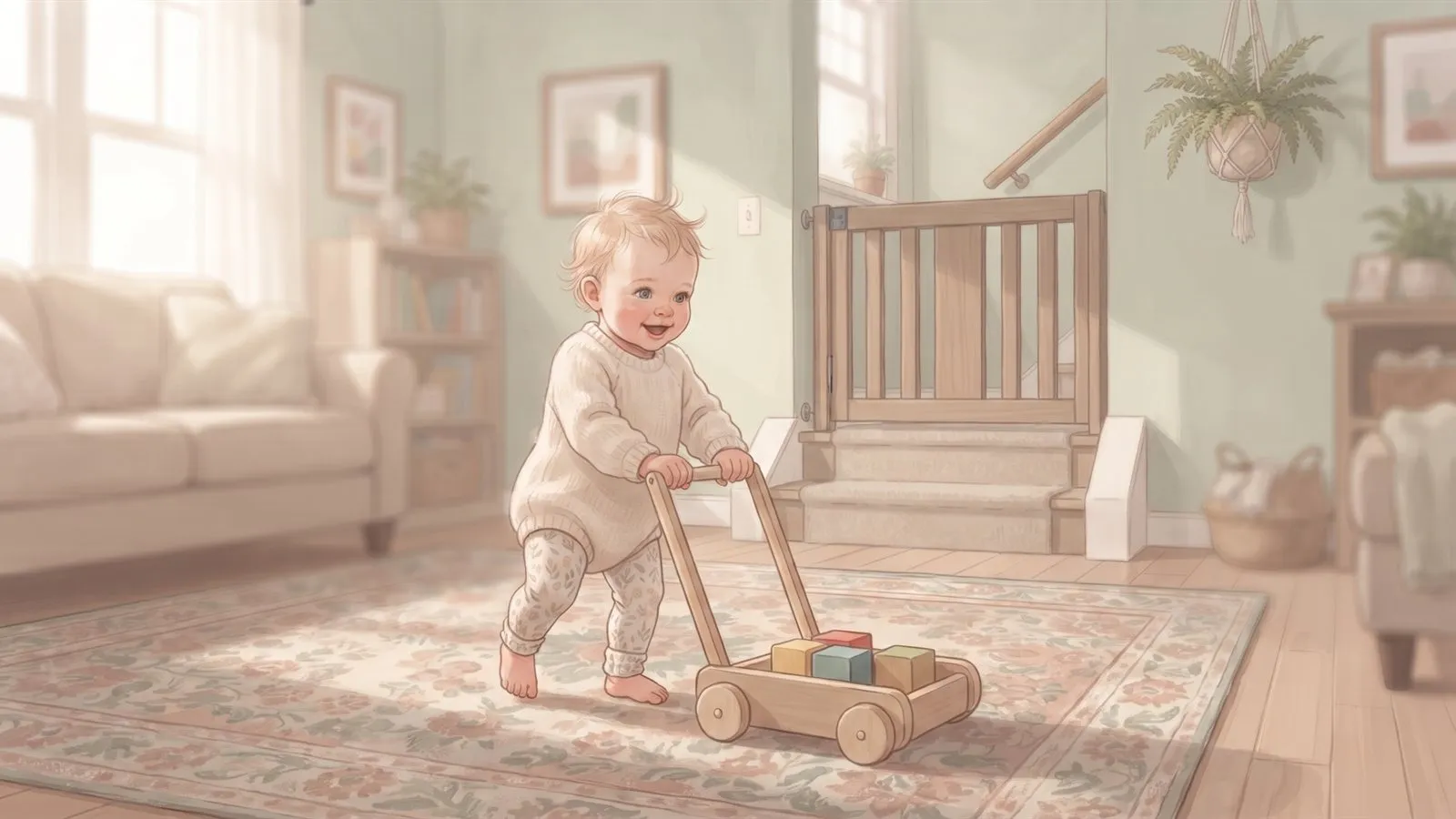
A walker here means a seat on wheels that a baby who can't yet walk sits in and pushes along with their feet. That's different from a push walker, a toy an older baby stands behind and pushes, and from a stationary activity center, which has no wheels. We cover both later.
What the AAP says
The AAP's position has been clear since the 1990s. Its policy statement, "Injuries Associated With Infant Walkers," published in Pediatrics in 2001, recommends a ban on the manufacture and sale of mobile infant walkers. It concluded that warning labels, parent education, adult supervision and stair gates were not enough to prevent injuries.
The AAP's current parent page on HealthyChildren.org, "Baby Walkers: A Dangerous Choice," repeats the call for a ban and makes three points worth knowing:
- Walkers are fast. The AAP says a child in a walker can move more than 3 feet in 1 second. That's faster than most parents can react.
- Most injuries happen with adults watching. Supervision doesn't make a walker safe, because the fall or grab happens in a second.
- Walkers can delay walking. More on this below.
The AAP suggests stationary activity centers, play yards and high chairs as safer places for a baby to sit and play.
What the injury research shows
The biggest US study is "Infant Walker-Related Injuries in the United States," by Sims and colleagues, published in Pediatrics in 2018. The researchers used national emergency room data from 1990 through 2014 for children younger than 15 months. They found:
- An estimated 230,676 walker-related injuries were treated in US emergency rooms over those 25 years.
- 90.6% were injuries to the head or neck.
- 74.1% happened when a baby fell down stairs in the walker.
- 4.5% of children were admitted to the hospital, and 37.8% of those admitted had a skull fracture.
Nationwide Children's Hospital, where the study was done, added that yearly injuries fell from 20,650 in 1990 to 2,001 in 2014, and that about 30% of injuries were concussions, closed head injuries or skull fractures. Falls out of the walker were the second most common cause. Babies were also hurt by reaching things they couldn't reach from the floor, and burns from hot objects were the most common of those injuries.
The decline is real, and the researchers credit safety standards for much of it. But they still backed the AAP's call for a ban, because the injuries that remain are often serious and the product offers babies no benefit.
Not just stairs
Stairs cause most walker injuries, but not all. A walker lets a baby reach higher and go farther, so the risks include:
- Pulling down hot drinks, pot handles or appliance cords
- Reaching medicines, cleaning products, button batteries and other poisons on low shelves or tables
- Tipping over on a rug edge, threshold or toy
- Rolling into a pool or spa. CPSC's 2010 rule cited 8 walker-related deaths reported from 2004 to 2008, and 3 were drownings after a walker rolled into a pool or spa.
The federal walker standard: what changed, and what didn't
Walker makers first adopted a voluntary standard in the 1990s. Under ASTM F977-96, walkers made after June 30, 1997 had to be wider than a 36-inch doorway or have a braking mechanism to stop them at the edge of a step. Injuries dropped sharply after that: CPSC reported an 88% reduction in walker injuries from 1994 to 2008.
In June 2010 CPSC issued a mandatory federal standard, 16 CFR part 1216, which took effect for walkers made or imported on or after December 21, 2010. It made the stair-fall test mandatory and stricter. A weighted walker is pushed toward the edge of a step at set speeds, and it must not fall off. The rule also added a parking brake test for walkers that have one. The standard has been updated since; the current version uses ASTM F977-22e1, mandatory since February 25, 2023.
The Sims study found that in the 4 years after the 2010 federal standard, the average number of walker injuries each year was 22.7% lower than in the 4 years before.
What the standard doesn't fix:
- Speed and reach. A compliant walker still moves fast and still lifts your baby to counter height.
- Open stair gates and missing steps. The test checks a single step edge, not every real-world layout. A walker that stops at a step edge in a lab can still tip on a sunken living room, a garage step or a pet door threshold.
- Walkers that don't meet the rule. CPSC keeps finding cheap walkers sold online that fit through a standard doorway, don't stop at the edge of a step, and let a baby slip down through the leg openings until their head gets trapped.
Recent CPSC recalls and warnings
Here are some of the recalls and warnings CPSC has issued in recent years for walkers that violate the federal standard. Most were sold online by little-known brands:
- Zeno infant walkers, recalled February 2022 for fall and entrapment hazards. The company was out of business, so owners were told to throw them away.
- Comfi Baby infant walkers, sold on Amazon. CPSC warned consumers in March 2024 to stop using them immediately.
- NVW infant walkers, a 2025 CPSC warning covering about 1,825 units.
- Kmaier infant walkers, a 2026 recall for a fall hazard and violating the mandatory standard.
If you're given a walker, look up the brand and model on CPSC.gov before you do anything else.
Canada banned walkers in 2004
Are baby walkers banned in the US? No. Canada has banned the sale, import and advertising of baby walkers since 2004, but in the US they're legal as long as they meet the federal standard in 16 CFR part 1216. The AAP has called for a US ban. CPSC still warns about walkers sold online that don't meet the standard.
Health Canada says it is an offence to manufacture, sell, advertise or import new or used baby walkers, even for your own use, and that giving one away is also an offence. If a relative in Canada offers you their old walker, it can't legally change hands there.
Do walkers help babies learn to walk?
Do baby walkers help babies learn to walk? No. The AAP says walkers don't help and can actually delay when a child starts to walk. A 2002 BMJ study of 190 babies found each 24 hours of total walker use was linked to a delay of about 3 days in walking alone. Babies learn to walk by pulling up, cruising along furniture and practicing on the floor.
The research behind that:
- Garrett, McElroy and Staines, BMJ 2002. In 190 babies, each 24 hours of total walker use was linked to a 3.3-day delay in walking alone and a 3.7-day delay in standing alone. Walker use wasn't linked to sitting or to walking with support.
- Siegel and Burton, Journal of Developmental and Behavioral Pediatrics, 1999. In 109 babies, those who used walkers sat, crawled and walked later than babies who didn't, and scored lower on standard tests of mental and motor development. Walkers that blocked a baby's view of their own feet had the biggest effect.
The likely reason is simple. In a walker, a baby moves by pushing with their toes while the seat holds their weight. They don't practice balance, they don't see what their feet are doing, and they spend less time on the floor rolling, crawling and pulling up, which is how walking develops.
Safer options for a busy baby
The goal behind a walker is reasonable: a safe place for your baby while your hands are busy, and something fun for a baby who's bored on the floor. Here's what to use instead, from most to least floor time.
1. Floor time on a safe play space
Plenty of floor time is what builds the strength and balance babies need to walk. A play mat in a babyproofed room, with toys just out of reach, gets babies rolling, crawling and pulling up. Rotating a few toys at a time keeps it interesting.
2. A play yard
The AAP names play yards, sometimes called playpens, as a safer place to set your baby down. They're the best choice when you need to step away for a minute, because a baby can't roll or climb anywhere dangerous.
3. A stationary activity center
Is a stationary activity center or jumper OK instead? A stationary activity center with no wheels is the alternative the AAP names. Use one for short stretches while you're nearby, keep it away from stairs, stoves and cords, and stop when your baby can climb out. It's a safe spot to play, not a place for long sessions or naps.
Doorway and freestanding jumpers fall in the same category: fine in short bursts, not a substitute for floor play. Our Fisher-Price Jumperoo review covers age and weight limits for one popular freestanding model. Many pediatric therapists suggest keeping sessions short, around 15 minutes at a time, though we didn't find an AAP time limit to cite.
4. A push walker or push toy, once your baby can stand
Are push walkers the same as baby walkers? No. A push walker is a toy a baby stands behind and pushes once they can pull up and stand. The baby isn't sitting in it and can let go at any time. Baby walkers are seats on wheels. Push walkers still need supervision and should be kept away from stairs.
Look for a wide, stable base and wheels with some resistance so it doesn't race away from a wobbly new walker. Our best push walkers for babies guide compares options, and the classic Fisher-Price Corn Popper is a simple push toy for babies who are already walking.
5. A high chair
The AAP also lists the high chair as a safe seat for a baby who wants to watch you cook. Strap your baby in every time, and keep it away from the stove and counters they could push off from.
If you already have a walker
The safest step is to give it up. If you decide to keep using one anyway, the AAP's 2001 policy said to choose a walker that meets the safety standard, and these steps lower the risk:
- Check the label. Look for a statement that it meets the federal standard, and check CPSC.gov for recalls by brand and model. Skip secondhand walkers with no label.
- Block every stair. Put a hardware-mounted gate, screwed into the wall, at the top of every staircase, and keep basement and garage doors shut. Pressure-mounted gates belong only in doorways or at the bottom of stairs. See our best baby gates for stairs for top-of-stair options.
- Use it only on one flat floor, away from stairs, steps, pools, tubs, fireplaces, heaters and stoves.
- Clear the reach zone. Move hot drinks, cords, tablecloths, medicines and cleaners well out of reach. Our babyproofing checklist goes room by room.
- Stay within arm's reach the whole time, and keep sessions short.
- Stop when your baby starts pulling up and cruising, or sooner.
If you received a walker as a gift, it's fine to pass on it. Many families swap it for a play yard or a stationary activity center.
More on babyproofing: see Regalo Easy Step Gate Review: Fit, Extensions and Install Rules and Button Battery and Magnet Safety for Kids.
Part of our Bath, Health & Safety section. Our main guide covers Best Baby Shampoo and Body Wash (2026).
How we researched this
This guide is research-based. In November 2026 we read the AAP's HealthyChildren.org page on baby walkers and its 2001 policy statement, the 2018 Pediatrics study by Sims and colleagues and Nationwide Children's Hospital's summary, CPSC's 2010 final rule and news release on infant walkers and its recent walker recalls and warnings, the current text of 16 CFR 1216, Health Canada's guidance on its walker ban, and the 1999 and 2002 studies on walkers and motor development. Some CPSC and AAP pages blocked our automated check, so a few recent recall details come from CPSC listings we found through search. For stair gate placement we used KidsHealth (Nemours) and Nationwide Children's Hospital guidance, because we didn't find an AAP or CPSC page that covers it. We could not confirm whether the AAP has formally reaffirmed its 2001 policy statement.
Sources
- HealthyChildren.org (AAP), Baby Walkers: A Dangerous Choice
- AAP Committee on Injury and Poison Prevention, Injuries Associated With Infant Walkers, Pediatrics (2001)
- Sims A et al., Infant Walker-Related Injuries in the United States, Pediatrics (2018)
- Nationwide Children's Hospital, Injuries associated with infant walkers (2018)
- CPSC, Safety Standard for Infant Walkers: Final Rule, Federal Register (2010)
- CPSC, CPSC Issues Final Mandatory Rule on Infant Baby Walkers (2010)
- 16 CFR 1216.2, Requirements for infant walkers
- CPSC, Zeno Recalls Infant Walkers (2022)
- CPSC, Warning on Comfi Baby Infant Walkers (2024)
- CPSC, Warning on NVW Infant Walkers (2025)
- CPSC, Kmaier Recalls Infant Walkers (2026)
- Health Canada, Is Your Child Safe?
- Garrett M et al., Locomotor milestones and babywalkers, BMJ (2002)
- KidsHealth (Nemours), Baby Gates
Questions parents ask
Are baby walkers safe?
The AAP says no. It has called for a ban on the manufacture and sale of baby walkers with wheels, because babies in walkers can roll fast, fall down stairs and reach hot or dangerous things. Walkers sold in the US must meet a federal safety standard, which has cut injuries, but thousands of babies are still hurt each year.
Do baby walkers help babies learn to walk?
No. The AAP says walkers don't help and can actually delay when a child starts to walk. A 2002 BMJ study of 190 babies found each 24 hours of total walker use was linked to a delay of about 3 days in walking alone. Babies learn to walk by pulling up, cruising along furniture and practicing on the floor.
Is a stationary activity center or jumper OK instead?
A stationary activity center with no wheels is the alternative the AAP names. Use one for short stretches while you're nearby, keep it away from stairs, stoves and cords, and stop when your baby can climb out. It's a safe spot to play, not a place for long sessions or naps.
Are push walkers the same as baby walkers?
No. A push walker is a toy a baby stands behind and pushes once they can pull up and stand. The baby isn't sitting in it and can let go at any time. Baby walkers are seats on wheels. Push walkers still need supervision and should be kept away from stairs.
Are baby walkers banned in the US?
No. Canada has banned the sale, import and advertising of baby walkers since 2004, but in the US they're legal as long as they meet the federal standard in 16 CFR part 1216. The AAP has called for a US ban. CPSC still warns about walkers sold online that don't meet the standard.
More in Bath, Health & Safety
Baby and Kids Product Recalls This Week: Nov 9–15, 2026
Kids' recalls for Nov 9–15, 2026: a SHEIN baby rattle set and Kakgold RC cars, plus CPSC warnings on a play yard mattress and a sling…
Exergen vs Braun ThermoScan 7: Forehead vs Ear Thermometer
Exergen vs Braun ThermoScan 7: forehead vs ear thermometer by age, what the accuracy studies show, current model numbers, prices and when…
Skip Hop Moby Bath Spout Cover Review
Skip Hop Moby spout cover review: which tub spouts it fits, the heat indicator it doesn't have, how to keep mold away, and why 120°F water…