
In this guide
- The short answer
- Why button batteries and magnets are so dangerous
- What to do if your child swallows a battery
- The honey rule
- What to do if your child swallows a magnet
- Symptoms to watch for
- Phone numbers to save
- Reese's Law and 16 CFR part 1263
- The CPSC magnet rule, 16 CFR part 1262
- Where button batteries and magnets hide
- How to prevent battery and magnet injuries
- How we researched this
- Sources
- Questions parents ask
Reader-supported: SproutPicks may earn a commission from qualifying affiliate links, at no extra cost to you. Full disclosure.
Button batteries and small, strong magnets are two of the most dangerous things a young child can swallow, and both hide in ordinary household items: TV remotes, key fobs, kitchen scales, greeting cards, desk toys and fridge magnets. A coin-sized lithium battery stuck in a child's throat can cause serious burns within 2 hours, and two magnets that snap together through the intestines can tear holes in them. The rule for both is the same: if you think your child swallowed one, go to the emergency room now, even if they seem fine. Below is what the American Academy of Pediatrics (AAP), the Consumer Product Safety Commission (CPSC) and the National Capital Poison Center say to do, when honey can help, the symptoms to watch for, and what two federal rules, Reese's Law and the CPSC magnet standard, now require of products sold in the US.
The short answer
- Suspected battery or magnet swallowed? Go to the ER or call 911 now. Don't wait for symptoms.
- Poison Help: 1-800-222-1222. It reaches your local poison center 24 hours a day. Call on the way, not instead of going.
- Honey only if your child is 12 months or older, the battery was swallowed within 12 hours and your child can swallow. Never delay leaving to find it.
- Don't make your child vomit, and give nothing else to eat or drink.
Why button batteries and magnets are so dangerous
Button batteries. The AAP explains that when a battery touches body fluids, the current produces lye, which quickly burns the surrounding tissue. Lithium coin cells, the flat, nickel- to quarter-sized batteries found in remotes, key fobs and scales, are the most dangerous because they're the right size to lodge in a toddler's esophagus. The AAP says a battery stuck there can cause chemical damage within 2 hours, and the National Capital Poison Center says severe damage can occur in just 2 hours. Batteries pushed into the nose or ears can also cause permanent injury.
Magnets. A single magnet often passes on its own. The danger comes when a child swallows two or more magnets, or a magnet and a piece of metal, at different times. They can attract each other through the walls of the intestines and pinch the tissue between them. The CPSC's magnet rule lists the possible results, which include bowel obstruction, perforation, infection and death. The CPSC estimates that about 26,600 magnet ingestions were treated in US emergency rooms from 2010 through 2021.
What to do if your child swallows a battery
Go to the emergency room or call 911 right away, even if your child seems fine. Don't make your child vomit, and don't give food or drink other than honey if your child qualifies for it. Tell the staff it may be a lithium coin battery and bring the package or the device if you can grab it quickly.
- Go now. The AAP says to go to the ER or call 911 right away. In most cases an X-ray is needed to see whether the battery has passed the esophagus, and a battery stuck there must be removed as quickly as possible.
- Don't wait for symptoms. The National Capital Poison Center says prompt action is critical and not to wait for symptoms to develop. Many children look normal at first.
- Bring the battery code. The number printed on the battery or package, such as 2032, helps the ER identify its size and type.
- Trust your instinct. The AAP tells parents who aren't sure whether a child swallowed a battery to trust their parental instinct. A missing battery from a remote is reason enough to get an X-ray.
The honey rule
Only if your child is 12 months or older, the battery was swallowed within the past 12 hours and your child can swallow. The National Capital Poison Center's guideline is 10 mL, or 2 teaspoons, of honey every 10 minutes, for up to 6 doses, on the way to the ER. Never delay leaving to find honey, and never give honey to a baby under 12 months.
Honey coats the battery and slows the burn, but it doesn't stop the injury or replace removal. A few more details from the Poison Center's guideline and the AAP:
- Use ordinary commercial honey, not specialty or artisanal honey.
- Give it if the battery might be a lithium coin cell. If you don't know the type, the guideline says to assume it is a lithium coin cell unless it's a hearing aid battery.
- Stop if your child vomits. The AAP says not to give another dose.
- Nothing else by mouth. Apart from honey, the Poison Center says nothing to eat or drink until an X-ray shows the battery is past the esophagus.
- Honey is for batteries only. It has no role if your child swallowed a magnet.
Babies under 12 months should never be given honey because of the risk of infant botulism, which is why the age limit is firm.
What to do if your child swallows a magnet
One small magnet often passes, but you can't be sure it was only one, and a single magnet can still attract a metal object such as a coin or battery. CPSC says to seek immediate medical attention if you suspect a child has swallowed magnets. Let the ER decide with an X-ray.
Tell the doctor what the magnets came from and how many may be missing. A set of tiny high-powered ball magnets from a desk toy is far more dangerous than a single large fridge magnet. Older children and teens are at risk too, so keep magnet sets away from them as well as from toddlers.
Symptoms to watch for
Many children have no symptoms at first, which is why you shouldn't wait for them. After a swallowed battery, the AAP and the Poison Center say to watch for fever, abdominal pain, vomiting or blood in the stools, and to report them immediately. If the doctor decides a battery can pass on its own, check your child's stools until it does.
For magnets, CPSC lists abdominal pain, nausea, vomiting and diarrhea, which are easy to mistake for a stomach bug. For a battery in the nose or ear, the Poison Center says to watch for pain or discharge, and not to use nose or ear drops until a doctor has examined your child.
Phone numbers to save
| Who | Number | When to use it |
|---|---|---|
| Emergency services | 911 | Your child has trouble breathing, is drooling or can't swallow, or you can't get to an ER quickly |
| Poison Help | 1-800-222-1222 | Advice from your local poison center, 24 hours a day, on the way to the ER |
| National Battery Ingestion Hotline | 1-800-498-8666 | Listed on the National Capital Poison Center's battery pages |
What number do I call for a swallowed battery? Call 911 or go to the ER first. For advice, Poison Help at 1-800-222-1222 reaches your local poison center 24 hours a day. The National Capital Poison Center's battery pages also list the National Battery Ingestion Hotline at 1-800-498-8666.
A note on that last number: 1-800-498-8666 is the number on the National Capital Poison Center's own battery pages and the AAP's. The Poison Center closed its own call center in March 2025, and its history page describes the battery hotline as running from 1982 to 2018, so we treat Poison Help as the dependable number. Neither is a reason to delay going to the ER. You can also use the Poison Center's free online tool, webPOISONCONTROL, at poison.org.
Reese's Law and 16 CFR part 1263
Reese's Law is a 2022 federal law that led to the CPSC rule at 16 CFR part 1263. It requires consumer products that use button or coin batteries to have battery compartments that need a tool or two separate hand movements at the same time to open, plus warning labels on products, packaging and instructions. Button battery packaging must also be child-resistant.
The law is named for Reese Hamsmith, a toddler who died after swallowing a button battery. Here's how the rules apply, based on the eCFR and CPSC's frequently asked questions:
- Products with button batteries must meet the safety standard ANSI/UL 4200A, which covers the secure compartment, abuse testing and warnings. It applies to general-use products made or imported on or after October 23, 2023, and to children's products on or after December 20, 2023. CPSC used enforcement discretion until March 19, 2024.
- Battery packaging must be child-resistant for packages made or imported after February 12, 2023, and must carry the new warning label after September 21, 2024.
- Toys are covered by a different rule. Toys that meet the federal toy standard at 16 CFR part 1250, which has its own battery-compartment rules, are exempt from part 1263.
- Hearing aid batteries (zinc-air) are not covered by part 1263, because CPSC found they don't pose the same ingestion hazard.
The law doesn't remove older products from your home. Remotes, scales and greeting cards made before these dates may have compartments a toddler can open by hand, so tape them shut or put them out of reach. Products sold by small sellers on online marketplaces are also recalled regularly for breaking these rules, so check CPSC's recall site before you buy cheap gadgets.
The CPSC magnet rule, 16 CFR part 1262
CPSC's Safety Standard for Magnets took effect for products made after October 21, 2022. It covers products with loose or separable magnets that are meant for entertainment, jewelry, mental stimulation or stress relief, such as magnetic ball sets sold as desk toys. Any magnet in those products that fits entirely in the federal small parts cylinder must have a flux index, a measure of strength, below 50 kG²mm². In plain terms, small magnets in these products must be weak enough not to pull strongly together inside the body.
Toys for children under 14 follow a separate set of magnet rules through the federal toy standard, and are exempt from part 1262. Magnetic building toys such as tiles keep their magnets sealed inside the pieces, which is why you should check them for cracks and throw away any tile with a loose magnet. Our guides to the best magnetic tiles and Magna-Tiles vs PicassoTiles vs Connetix cover the main brands, and our Tegu magnetic blocks review looks at a wooden option.
Where button batteries and magnets hide
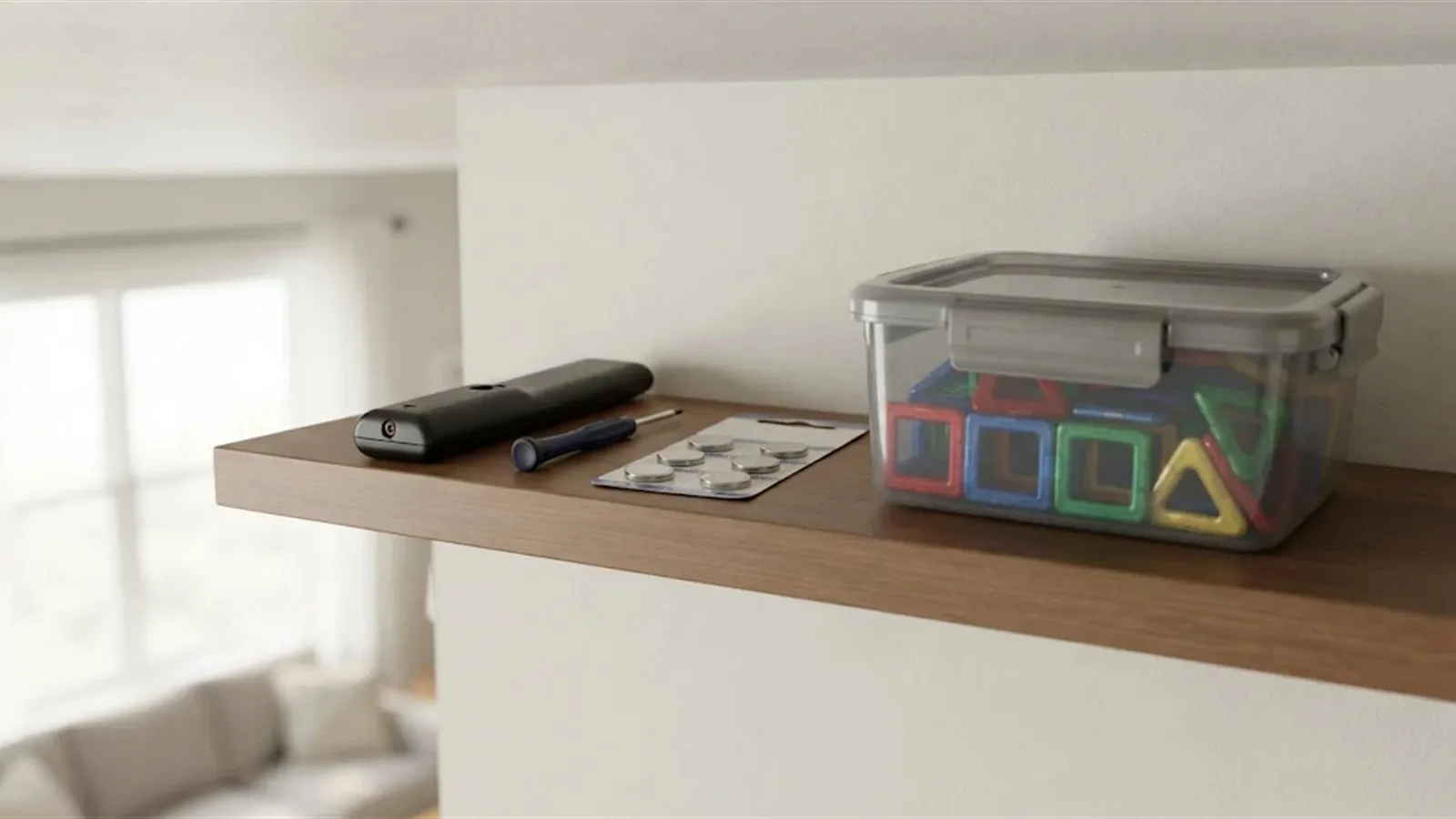
The AAP lists remote controls, thermometers, games and toys, hearing aids, calculators, bathroom scales, key fobs, watches and electronic jewelry, flashing shoes and clothing, cameras, holiday ornaments, flameless candles and musical greeting cards. Small magnets turn up in fridge magnets, magnetic desk toys, magnetic jewelry and cabinet latches, and on the backs of toys sold for older kids.
How to prevent battery and magnet injuries
- Buy batteries in child-resistant packaging, and consider brands with a bitter coating or a dye that signals swallowing, which the AAP suggests.
- Check every battery compartment. If it opens by hand or has a broken screw, tape it shut with strong tape or put the device away.
- Store spares and devices out of reach and out of sight, in a closed drawer or cabinet. Hang keys with fobs up high.
- Dispose of used batteries right away. The AAP suggests taping them and putting them in an outside trash can, or recycling them. Used batteries can still be dangerous if swallowed.
- Keep high-powered magnet sets out of homes with young children, and check magnetic toys for cracks or loose pieces.
- Tell grandparents, sitters and older siblings. Visitors' bags, hearing aids, car keys and older kids' toys are common sources.
More on babyproofing: start with our guide to babyproofing checklist, then Regalo Easy Step Gate Review: Fit, Extensions and Install Rules and Best Baby Gates for Stairs: Top-of-Stairs Picks.
Part of our Bath, Health & Safety section. Our main guide covers Best Baby Shampoo and Body Wash (2026).
How we researched this
This is a research-based guide, not medical advice, and we did not test any products. In November 2026 we read the AAP's HealthyChildren.org page on button and lithium coin batteries, the National Capital Poison Center's battery pages and its button battery ingestion guideline, CPSC's magnet safety page and its Reese's Law FAQs, and the current text of 16 CFR parts 1262 and 1263 on eCFR. We checked the battery hotline number against the Poison Center's own pages, and we note above that the Poison Center closed its call center in 2025. If your child may have swallowed a battery or magnet, follow your doctor's and the ER's advice over anything here.
Sources
- AAP HealthyChildren.org, What Parents Need to Know about Button Batteries and Lithium Coin Batteries
- National Capital Poison Center, Button Batteries
- National Capital Poison Center, Button Battery Ingestion Triage and Treatment Guideline
- National Capital Poison Center, About Poison Control
- National Capital Poison Center, Call Center Closure
- CPSC, Button Cell and Coin Battery FAQs
- eCFR, 16 CFR part 1263, Safety Standard for Button Cell or Coin Batteries
- eCFR, 16 CFR part 1262, Safety Standard for Magnets
- CPSC, Magnets Information Center
Questions parents ask
What should I do if my child swallows a button battery?
Go to the emergency room or call 911 right away, even if your child seems fine. Don't make your child vomit, and don't give food or drink other than honey if your child qualifies for it. Tell the staff it may be a lithium coin battery and bring the package or the device if you can grab it quickly.
Should I give honey if my child swallowed a battery?
Only if your child is 12 months or older, the battery was swallowed within the past 12 hours and your child can swallow. The National Capital Poison Center's guideline is 10 mL, or 2 teaspoons, of honey every 10 minutes, for up to 6 doses, on the way to the ER. Never delay leaving to find honey, and never give honey to a baby under 12 months.
Is swallowing one magnet dangerous?
One small magnet often passes, but you can't be sure it was only one, and a single magnet can still attract a metal object such as a coin or battery. CPSC says to seek immediate medical attention if you suspect a child has swallowed magnets. Let the ER decide with an X-ray.
What is Reese's Law?
Reese's Law is a 2022 federal law that led to the CPSC rule at 16 CFR part 1263. It requires consumer products that use button or coin batteries to have battery compartments that need a tool or two separate hand movements at the same time to open, plus warning labels on products, packaging and instructions. Button battery packaging must also be child-resistant.
What number do I call for a swallowed battery?
Call 911 or go to the ER first. For advice, Poison Help at 1-800-222-1222 reaches your local poison center 24 hours a day. The National Capital Poison Center's battery pages also list the National Battery Ingestion Hotline at 1-800-498-8666.
More in Bath, Health & Safety
NoseFrida vs Braun Electric Nasal Aspirator
NoseFrida vs Braun Electric Nasal Aspirator: mouth suction vs battery suction, filters, cleaning, price, and AAP saline tips plus when to…
Boon Frog Pod Bath Toy Scoop Review
Boon Frog Pod review: how the draining scoop works, adhesive and screw mounting, what it can and can't do about bath toy mold, and why…
Baby and Kids Product Recalls This Week: Nov 9–15, 2026
Kids' recalls for Nov 9–15, 2026: a SHEIN baby rattle set and Kakgold RC cars, plus CPSC warnings on a play yard mattress and a sling…