
In this guide
Reader-supported: SproutPicks may earn a commission from qualifying affiliate links. The manufacturer and editorial reference links in this review are not affiliate links. Full disclosure.
Created and fact-checked (America/Chicago). Source-based editorial review; not a hands-on test.
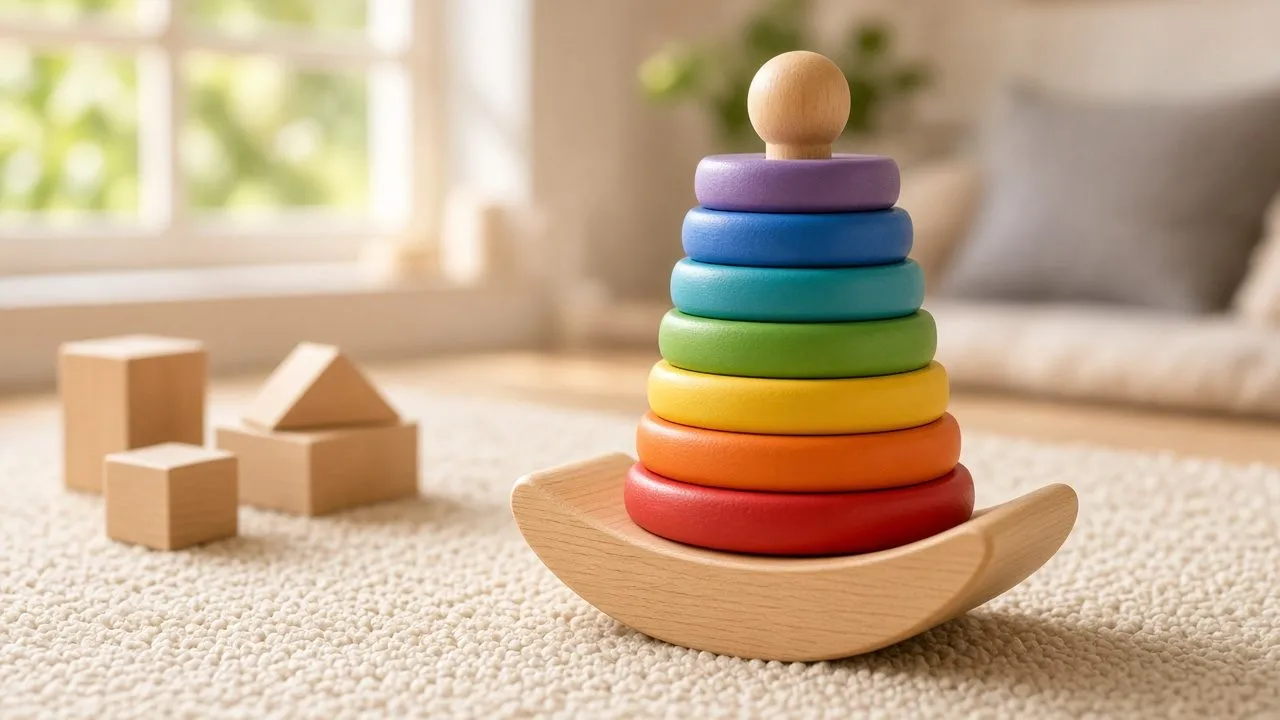
Rock-a-Stack is the cone of colorful rings on a wobbly base that many parents remember from childhood. The Weekend Historian wrote in January 2019 that Fisher-Price introduced it in 1960 with six rings, and that a 1964 Sears catalog listed it at 77 cents. [1]
Our source-based verdict: an inexpensive, durable first stacking toy. It will not hold attention for long, but that is fine at this price. We have not tested it ourselves.
At a glance
Fisher-Price Rock-a-Stack
- Main limit
- Simple toy; short attention span
A single-model review, not a ranked or scored roundup.
The current version
Mattel's listing describes five colorful rings, with the smallest ring having a shiny, reflective surface and beads inside. [2] The base rocks, so it wobbles when tapped. [2] Mattel listed it at $7.99 on November 9, 2026. [2]
What it practices
Younger babies grab, mouth and shake rings. Older babies take rings off before they can put them on, and eventually start sorting by size. Do not expect correct order for a while.
Care
Wipe rings clean with mild soap and water, and check for cracks now and then, as with any plastic toy.
Plastic vs wooden stackers
Wooden stackers look nicer and last for years, but cost more and are harder to clean after mouthing. Plastic stackers like this one are cheap, light and wipeable. A baby gets the same grasp-and-release practice from either, so choose by budget and taste. Either way, offer just two or three rings at first, then add more as your baby gets the idea. Big-to-small order usually comes much later.
Pros and trade-offs
What looks useful on the evidence
Where expectations need restraint
Who it suits—and who should skip it
Consider it if: you want a cheap, classic first stacker.
Look elsewhere if: you prefer wooden or open-ended stackers.
Alternatives and related reading
- Push toy: Corn Popper review.
- Wooden blocks: HABA blocks review.
- Montessori picks: Best Montessori Toys for Toddlers.
More on montessori and classic toys: see Fisher-Price Chatter Telephone Review: Pull-Along Since 1961 and How to Set Up a Toy Rotation.
Also useful: our holiday gift guide by age.
Part of our Toys & Learning section. Our main guide covers developmental toys by age.
Questions parents ask
How many rings?
Five in the current version. [2]
When did it launch?
1960, per The Weekend Historian. [1]
Sources and research method
We compared dated launch or availability evidence with current manufacturer information checked on November 9, 2026. This is desk research, not a purchased-product test, a lab measurement or an owner survey. We have not verified current store stock, prices or reuse rights for product photography; official photos can be viewed through the manufacturer link.
- The Weekend Historian: "Toy History: Rock-a-Stack", January 21, 2019.
- Mattel Shop: Fisher-Price Rock-a-Stack, checked November 9, 2026.
More in Toys & Learning

JLab JBuddies Studio 2 Review: Budget Volume-Limited Headphones
JLab JBuddies Studio 2 review: budget kids headphones with 85/95 dB volume limits and long battery life. Research-based, not tested.

Puro BT2200-Plus Review: 85 dB Kids Headphones for Travel
Puro BT2200-Plus review: 85 dB volume-limited kids headphones for flights and road trips. Isolation and battery. Research-based, not tested.

Green Toys Recycling Truck Review: Recycled Plastic, No Metal
Green Toys Recycling Truck review: a recycled-plastic toy with no metal for sandbox, bath and living room play. Research-based, not tested.