
In this guide
Reader-supported: we may earn a commission from links on this page. Full disclosure
Updated: October 2026 · Researched from manufacturer specs, safety standards and public buyer reviews.
The Micro Kickboard Mini Deluxe and the Globber Primo are the two three-wheel scooters parents compare most for toddlers and preschoolers. Both use lean-to-steer, both have rear foot brakes and both hold riders up to 110 lb. The real differences are handlebar height, weight, the Primo's steering lock, and price.
The short answer: pick the Micro Mini Deluxe for a 2-year-old or a small 3-year-old, or if you want a light scooter that can be handed down. Pick the Globber Primo for a child who is 3 or older, a nervous beginner who would benefit from the steering lock, or if you want to spend a little less and get a few more years of handlebar height.
Safety note: Always use a properly fitted helmet, and consider knee and elbow pads. Ride on smooth, flat paths away from traffic, driveways and hills, and supervise closely.
Quick picks
Micro Kickboard Mini Deluxe
- Weight · age (per maker)
- 4.2 lb · ages 2–5
Globber Primo 3-Wheel Scooter
- Weight · age (per maker)
- 5.1 lb · ages 3–7
Radio Flyer My 1st Scooter Sport
- Weight · age (per maker)
- Wide base · ages 2–5
Micro Mini vs Globber Primo: head-to-head
Specs come from Micro Kickboard's and Globber's US product pages (checked October and November 2026). Micro measures handlebar height from the ground on its US page; Globber also measures from the ground.
| Feature | Micro Mini Deluxe | Globber Primo |
|---|---|---|
| Age range (per maker) | 2–5 years | 3–7 years (95–120 cm tall) |
| Scooter weight | 4.2 lb (1.95 kg) | 2.33 kg (about 5.1 lb); foldable 2.5 kg |
| Handlebar height from ground | 19.25–27 in., any height in range | 26.5, 28.5 or 30.5 in. (67.5/72.5/77.5 cm) |
| Steering | Lean-to-steer | Lean-to-steer with lockable steering |
| Max rider weight | 110 lb | 50 kg (110 lb) |
| Wheels | 120 mm front, 80 mm rear, polyurethane | 121 mm front, 80 mm rear, PU on ABEC 5 bearings |
| Deck | 12 x 4.5 in., flexible fiberglass-reinforced | Composite, anti-slip |
| Folding | Foldable version sold separately | Primo Foldable sold separately |
| Warranty | 2-year manufacturer defect warranty | Check retailer and Globber terms |
| Main owner complaint | Price | Heavier to carry; too tall for young 2s |
The differences that matter
Handlebar height decides the age
The Mini Micro's handlebar starts at 19.25 inches from the ground and slides to any height up to 27 inches. The Primo's lowest setting is 26.5 inches. That single number explains most of the "which one for my child" question: the Micro fits small toddlers, while the Primo fits taller preschoolers and lasts longer at the top end.
Weight matters more than you'd think
About a pound separates them on paper (4.2 lb vs about 5.1 lb). For a 30-lb toddler that is noticeable when lifting the scooter over a curb, and for parents it matters on the carry home, which happens more often than anyone plans.
The steering lock
Lean-to-steer is intuitive for most kids, but some beginners wobble and turn when they only mean to push. The Primo's lock keeps the wheels straight so they can build confidence first, then unlock it. The Mini Micro skips the lock; most kids adapt within a few rides.
Durability and parts
Micro sells spare parts for nearly every component and offers a 2-year defect warranty. Owners frequently describe Mini Micros lasting through several children. Globber scooters are also well regarded, though owner reviews mention more wear on wheels and a slightly noisier ride.
Price
Micro listed the Mini at $89.99 on sale (regular $99.99) and the LED version at $99.99 (regular $109.99) when we checked in November 2026. The Primo typically sells for less. See the price history notes under each pick for Amazon's tracked range.
How we picked
We did not buy or test these scooters. This comparison follows our standard research method:
- Started with the search. "Micro mini vs globber" is a common comparison among parents shopping for a first scooter.
- Pulled specs from the makers. Weights, handlebar heights, age ranges, wheel sizes and rider limits come from Micro Kickboard and Globber product pages.
- Read owner feedback. We looked for patterns in Amazon reviews and parent discussions, especially complaints after months of use.
- Checked safety guidance. We reviewed CPSC and AAP guidance on helmets and riding toys.
- Added a budget option. For families unsure whether their child will take to scooting.
How we score: SproutPicks Scores are our own editorial ratings, based on published specs, safety certifications and standards, and patterns across verified owner reviews. We don't hands-on test every product, and these scores are not Amazon ratings. Outdoor-play scores include sub-scores for Safety, Learning Value and Durability.
Micro Kickboard Mini Deluxe
The Mini Deluxe is Micro Kickboard's classic three-wheel, lean-to-steer scooter, and it is the one most parents mean by "Mini Micro." Micro lists a 4.2 lb scooter, a 12 x 4.5-inch flexible fiberglass-reinforced deck with an anti-slip silicone footplate, 120 mm front and 80 mm rear polyurethane wheels, a T-bar that adjusts from 19.25 to 27 inches above the ground, a 110 lb maximum rider weight and an age range of 2 to 5 years.
Two things set it apart. First, the low handlebar: it starts lower than the Globber Primo's, so it suits small 2-year-olds. Second, Micro's modular design means nearly every part, from wheels to grips, can be replaced, and Micro backs it with a 2-year manufacturer defect warranty. That's why so many Mini Micros get handed down to younger siblings.
There is no steering lock. Kids steer by leaning from the first ride, which most pick up quickly, but a few beginners find it wobbly at first. Maisonette sells the light-up LED version of this scooter.
- ✓Lightest scooter here at 4.2 lb
- ✓Lowest handlebar, suits 2-year-olds
- ✓Flexible deck soaks up sidewalk bumps
- ✓Replaceable parts and a 2-year warranty
- ✓LED-wheel version available
- ✕Usually the most expensive option
- ✕No steering lock for nervous beginners
- ✕Shorter handlebar range than the Primo, so kids outgrow it around 5
Globber Primo 3-Wheel Scooter
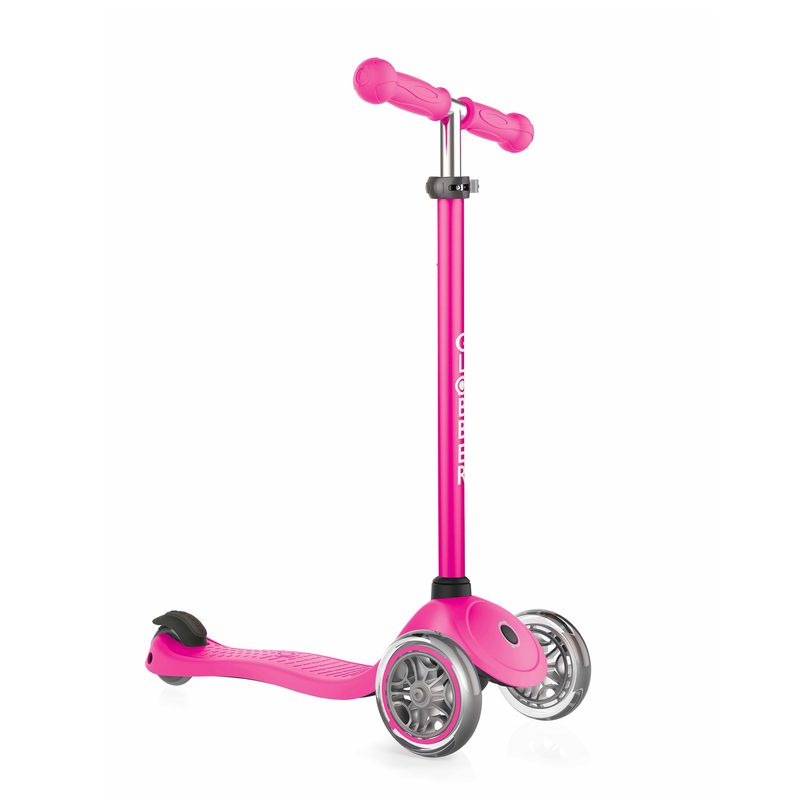 Image: Globber
The Globber Primo is the best-known alternative to the Mini Micro. Globber lists a 2.33 kg (about 5.1 lb) scooter with a composite deck, 121 mm front and 80 mm rear polyurethane wheels on ABEC 5 bearings, a composite rear brake, a 50 kg (110 lb) rider limit, and an aluminum T-bar with three heights: 67.5, 72.5 and 77.5 cm from the ground (about 26.5, 28.5 and 30.5 inches). It is labeled for ages 3 to 7 and child heights of 95 to 120 cm.
Its signature feature is Globber's patented steering lock. Press the button and the front wheels only go straight, so a beginner can focus on pushing and gliding. Unlock it and the scooter switches to lean-to-steer. A foldable version (Primo Foldable, 2.5 kg) is also available.
The trade-off is the starting handlebar height. At 67.5 cm (about 26.5 in.) from the ground, the lowest setting is close to the Mini Micro's highest, so it is usually too tall for a young 2-year-old.
- ✓Steering lock helps true beginners
- ✓Taller T-bar fits until about age 7
- ✓Usually costs less than the Mini Micro
- ✓Foldable version available
- ✕Heavier than the Mini Micro
- ✕Too tall for most 2-year-olds
- ✕Only three fixed handlebar heights
Radio Flyer My 1st Scooter Sport
If you aren't sure your toddler will take to scooting, Radio Flyer's My 1st Scooter Sport is a cheaper way to find out. Radio Flyer lists an extra-wide base, two front wheels and a rear foot brake, and labels it for ages 2 to 5.
It uses handlebar steering rather than lean-to-steer, which some very young children find more intuitive. It is less smooth and less adjustable than the Micro or Globber, so expect to replace it sooner.
- ✓Low price
- ✓Very stable wide base
- ✓Simple handlebar steering
- ✕Outgrown faster
- ✕Rougher ride on cracked sidewalks
- ✕Doesn't teach lean-to-steer balance
Buying guide: which scooter fits your child?
By age
- Around 2: Mini Micro Deluxe. Its low handlebar and light weight suit small riders.
- 3 to 4: either works. Choose the Micro if your child is small or you want the lightest scooter; choose the Primo if your child is tall, cautious or likely to ride until 6 or 7.
- 5 and up: the Primo still fits many 5- and 6-year-olds; for Micro, look at the larger Maxi range instead.
Measure the handlebar against your child
Have your child stand in shoes and measure from the floor to their waist and to their lower chest. The handlebar should land in that range. If the Primo's lowest 26.5-inch setting is above their chest, it's too tall for now.
Think about carrying
Toddlers often ride out and walk back. A light scooter, a carry strap or a foldable version makes that easier. Both brands sell foldable variants that are a bit heavier than the standard models.
Light-up wheels
Both brands offer LED-wheel versions that light up as the wheels spin, with no batteries. They add visibility at dusk and a lot of fun, but they don't change how the scooter rides.
Teaching tips
Start on a flat, smooth surface like an empty playground or tennis court. Practice push-and-glide, then braking with the back foot, then gentle leaning turns. Keep early sessions short and fun; most preschoolers pick up the basics within a few outings.
Safety notes
- Helmets every ride. Use a helmet that meets the CPSC bicycle helmet standard and fits snugly.
- Pick the right place. Avoid hills, driveways and streets. Three-wheel scooters are stable but can still tip on slopes or sharp turns.
- Check the scooter. Make sure the T-bar clamp is tight and wheels spin freely before each ride.
- Follow the age and weight labels on each model.
- Check recalls at CPSC.gov/Recalls.
More on balance bikes, trikes and scooters: see Best Balance Bike for an 18-Month-Old (2026) and Wishbone 3-in-1 Review: Trike-to-Balance-Bike From Age 1.
Also useful: all our head-to-head comparisons.
FAQ
Micro Mini vs Globber Primo: which is better? For a 2-year-old or a small 3-year-old, the Micro Mini Deluxe is the better pick because its handlebar starts lower and it weighs less. For a child who is 3 or older, or a nervous beginner, the Globber Primo is often the better value thanks to its steering lock and taller T-bar that fits until about age 7.
Is the Mini Micro worth the extra money? Many owners think so. It is light, very smooth, has replaceable parts and a 2-year warranty, and Mini Micros often get passed down to younger siblings. If you only need a scooter for a year or two, the Globber Primo or a budget scooter may be enough.
Which is lighter, Micro Mini or Globber Primo? The Micro Mini Deluxe. Micro lists it at 4.2 lb, while Globber lists the Primo at 2.33 kg (about 5.1 lb) and the Primo Foldable at 2.5 kg.
Can a 2-year-old ride a Globber Primo? Globber labels the Primo for ages 3 to 7. Its lowest handlebar setting is about 26.5 inches from the ground, which is usually too tall for a 2-year-old. The Mini Micro Deluxe, labeled for ages 2 to 5, starts lower.
What is a steering lock on a scooter? A steering lock keeps the front wheels pointing straight so a beginner can practice pushing and gliding without the scooter turning. The Globber Primo has one; the Mini Micro does not.
Do Micro and Globber scooters have brakes? Yes. Both have a rear foot brake: the child presses the rear fender with their foot to slow down. Practice braking on flat ground before riding near any slope.
How high should a scooter handlebar be? Roughly between your child's waist and lower chest. Too high and it is hard to lean and steer; too low and they will hunch over.
When should my child move to a two-wheel scooter? Most children move up somewhere between ages 5 and 7, once they can glide on one foot, turn smoothly and brake on their own.
Should my child wear a helmet on a scooter? Yes. Use a properly fitted helmet every ride, and consider knee and elbow pads for beginners.
Related reviews
- Best Kids Scooters for Ages 3–5
- Best Toddler Balance Bikes
- Best Outdoor Playsets and Climbers for Toddlers
More in Outdoor Play & Ride-Ons
Little Tikes Cozy Coupe Review: Classic Ride-On, Real Limits
Little Tikes Cozy Coupe review: the classic toddler ride-on car. Size, durability, and what it will not teach. Research-based, not tested.

Best Toddler Snowsuits (2026)
The best toddler snowsuits from Reima, L.L.Bean, The North Face, Columbia and Patagonia, plus AAP layering advice and why snowsuits don't…

Best Kids' Sleds (2026)
Five kids' sleds compared, from steerable sleds with brakes to baby pull sleds, plus AAP rules on helmets, supervision, feet-first riding…