
In this guide
- Quick picks
- The small parts rule for children under 3
- No button batteries or loose magnets
- Choking-size candy and snacks
- Indestructibles board books
- Crayola Palm Grasp Toddler Crayons
- Fat Brain Toys Dimpl
- Melissa & Doug Water Wow!
- Crayola Color Wonder Mess Free Mini Markers
- More low-risk stocking ideas
- How we researched this
- Sources
- Questions parents ask
Reader-supported: SproutPicks may earn a commission from qualifying affiliate links, at no extra cost to you. Full disclosure.
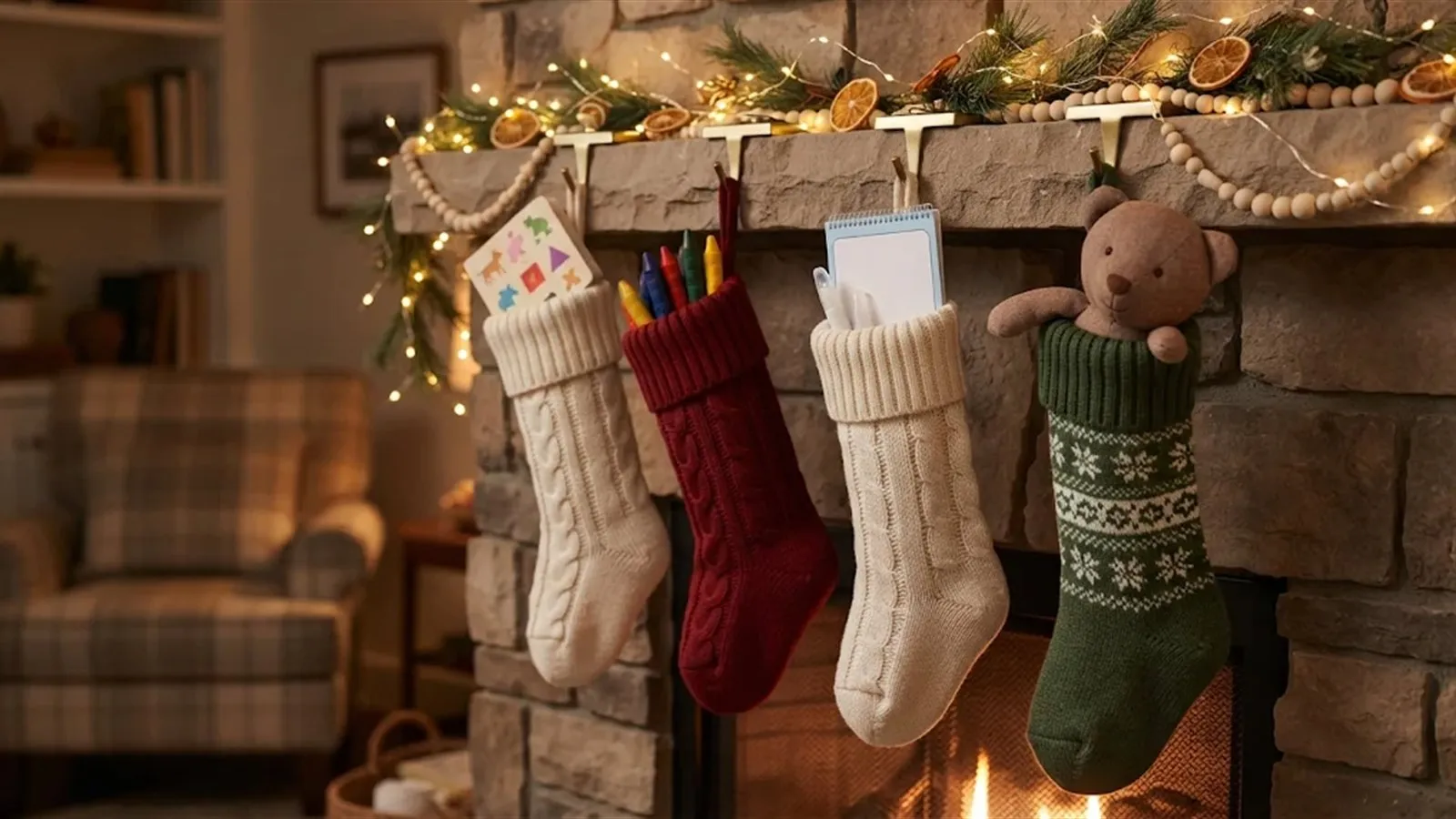
Toddler stockings fill up fast with the small, cheap and shiny: light-up novelties, tiny figures, candy and anything from the checkout aisle. Those are often exactly the things that are risky for children under 3, who still put everything in their mouths. This guide covers five small gifts that fit a toddler stocking and fit the age guidance, with ages and prices checked on maker pages and retailer listings, plus the safety rules worth knowing before you shop: the federal small parts rule, button batteries, magnets and choking-size foods.
Quick picks
Indestructibles board books
Crayola Palm Grasp Toddler Crayons
Fat Brain Toys Dimpl
Melissa & Doug Water Wow!
Crayola Color Wonder Mess Free Mini Markers
How we score: SproutPicks Scores are our own editorial ratings out of 10. They weigh the maker's age grade, whether a product has small or detachable parts, batteries or magnets, how long a toddler is likely to use it, how well it fits in a stocking, and price. We used maker product pages, publisher pages, retailer listings, CPSC rules and AAP guidance. They are not Amazon ratings, and we did not test these products with children.
The small parts rule for children under 3
CPSC's small parts rule, at 16 CFR part 1501, bans toys and other children's products intended for children under 3 if they have small parts that could cause choking, aspiration or ingestion. A small part is anything that fits entirely inside CPSC's small parts test cylinder, which CPSC says approximates the size of the fully expanded throat of a child under 3. The cylinder is about 1.25 inches wide. Some items, such as books and other paper products, writing materials like crayons, and modeling clay, are excluded from the ban.
How do I know if a toy is too small for a toddler? Under the federal small parts rule, toys for children under 3 can't have parts that fit entirely inside a test cylinder about 1.25 inches wide, sized to approximate a young child's throat. Follow the age grade on the package, and skip anything with pieces that could come loose.
Toys for older children can legally contain small parts, but under 16 CFR 1500.19, toys with small parts meant for children ages 3 to 6 must carry a choking hazard warning. That's why many stocking-size toys say "Not for children under 3 yrs." on the package.
Are toys labeled 3+ safe for a 2-year-old? Not necessarily. A 3+ label often means the toy has small parts, which the federal small parts rule bans in toys for children under 3. Age grades also reflect a child's skills, so follow them and save 3+ toys until your child is old enough. The AAP's choking prevention guidance makes the same point: follow the age labels on toy packages, which account for choking hazards and a child's abilities.
No button batteries or loose magnets
Many holiday novelties hide one of these: light-up toys, musical cards, flashing jewelry, remote controls and magnetic fidget toys.
- Button and coin batteries. The AAP lists small button-type batteries as a choking hazard and notes that they can cause internal burns if swallowed. Toys sold for children must keep battery compartments secure under the federal toy standard. Reese's Law, at 16 CFR part 1263, added requirements for other consumer products that use button or coin cells, including compartments that need a tool or two separate hand motions to open; CPSC applies them to products made or imported after March 19, 2024. Older products and cheap imports may not comply, so skip novelty items with these batteries entirely.
- Magnets. CPSC's magnet rule, at 16 CFR part 1262, limits the strength of small, loose magnets in products sold for entertainment, jewelry, mental stimulation or stress relief, for products made after October 21, 2022. CPSC estimated about 26,600 magnet ingestions were treated in hospital emergency rooms from 2010 through 2021, and it urges people who own high-powered magnet sets to throw them away to protect children.
Why are button batteries and magnets so dangerous? A swallowed button battery can cause serious internal burns, and the AAP lists small button-type batteries as a choking hazard. Swallowed magnets can attract each other inside the body. CPSC estimated about 26,600 magnet ingestions were treated in hospital emergency rooms from 2010 through 2021.
What should I keep out of a toddler's stocking? Skip anything with small parts, button or coin batteries, loose magnets, latex balloons and hard or sticky candy. The AAP lists coins, marbles, small balls, pen caps, button batteries and toys that can be squeezed to fit into a child's mouth as choking hazards for young children. The AAP also notes that balloons pose a choking risk for children up to 8 years old.
Choking-size candy and snacks
Stockings often come with treats, and several holiday staples are on the AAP's list of foods to hold off on. What candy and snacks are choking hazards for toddlers? The AAP lists hard, gooey or sticky candy, chewing gum, nuts and seeds, popcorn, marshmallows, whole grapes and chunks of cheese among the foods to keep from children until 4 years of age or older, depending on the child. Cut other foods into pieces no larger than one-half inch.
That rules out candy canes, hard mints, gumdrops, caramels, mixed nuts and popcorn strings for most toddlers. If you want a treat in the stocking, a snack your child already eats safely works better, packed in a toddler snack cup so it doesn't spill.
Indestructibles board books
Indestructibles are thin, 12-page books from Workman, an imprint of Hachette Book Group. The publisher describes them as chew-proof, rip-proof and drool-proof, printed on nontoxic paper, and safe to wash. They're listed for ages 0 to 2, and they're flat and light enough to slide into any stocking. Hachette listed titles such as Baby Faces and Things That Go! at $5.99 when we checked. Books and other paper products are excluded from the small parts ban, but these are also designed to survive a toddler's mouth.
- ✓Made to be chewed, pulled and washed
- ✓No small parts
- ✓Low price, with many titles
- ✕Simple picture books that older toddlers may outgrow fast
- ✕Thin pages feel different from standard board books
Crayola Palm Grasp Toddler Crayons
Crayola makes these chunky crayons for small hands that grip with the whole palm. The 6-count set is listed for ages 1 and up on Crayola's site. Writing materials such as crayons are excluded from the small parts ban, so Crayola's age grade is the guide; supervise early scribbling, since toddlers may still try to chew a crayon. Add a pad of plain paper and they make an easy stocking pair. We didn't find a current price on Crayola's US site, and they're widely sold at big-box and craft stores.
- ✓Shaped for a toddler's palm grip
- ✓Listed for ages 1 and up
- ✓Small enough for a stocking
- ✕Needs supervision while your child learns not to chew
- ✕Only six colors
Fat Brain Toys Dimpl
Dimpl has five food-grade silicone bubbles set into a plastic frame that babies push from one side to the other. Fat Brain Toys' page didn't load for us, so we used Target's listing, which shows it for ages 6 months and up, BPA-free, with no batteries, lights or sounds, at about 6.25 by 5.8 inches. Target listed it at $9.99 in November 2026, and other US retailers listed it at about $13 to $15. It's a good pick for a toddler on the younger end, though older toddlers may lose interest.
- ✓No batteries, lights or noise
- ✓Silicone bubbles in a one-piece frame
- ✓Fits in a stocking
- ✕Simple, so older toddlers may get bored
- ✕Details verified on retailer listings, not the maker's page
Melissa & Doug Water Wow!
Water Wow! pads come with a chunky pen that you fill with water. Kids "paint" the pages to reveal colors, and the pictures fade as the pages dry, so the pad can be used again. Melissa & Doug lists many themes, including Animals, at $8.99 each on its site in November 2026. Retailers list the pads for ages 3 and up, so this is a pick for the oldest toddlers. Check that the pen's cap stays on, and keep the pad away from younger siblings.
- ✓Reusable and mess-free
- ✓Flat, spiral-bound pad fits in a stocking
- ✓Many themes
- ✕For ages 3 and up
- ✕Pictures are the same each time, so the novelty fades
Crayola Color Wonder Mess Free Mini Markers
Crayola's Color Wonder markers only show color on special Color Wonder paper, which is sold separately. Crayola says the 10-count Mini Markers set is nontoxic and recommended for ages 3 and up. Crayola's site lists Classic and Pastel color sets. Pair the markers with a Color Wonder pad, since the markers won't work on regular paper. Marker caps are on the AAP's list of choking hazards, so this one is for children who are old enough for the age grade.
- ✓Colors show only on Color Wonder paper
- ✓Small markers fit easily in a stocking
- ✕For ages 3 and up
- ✕Requires special paper
- ✕Caps are a choking hazard for younger siblings
More low-risk stocking ideas
- A toddler snack cup or water bottle they'll use every day. See our guides to toddler snack cups and kids water bottles.
- A toy that's too big to fit in the stocking, left next to it. The Green Toys Recycling Truck and the Fisher-Price Chatter Telephone are two we've reviewed.
- Ideas by age. Our Montessori toys for toddlers and toys for 3-year-olds guides have more picks.
Before wrapping, remove tags, ribbons and plastic packaging pieces, and check each item once more for loose parts.
More on toys by age: start with our guide to toys for babies and toddlers, then How to Choose Safe, Age-Appropriate Toys and Best Toys for 1-Year-Olds: Simple, Safe Classics.
Also useful: our holiday gift guide by age.
How we researched this
These picks are research-based. We did not test these products with children. In November 2026 we read CPSC's business guidance on small parts, button cell and coin batteries and magnets, and the AAP's choking prevention guidance on HealthyChildren.org. We checked ages, features and prices on the makers' and publisher's sites for Melissa & Doug, Crayola and Hachette Book Group. Fat Brain Toys' site didn't load for us, so we used Target's listing for Dimpl, and we used retailer listings for the Water Wow! age grade. Prices change often.
Sources
- CPSC, Small Parts for Toys and Children's Products
- CPSC, Button Cell and Coin Battery Business Guidance
- CPSC, Magnets Business Guidance
- CPSC, CPSC Approves New Federal Safety Standard for Magnets
- AAP HealthyChildren.org, Choking Prevention for Babies and Children
- Hachette Book Group, Indestructibles: Baby Faces
- Crayola, Palm Grasp Toddler Crayons, 6 Count
- Target, Fat Brain Toys Dimpl
- Melissa & Doug, Water Wow! Animals
- Crayola, Color Wonder Mess Free Mini Markers, Classic Colors
Questions parents ask
How do I know if a toy is too small for a toddler?
Under the federal small parts rule, toys for children under 3 can't have parts that fit entirely inside a test cylinder about 1.25 inches wide, sized to approximate a young child's throat. Follow the age grade on the package, and skip anything with pieces that could come loose.
What should I keep out of a toddler's stocking?
Skip anything with small parts, button or coin batteries, loose magnets, latex balloons and hard or sticky candy. The AAP lists coins, marbles, small balls, pen caps, button batteries and toys that can be squeezed to fit into a child's mouth as choking hazards for young children.
What candy and snacks are choking hazards for toddlers?
The AAP lists hard, gooey or sticky candy, chewing gum, nuts and seeds, popcorn, marshmallows, whole grapes and chunks of cheese among the foods to keep from children until 4 years of age or older, depending on the child. Cut other foods into pieces no larger than one-half inch.
Are toys labeled 3+ safe for a 2-year-old?
Not necessarily. A 3+ label often means the toy has small parts, which the federal small parts rule bans in toys for children under 3. Age grades also reflect a child's skills, so follow them and save 3+ toys until your child is old enough.
Why are button batteries and magnets so dangerous?
A swallowed button battery can cause serious internal burns, and the AAP lists small button-type batteries as a choking hazard. Swallowed magnets can attract each other inside the body. CPSC estimated about 26,600 magnet ingestions were treated in hospital emergency rooms from 2010 through 2021.
More in Toys & Learning
Plus-Plus Learn to Build Review: One-Shape Building Pieces
Plus-Plus Learn to Build review: a compact, one-shape building set for fine motor play, with small-piece cautions. Research-based, not…

Fisher-Price Corn Popper Review: The 1957 Push Toy
Fisher-Price Corn Popper review: the noisy 1957 push toy for cruisers and new walkers, and why it is not a walker. Research-based, not…
Fisher-Price Rock-a-Stack Review: Classic Stacking Rings
Fisher-Price Rock-a-Stack review: the classic stacking rings. A cheap, durable first toy, with honest limits. Research-based, not tested.