
In this guide
- Quick picks
- What real owners say: the big takeaways
- How we picked
- Comparison table
- Feature-by-feature comparison
- Learning Resources Code & Go Robot Mouse Activity Set
- Learning Resources Coding Critters Ranger & Zip
- Learning Resources Gears! Gears! Gears! Building Set
- Learning Resources Primary Science Lab Set
- MAGNA-TILES Classic 32-Piece Set
- Recall and spec check
- Best STEM toys by age
- FAQ
- Buying guide: choosing STEM toys for preschoolers
- Easy STEM activities at home
- Safety notes
- Related reviews
Reader-supported: we may earn a commission from links on this page. Full disclosure
Updated: November 2026 · Researched from manufacturer specs, safety standards and public buyer reviews.
Quick answer
The best STEM toys for most 3- to 5-year-olds are simple and screen-free: the Learning Resources Code & Go Robot Mouse for early coding (labeled 4+), Gears! Gears! Gears! for building and engineering (3+), and MAGNA-TILES for open-ended play (3+).
Preschoolers don't need screens or complicated kits to start learning science, engineering and early coding. The best STEM toys for ages 3 to 5 are simple, hands-on and open-ended: they let kids test an idea, see what happens and try again.
The big thing to watch is age grading. Many STEM toys are labeled 4+ or 5+ because of reading, small parts or how much patience the activity takes. Below are five well-reviewed picks that sit right in the 3 to 5 window, with the manufacturer's age label for each.
Safety note: Toys sold in the US for kids under 14 must meet the ASTM F963 toy safety standard. Toys with small parts must carry a choking-hazard warning and are not meant for children under 3. If you have a baby or young toddler at home, store small pieces out of reach.
Quick picks
Learning Resources Code & Go Robot Mouse Activity Set
- Age label
- 4+
Learning Resources Coding Critters Ranger & Zip
- Age label
- 4+
Learning Resources Gears! Gears! Gears! Building Set
- Age label
- 3+
Learning Resources Primary Science Lab Set
- Age label
- 3+
MAGNA-TILES Classic 32-Piece Set
- Age label
- 3+
What real owners say: the big takeaways
We read Amazon reviews, parenting forum threads and Reddit discussions. These patterns kept coming up:
- Screen-free coding is a hit with this age. Parents like that button-based robots teach sequencing without adding more screen time.
- Adult help matters at first. Many reviewers say 3- and 4-year-olds need a grown-up to set up mazes or read activity cards before they can play alone.
- Open-ended toys last longest. Building sets like gears and magnetic tiles get played with for years, while single-activity toys can lose their appeal sooner.
- Batteries and small pieces are the usual gripes. Robot toys often need batteries that aren't included, and sets with many pieces need a storage plan.
- Classroom use is common. A lot of these toys are used by preschool teachers, which is a good sign for durability.
How we picked
We did not buy or test these products. Here is how we chose them:
- Started with what parents and teachers actually buy. We looked at best-selling, highly reviewed STEM toys for preschoolers on Amazon.
- Checked the age label and safety warnings. We only included toys whose manufacturer age grading fits ages 3 to 5, and we noted small-parts warnings.
- Read the listings closely. We pulled what's in the box and power needs from manufacturer listings.
- Read the complaints, not just the praise. We looked for patterns in critical reviews and parent discussions.
- Covered different STEM skills. We picked a mix of coding, engineering, science and spatial play.
We'll update this guide as listings and owner feedback change.
What we weighed most. A good preschool STEM toy should teach through play, not worksheets. We gave the most weight to how clearly it builds a skill (sequencing, cause and effect, observation, spatial reasoning), how independently a 3- to 5-year-old can use it, how it grows in difficulty, and durability. After that came screen-free play, number of small pieces, storage, batteries and price.
Sources. Ages and contents come from maker listings. We did not play with these toys with children ourselves.
How we score: SproutPicks Scores are our own editorial ratings, based on published specs, safety certifications and standards, and patterns across verified owner reviews. We don't hands-on test every product, and these scores are not Amazon ratings. Toy scores include sub-scores for Safety, Learning Value and Durability.
Comparison table
| Toy | STEM skill | Age label | Power | What's in the box | Score |
|---|---|---|---|---|---|
| Code & Go Robot Mouse Activity Set | Coding, sequencing | 4+ | 3 AAA (not included) | Robot mouse, 16 maze grids, 22 walls, 3 tunnels, coding and activity cards | 9.2/10 |
| Coding Critters Ranger & Zip | Coding, storytelling | 4+ | Check listing | 22 pieces: coding pet, playset, storybook | 8.8/10 |
| Gears! Gears! Gears! Building Set | Engineering, cause and effect | 3+ | None | Gears, pillars, connectors, crank, interlocking bases, activity guide | 8.7/10 |
| Primary Science Lab Set | Science, observation | 3+ | None | 22 pieces: beaker, magnifier, funnel, eyedropper, flask, test tubes, goggles, activity cards | 8.6/10 |
| MAGNA-TILES Classic 32-Piece | Spatial reasoning, geometry | 3+ | None | 32 translucent tiles in six colors | 8.5/10 |
Feature-by-feature comparison
| Toy | Skill | Grows with child | Batteries | Main owner complaint |
|---|---|---|---|---|
| Code & Go Robot Mouse | Coding, sequencing | High | 3 AAA | Lost pieces |
| Coding Critters | Coding, storytelling | Medium | Check listing | Outgrown faster |
| Gears! Gears! Gears! | Engineering | Medium | None | Bases pop apart |
| Primary Science Lab | Observation | Medium | None | Pieces less sturdy |
| MAGNA-TILES 32 | Geometry, balance | High | None | Want more tiles |
Learning Resources Code & Go Robot Mouse Activity Set
Kids build a maze, lay out a path with coding cards, then press the matching arrow buttons on Colby the robot mouse to send it to the cheese. The set includes 16 maze grids that make a 20-by-20-inch board, 22 maze walls, 3 tunnels, 30 double-sided coding cards, 10 activity cards and a guide. It's labeled for ages 4+, and the mouse needs 3 AAA batteries that aren't included.
- ✓Teaches step-by-step thinking without a screen
- ✓Lots of reusable maze challenges
- ✓Popular in classrooms, so it's built for heavy use
- ✕Batteries not included
- ✕Younger kids may need help reading the cards
- ✕Many small wall pieces to keep track of
Learning Resources Coding Critters Ranger & Zip
Coding Critters wraps early coding in a story. Kids follow a storybook and program Ranger the puppy through simple sequences, with a playset and Zip as a sidekick. The listing describes it as a 22-piece, screen-free set for ages 4+.
- ✓Pretend play makes coding feel less like a lesson
- ✓Storybook gives structure for new coders
- ✓Screen-free
- ✕Fewer open-ended challenges than a maze set
- ✕Check the listing for battery needs
- ✕Smaller set, so less replay value for kids who want new challenges
Learning Resources Gears! Gears! Gears! Building Set
Kids snap colorful gears onto pillars and interlocking bases, then turn the crank to watch the whole chain spin. It's a simple way to explore cause and effect and early engineering. The set is labeled for ages 3+ and works with other Gears! Gears! Gears! sets.
- ✓Easy for 3-year-olds to use
- ✓No batteries
- ✓Expandable with other sets in the line
- ✕Small parts, so not for kids under 3
- ✕Builds can come apart if bumped
- ✕Lots of pieces to store
Learning Resources Primary Science Lab Set
This kid-sized lab set includes a beaker, magnifying glass, funnel, eyedropper, flask, tweezers, goggles, test tubes and 10 activity cards. It's labeled for ages 3+ and pairs well with water play, kitchen experiments and nature walks.
- ✓Chunky, kid-friendly tools
- ✓Activity cards give ideas to get started
- ✓Works for both pretend play and real experiments
- ✕You supply the experiment materials
- ✕Some owners find the plastic lightweight
- ✕Kids may need help with the activity cards
MAGNA-TILES Classic 32-Piece Set
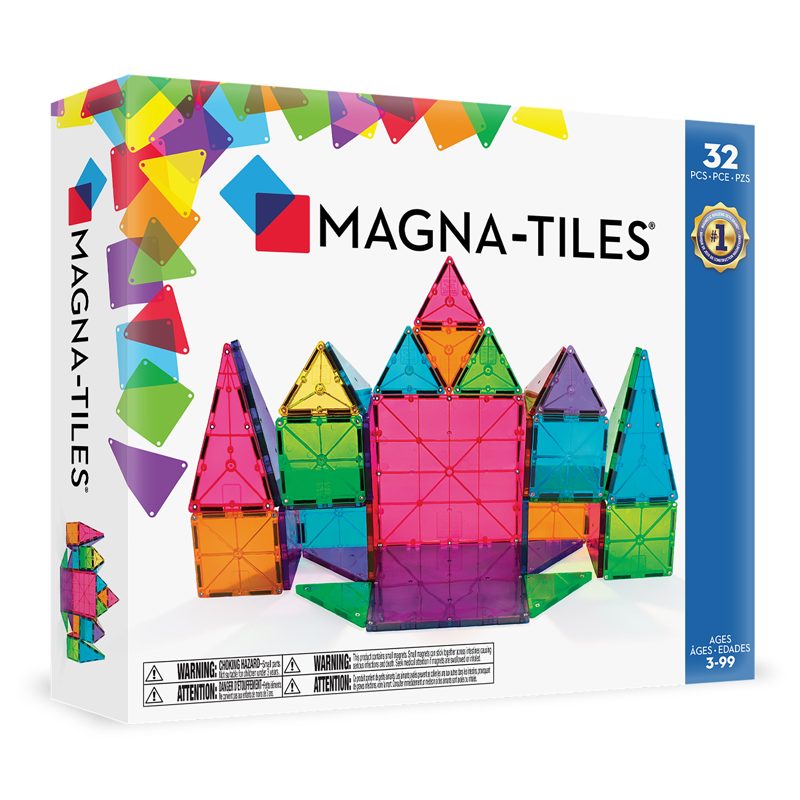 Image: MAGNA-TILES
Magnetic tiles teach shapes, symmetry and balance as kids build walls, towers and 3D shapes. This 32-piece starter set has translucent tiles in six colors. MAGNA-TILES labels it for ages 3 and up. For a full guide, see our magnetic tiles roundup.
- ✓Kids use them for years
- ✓No instructions needed
- ✓Compatible with other MAGNA-TILES sets
- ✕32 pieces goes fast with two kids
- ✕Premium price compared with other brands
- ✕Contains magnets, so check tiles for damage
Recall and spec check
On November 19, 2026 we searched the CPSC recall records for every pick in this guide and linked each maker’s own product page so you can confirm current specs and limits. Recalls can be announced at any time, so check CPSC and register your product with the maker to get notices.
- Learning Resources Code & Go Robot Mouse Activity Set · no recall found
- Learning Resources Coding Critters Ranger & Zip · no recall found
- Learning Resources Gears! Gears! Gears! Building Set · no recall found
- Learning Resources Primary Science Lab Set · no recall found
- MAGNA-TILES Classic 32-Piece Set · maker’s product page · no recall found
Best STEM toys by age
- Age 3: start with building and cause-and-effect. Gears! Gears! Gears!, the Primary Science Lab Set and MAGNA-TILES Classic are all labeled 3+.
- Age 4: screen-free coding starts to click. The Code & Go Robot Mouse and Coding Critters Ranger & Zip are both labeled 4+.
- Age 5: the same coding toys become more independent play, and magnetic tile builds get bigger and more ambitious. Add more pieces rather than a new toy.
Engineering and mechanical toys for 3- and 4-year-olds
Gear sets and magnetic tiles are the best first engineering toys. Kids build something, see whether it turns or stands, and fix it themselves. Supervise sets with small parts, and follow the age label.
More on building toys: see HABA Basic Building Blocks Review: 60-Piece Beech Set and Lincoln Logs Review: Notched Wood Building Since 1916.
Also useful: our holiday gift guide by age.
Part of our Toys & Learning section. Our main guide covers developmental toys by age.
FAQ
What are good engineering toys for 3-year-olds?
Gear sets and magnetic tiles. Gears! Gears! Gears! and MAGNA-TILES are both labeled 3+, and they let kids build, test and fix their own designs.
What STEM toys are best for a 4-year-old?
Four is when screen-free coding toys start to click. The Code & Go Robot Mouse and Coding Critters Ranger & Zip are both labeled 4+.
What makes a toy a STEM toy? STEM stands for science, technology, engineering and math. For preschoolers, that usually means toys that build sequencing, cause and effect, shapes and spatial thinking through play.
Can a 3-year-old use coding toys? Some can with help, but most screen-free coding toys are labeled 4+. Building sets and science tools are easier starting points for 3-year-olds.
Are these toys safe? Toys sold in the US must meet ASTM F963. Follow the age label and choking-hazard warnings, and keep small pieces away from children under 3.
Do STEM toys need screens? No. Every pick in this guide is screen-free.
What's the best first coding toy for a preschooler? A simple screen-free robot like the Code & Go Robot Mouse is a popular start for ages 4 and up.
How do I store STEM sets with many pieces? Use labeled bins or zip bags, and keep cards and pieces together.
Are STEM toys worth it for 3-year-olds? Simple open-ended toys like gears, tiles and science tools work well at 3. Coding toys usually click closer to age 4 or 5. Everyday play with blocks, water and sand builds the same early skills.
Buying guide: choosing STEM toys for preschoolers
1. Start with your child's interests
Builders may love gears and tiles. Kids who like stories may connect with coding critters. Curious explorers enjoy science kits.
2. Screen-free is fine
Preschool coding toys teach sequencing with buttons and cards. No screen is needed.
3. Room to grow
Toys with expandable challenges or add-on sets last longer.
4. Adult involvement
Many STEM toys work best when an adult plays along at first.
Easy STEM activities at home
- Sink-or-float tests with kitchen objects.
- Build ramps and race cars to test speed and angle.
- Go on a nature walk with a magnifying glass.
- Build with magnetic tiles, and count shapes together.
Safety notes
- Small parts: Many sets are labeled 3+ or 4+. Keep them away from younger siblings.
- Batteries: Keep battery compartments screwed shut, and store button batteries securely.
- Science play: Supervise water and kitchen experiments, and use goggles as included.
- Check recalls at CPSC.gov/Recalls.
Related reviews
More in Toys & Learning

How to Set Up a Toy Rotation
How to set up a toy rotation step by step: how many toys to leave out, how often to swap, where to store the rest, and what the research…
Best Toys for 5-Year-Olds (2026)
Six toys for 5-year-olds compared, from LEGO and a co-op game to a coding robot and a scooter, matched to CDC milestones, with magnet and…

Best Toy Storage and Organizers (2026)
Five toy storage picks compared, from bin organizers and cube shelves to toy boxes with safety hinges, plus tip-over anchoring and CPSC…