
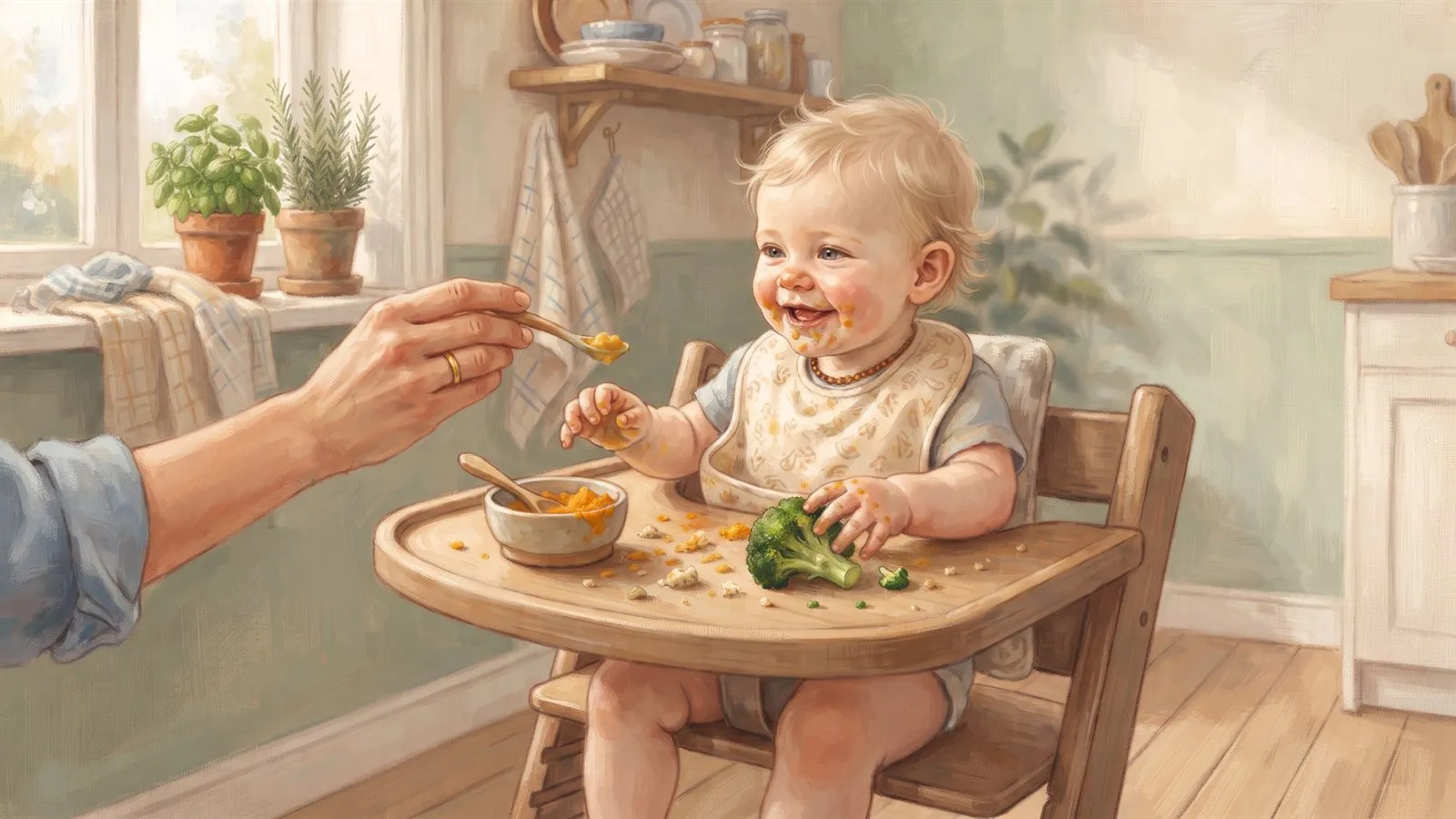
In this guide
- When to start solids
- Signs your baby is ready
- Purees vs baby-led weaning at a glance
- How to start with purees
- How to start with baby-led weaning
- The mixed approach
- Introducing allergens
- Foods and drinks to avoid in the first year
- Choking hazards to avoid or modify
- Gagging vs choking
- A simple plan for the first few weeks
- The gear that actually helps
- How we researched this
- Sources
- Questions parents ask
Reader-supported: SproutPicks may earn a commission from qualifying affiliate links, at no extra cost to you. Full disclosure.
Starting solids is one of the biggest feeding changes of your baby's first year, and it comes with a lot of conflicting advice. Should you start with smooth purees on a spoon, or hand your baby soft finger foods and let them feed themselves? When is your baby actually ready? And what about peanut, egg and choking?
This guide walks through how to start solids using guidance from the American Academy of Pediatrics (AAP), through its parenting site HealthyChildren.org, and the Centers for Disease Control and Prevention (CDC). We cover readiness signs, the case for purees and for baby-led weaning (BLW), how to introduce common allergens, which foods are choking hazards before age 1, and how to tell normal gagging from true choking. It isn't medical advice, so check your plan with your pediatrician, especially if your baby was born early or has eczema, reflux or a feeding issue.
When to start solids
When should my baby start solid foods? Around 6 months for most babies. The AAP recommends breast milk only for about the first 6 months, and the CDC says starting solids before 4 months is not recommended. Go by readiness signs, not just the calendar, and talk to your pediatrician, especially if your baby was born early.
The AAP notes that some babies show readiness closer to 4 months, but the general target from the AAP, the CDC and the Dietary Guidelines for Americans is about 6 months. Breast milk or formula stays your baby's main source of nutrition for the rest of the first year. Solids add to it rather than replacing it.
Signs your baby is ready
Readiness is about development, not size alone. The CDC and AAP describe the same core signs. Your baby is likely ready when they can:
- Sit up with good head control. They can sit in a high chair or feeding seat, with or without a little support, and hold their head and neck steady.
- Open their mouth when food comes near. They watch you eat, lean in or reach for your plate.
- Swallow instead of pushing food out. Younger babies have a tongue-thrust reflex that pushes food back out. The AAP says if food dribbles onto the chin, your baby may not be ready yet, so wait a week or two and try again.
- Bring things to their mouth and grasp small objects. This matters most if you plan to offer finger foods.
The AAP's baby-led weaning article adds that you should wait if your baby was born prematurely, can't sit up on their own or struggles to chew and swallow soft solids. Ask your pediatrician about timing in those cases.
Purees vs baby-led weaning at a glance
There are two main ways to start. With traditional spoon-feeding, you offer smooth purees and gradually thicken them toward mashed, lumpy and then soft chopped foods. With baby-led weaning, you skip purees and offer soft, finger-length pieces of family food that your baby picks up and feeds to themselves. Many families do a mix of both.
| Question | Purees (spoon-feeding) | Baby-led weaning |
|---|---|---|
| Who controls the food? | Parent offers spoonfuls; baby signals when done | Baby picks up food and decides how much to eat |
| First textures | Smooth, then mashed, then lumpy | Soft finger-length strips that mash with gums |
| Iron and calories | Easy to offer iron-fortified cereal and pureed meat | Needs planning; the AAP notes self-fed diets can run low in iron and calories |
| Choking risk | Low with smooth textures; rises as textures advance | The AAP says some studies suggest it isn't higher than spoon-feeding when done right |
| Mess | Moderate | High, especially early on |
| Travel and daycare | Easy to pack and hand off | Harder to do on the go |
| Possible benefits | Easy to see how much baby ate | More textures and family foods early, practice with self-feeding; the AAP notes few studies back these up |
The table summarizes the AAP's baby-led weaning article and its starting-solids guidance, plus the CDC's guidance on textures. Neither approach is "the right one." The safety rules are the same for both.
How to start with purees
Purees are the traditional route, and they're still a solid choice. The AAP says purees can be nutritious, easy to make at home and practical for travel or tight schedules. Here's a simple way to begin:
- Pick a calm time. Choose a time when your baby isn't overtired or starving. The AAP suggests offering a little breast milk or formula first, then small amounts of food, then more milk or formula.
- Seat your baby upright and buckled. Use a high chair with the harness done up, not a bouncer, swing or car seat. Our best high chairs guide covers seats with a footrest and an easy-clean tray.
- Start tiny. The AAP suggests half a spoonful or less at first, with a teaspoon or two as your baby gets the hang of it. Expect faces, confusion and most of it on the bib.
- Offer one new single-ingredient food at a time. The AAP and CDC both suggest waiting 3 to 5 days before adding another new food, so you can spot a reaction.
- Lead with iron. The AAP points to iron- and zinc-rich foods early, such as pureed meat or iron-fortified infant cereal made for babies. The CDC suggests rotating oat, barley and multigrain cereals, because relying on rice cereal alone can raise arsenic exposure.
- Thicken over time. The CDC says to move from smooth to thicker, lumpier textures as your baby's skills develop. Don't stay on smooth purees for months.
- Stop when your baby says stop. Turning away, closing the mouth or crying means they're done. The AAP says not to force feeding.
Don't put cereal in a bottle. The AAP says it can cause choking and extra weight gain, unless your doctor recommends it for reflux. If you plan to make your own, a steamer-blender helps; see our best baby food makers roundup. A simple fork or blender works too.
How to start with baby-led weaning
The AAP describes baby-led weaning as giving babies small portions of family foods that they feed themselves, usually while seated with the family, without spoon-feeding or pressure to finish. If you go this route, the details matter more than the label:
- Choose foods soft enough to mash between your fingers. The AAP says foods should be soft enough for a baby to mash with their gums. Its examples include ripe banana, avocado, steamed broccoli or carrots, shredded lean meat, eggs, yogurt and cheese.
- Cut finger-length strips. The AAP suggests pieces about the size and shape of a small baby carrot, so your baby can hold one end and gnaw on the other.
- Skip round, coin-shaped slices. Rounds of hot dog, carrot, grape or banana can block a small airway. The AAP specifically warns against coin shapes.
- Plan for iron and calories. The AAP notes babies doing BLW may prefer fruit and skip meat and other energy-dense foods. Offer iron-rich options at most meals, like shredded meat, egg strips or iron-fortified foods, and keep breast milk or formula going.
- Ignore viral videos. The AAP calls videos of babies gnawing a whole chicken leg "dangerously misleading." Stick to soft, safe shapes.
- Talk to your pediatrician first. The AAP suggests building a feeding plan with your baby's doctor before you start BLW.
Expect a lot of mess. A suction mat or bowl keeps more food on the tray; our ezpz Happy Mat review and best toddler plates and suction bowls guide compare options, and a few wipeable bandana bibs or a sleeved bib help with clean-up.
Is baby-led weaning safer or riskier than purees? Neither approach is clearly safer if it's done right. The AAP notes that some studies suggest baby-led weaning doesn't carry a higher choking risk than spoon-feeding. What matters most is soft food, safe shapes, an upright seated baby and an adult watching every bite.
The mixed approach
Can I mix purees and baby-led weaning? Yes. The AAP says baby-led weaning can be adapted, and that purees can be nutritious and practical. Many families spoon-feed some meals and offer soft finger foods at others. A mixed approach also makes it easier to get iron-rich foods and allergens in early.
A common pattern is a spoon of iron-fortified cereal or pureed meat at breakfast, plus soft finger foods at family dinner. Preloaded spoons, where you load the spoon and let your baby bring it to their mouth, sit right in the middle. So do yogurt and mashed foods your baby can scoop with their hands.
Introducing allergens
When should I give my baby peanut and egg? Common allergens like egg, peanut, dairy, soy, wheat, fish and shellfish can be introduced with other foods once your baby has started solids, around 6 months. The AAP says waiting doesn't prevent food allergies. If your baby has severe eczema or an egg allergy, ask your pediatrician before giving peanut foods.
Practical tips for allergens:
- Never give whole peanuts or spoonfuls of nut butter. Both are choking hazards. Thin smooth peanut butter with water, breast milk or formula, or stir a little into a puree or oatmeal.
- Introduce one at a time, at home. Offer a new allergen early in the day, then wait a few days before the next new food, so you can spot hives, vomiting or swelling.
- Keep it in the rotation. Once a food is tolerated, keep offering it regularly.
- Know the emergency signs. Trouble breathing, swelling of the lips or face, repeated vomiting or sudden floppiness after a new food means call 911.
Foods and drinks to avoid in the first year
- Honey. The CDC says not to give honey to a child younger than 1 year old, because it can contain the bacteria that cause infant botulism. That includes honey in baked goods made at home and honey pacifiers.
- Cow's milk as a drink. The CDC says cow's milk and fortified dairy alternatives shouldn't be given as a drink until after 12 months. Yogurt and cheese without added sugar are fine earlier.
- Juice. The AAP says babies under 12 months shouldn't have juice.
- Lots of water. Healthy babies don't need extra water before solids. Once solids start, the AAP says small sips from an open, sippy or straw cup are fine, up to 8 ounces a day.
- Added sugar and sweeteners. The CDC says added sugars and low- or no-calorie sweeteners aren't recommended for young children.
Choking hazards to avoid or modify
The CDC lists foods that commonly cause choking in young children. Avoid these, or change their shape and texture before serving:
| Food | Why it's risky | Safer way to serve |
|---|---|---|
| Grapes, cherry tomatoes, berries, cherries | Round, the size of a small airway | Cut into small pieces; quarter lengthwise |
| Hot dogs, sausages, string cheese | Round and firm | Cut into short, thin strips, never coins |
| Raw carrots, raw apple | Hard and hard to chew | Steam or cook until soft, or grate |
| Whole nuts, seeds, spoonfuls of nut butter | Hard pieces; sticky globs | Thin nut butter; use finely ground nuts in food |
| Popcorn, chips, pretzels, hard crackers | Hard, breaks into sharp bits | Skip in the first year |
| Whole corn kernels, whole beans | Small and firm | Mash or smash |
| Raisins and dried fruit | Sticky and chewy | Skip, or chop and soak until soft |
| Hard candy, gummies, marshmallows, gum | Hard or sticky | Skip |
| Tough meat, meat with bones | Hard to chew; bones | Shred soft meat; remove all bones, skin and fat |
The CDC also says to keep mealtimes calm and unhurried, have your child sit upright in a high chair or other safe spot (not a car seat or stroller), serve small portions, remove seeds and pits, and always watch your child while they eat.
Gagging vs choking
Gagging is the reason many parents panic during the first weeks of solids. It's a normal reflex that moves food forward when your baby takes too much or it hits the back of the tongue. The AAP says gagging is expected while babies learn, and that it usually decreases with practice. Choking is different: food is blocking the airway.
How do I tell gagging from choking? Gagging is noisy: your baby coughs, sputters or pushes food forward, and usually clears it alone. Choking is often silent: your baby can't cry, cough or breathe, may look panicked and can turn blue. Choking is an emergency that needs infant back blows and chest thrusts and a call to 911.
| Gagging | Choking | |
|---|---|---|
| Sound | Loud: coughing, retching, sputtering | Silent, or a weak high-pitched noise |
| Breathing | Still breathing | Can't breathe, cry or cough well |
| Color | Face may go red | Lips or skin may turn blue or gray |
| What to do | Stay calm, keep baby upright, let them work it out; don't reach in | Call 911 and start infant first aid right away |
During gagging, don't put your fingers in your baby's mouth, because that can push food farther back. Children's Wisconsin's guidance on choking first aid for babies is to alternate back blows with chest thrusts, remove an object only if you can see it, avoid blind finger sweeps, and start CPR and call 911 if the baby becomes unresponsive. Before you start solids, take an infant CPR and choking class, which many hospitals and the American Red Cross offer.
A simple plan for the first few weeks
- Week 1: One meal a day, a few spoonfuls or a few soft strips. Start with an iron-rich food.
- Weeks 2 to 3: Add a new single-ingredient food every 3 to 5 days. Start introducing allergens, one at a time.
- Weeks 3 to 6: Move to two meals a day. Thicken purees or add more soft finger foods. Offer sips of water from an open or straw cup with meals.
- The months after: Keep building toward more texture, more meals and soft chopped family foods as your baby's skills grow. Your pediatrician can tell you how many meals a day suit your baby at each checkup.
Teething can make some days harder. If sore gums slow things down, chilled soft foods may help; our best teething feeders guide covers mesh and silicone feeders, which also let babies taste fruit with less risk of large pieces.
The gear that actually helps
- A high chair with a harness and footrest. Upright, stable seating is a safety rule, not just a comfort feature.
- Soft-tipped spoons for purees and preloaded spoons for self-feeding practice.
- A suction plate or mat so food stays put instead of flying.
- An open cup or straw cup for small sips of water.
- Wipeable or sleeved bibs and a splat mat under the chair.
You don't need all of this on day one. A spoon, a bowl, a bib and a safe seat are enough.
How we researched this
This guide is research-based. We did not run feeding trials. In November 2026 we reviewed the AAP's starting-solids and baby-led weaning articles on HealthyChildren.org, the CDC's infant and toddler nutrition pages on when, what and how to introduce solid foods and on choking hazards, the CDC's botulism prevention page, and Children's Wisconsin's guidance on gagging and choking. Where sources differ in detail, we followed the AAP and CDC. Talk to your pediatrician about your baby's specific needs.
Sources
- HealthyChildren.org (AAP), Starting Solid Foods
- HealthyChildren.org (AAP), Baby-Led Weaning: Is It Safe?
- CDC, When, What, and How to Introduce Solid Foods
- CDC, Choking Hazards
- CDC, Preventing Botulism (honey and infants)
- Children's Wisconsin, Choking vs. gagging when introducing solid foods
Questions parents ask
When should my baby start solid foods?
Around 6 months for most babies. The AAP recommends breast milk only for about the first 6 months, and the CDC says starting solids before 4 months is not recommended. Go by readiness signs, not just the calendar, and talk to your pediatrician, especially if your baby was born early.
Is baby-led weaning safer or riskier than purees?
Neither approach is clearly safer if it's done right. The AAP notes that some studies suggest baby-led weaning doesn't carry a higher choking risk than spoon-feeding. What matters most is soft food, safe shapes, an upright seated baby and an adult watching every bite.
When should I give my baby peanut and egg?
Common allergens like egg, peanut, dairy, soy, wheat, fish and shellfish can be introduced with other foods once your baby has started solids, around 6 months. The AAP says waiting doesn't prevent food allergies. If your baby has severe eczema or an egg allergy, ask your pediatrician before giving peanut foods.
How do I tell gagging from choking?
Gagging is noisy: your baby coughs, sputters or pushes food forward, and usually clears it alone. Choking is often silent: your baby can't cry, cough or breathe, may look panicked and can turn blue. Choking is an emergency that needs infant back blows and chest thrusts and a call to 911.
Can I mix purees and baby-led weaning?
Yes. The AAP says baby-led weaning can be adapted, and that purees can be nutritious and practical. Many families spoon-feed some meals and offer soft finger foods at others. A mixed approach also makes it easier to get iron-rich foods and allergens in early.
More in Feeding & Mealtime
Natursutten Pacifier Review: One-Piece Natural Rubber Soother
Natursutten pacifier review: a one-piece natural rubber soother. Plastic-free pros, wear, and latex-allergy cautions. Research-based, not…

Sophie la Girafe Review: The Natural Rubber Teether Since 1961
Sophie la Girafe review: the natural rubber teether since 1961. Grip, cleaning needs, and whether the name is worth it. Research-based,…
Stokke Tripp Trapp Review: Grow-With-Me Chair Pros and Cons
Stokke Tripp Trapp review: the grow-with-me chair. Pros, cons, Baby Set needs and when a tray chair fits better. Research-based, not tested.