
In this guide
- Quick picks
- Formula prep and storage rules from the CDC and FDA
- The measuring accuracy caveat
- Baby Brezza Formula Pro Advanced
- Dr. Brown's Formula Mixing Pitcher
- OXO Tot Formula Dispenser
- Baby Brezza Formula Pro Mini
- Munchkin Formula Dispenser
- Machine, pitcher or dispenser?
- How we researched this
- Sources
- Questions parents ask
Reader-supported: SproutPicks may earn a commission from qualifying affiliate links, at no extra cost to you. Full disclosure.
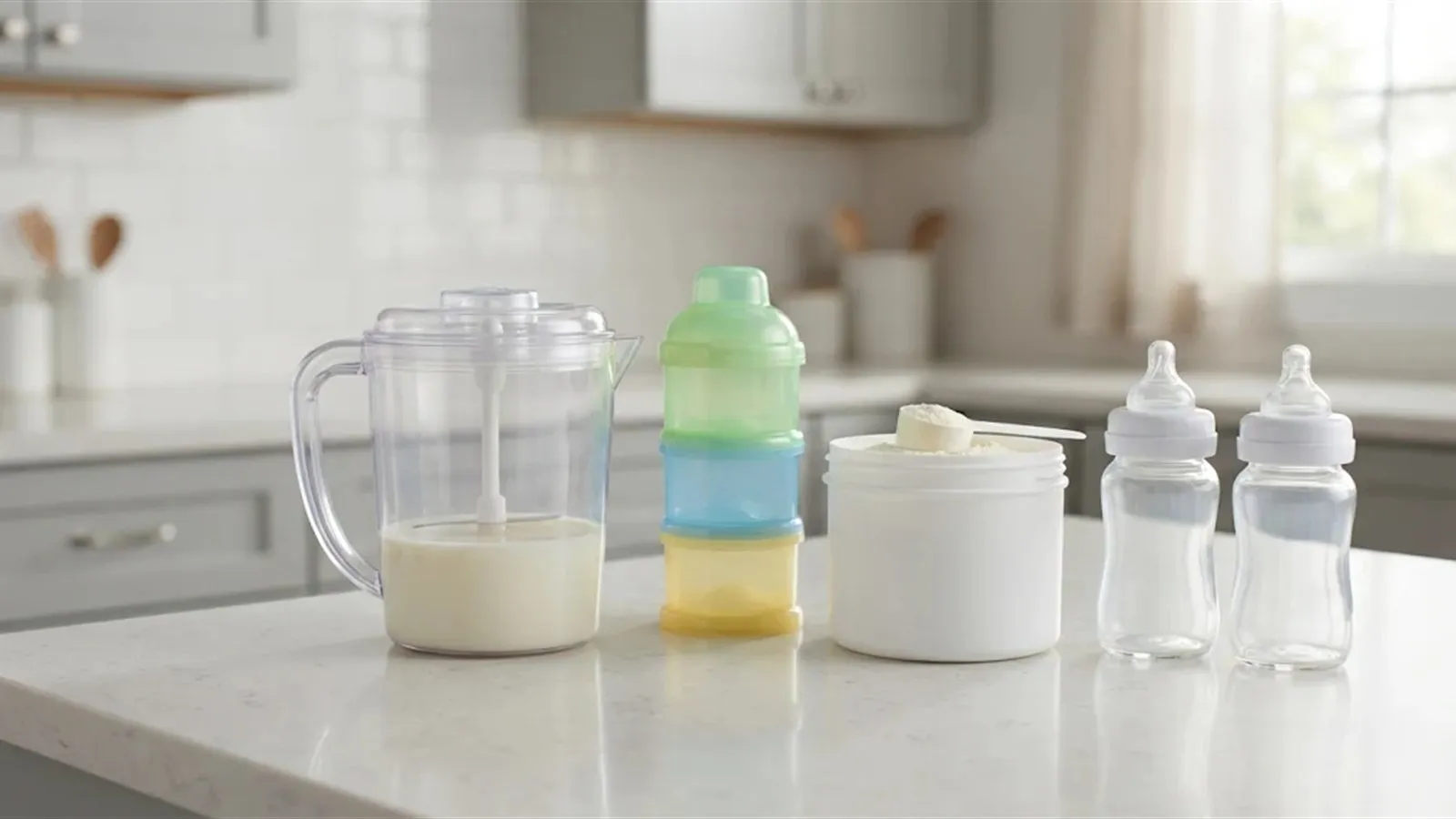
Night feeds go faster when you aren't leveling scoops in the dark. A formula machine can mix a warm bottle at the push of a button, a mixing pitcher can make a day's worth of formula at once, and a cheap powder dispenser lets you pre-measure feeds for the diaper bag. Each one comes with a catch, though. Prepared formula has strict time limits, and any device that measures for you is only as accurate as its settings. Below are five picks with specs and prices checked on maker pages and retailer listings, followed by what the CDC and FDA say about preparing and storing formula.
Quick picks
Baby Brezza Formula Pro Advanced
Dr. Brown's Formula Mixing Pitcher
OXO Tot Formula Dispenser
Baby Brezza Formula Pro Mini
Munchkin Formula Dispenser
How we score: SproutPicks Scores are our own editorial ratings out of 10. They weigh how well a product fits CDC and FDA preparation guidance, how it handles measuring, ease of cleaning, capacity and value. We used maker product pages, retailer listings where a maker page didn't load, and CDC and FDA guidance. They are not Amazon ratings, and we did not use these products ourselves.
Formula prep and storage rules from the CDC and FDA
Whatever tool you use, the same rules apply. The CDC and FDA guidance lines up closely:
- Follow the label. The FDA says to add the exact amount of water to the bottle and then the exact amount of formula the label says. The CDC says to measure the water first, then add the powder.
- Get the ratio right. The FDA says formula with too little water can cause dehydration, and formula with too much water won't provide enough nutrition. Never add extra water to stretch formula.
- Watch the clock. The CDC says to use prepared formula within 2 hours of preparation and within 1 hour from when the feeding begins.
- Refrigerate what you won't use. If you won't start the feeding within 2 hours, store the bottle in the refrigerator and use it within 24 hours.
- Toss leftovers. Throw out any formula left in the bottle after a feeding. The FDA explains that saliva in the bottle can help bacteria grow.
- Store powder properly. Keep opened containers in a cool, dry place with the lid closed, not in the refrigerator, and use them within the time on the label, usually 1 month.
- Take extra care with young or vulnerable babies. The CDC notes that powdered formula is not sterile. For babies under 2 months old, born before 37 weeks or with a weakened immune system, it says to boil water, let it cool for about 5 minutes and mix while it's still very hot, around 158°F (70°C), then cool the bottle before feeding.
- Skip the microwave. Both agencies say not to warm bottles in the microwave, since it can create hot spots.
In short: how long can mixed formula sit out? The CDC says to use prepared formula within 2 hours of preparation and within 1 hour from when the feeding begins. If you won't start the feeding within 2 hours, store the bottle in the refrigerator and use it within 24 hours. Throw out any formula left in the bottle after a feeding.
The measuring accuracy caveat
Why does the ratio matter so much? The FDA says formula with too little water can cause dehydration, and formula with too much water won't provide enough nutrition. Always add the exact amounts of water and powder that the formula label lists.
A device that measures for you makes the ratio feel automatic, but it can still be off. Machines depend on a powder setting that must match your specific formula, and powder can build up in the funnel. Dispensers only hold what you scoop into them, so a mistake at the counter travels with you. Pitchers need you to scale up the label's ratio correctly for a bigger batch.
Are formula machines more accurate than scooping by hand? They can be, but only if the powder setting matches your formula and the machine is kept clean. Baby Brezza says its machines dispense powder by weight and tells parents to look up the right setting for their formula and to clean the funnel often, since buildup can make bottles look watery. Check a few bottles against the label.
A few habits help with any method:
- Use the scoop that came with your formula, and level it the way the label shows.
- When you switch formula brands or types, recheck the machine setting or the pitcher math.
- For a machine, Baby Brezza describes an at-home check: catch one dispense of powder on a scale that reads to 0.01 gram and compare it with the weight of the correct number of level scoops.
- If bottles look thinner or thicker than usual, stop and mix by hand until you find the cause.
Baby Brezza Formula Pro Advanced
Baby Brezza's best-known machine stores powder and water separately, then mixes, warms and dispenses a bottle. Its product page lists three temperatures (body temperature, warmer than body temperature and room temperature), bottle sizes from 2 to 10 oz, a water-only option and a dishwasher-safe water tank, and says it works with nearly all formula brands. It was $229.99 on Baby Brezza's site in November 2026; a WiFi version that sends alerts to your phone was $329.99. Baby Brezza says the machine measures powder by weight and cites clinical studies finding that 1 in 3 hand-made bottles were off by 10% or more, which is the maker's own claim. The machine doesn't sterilize water, and Baby Brezza recommends cleaning the funnel daily or after every fourth bottle.
- ✓Mixes and warms a bottle in seconds, which helps at night
- ✓Three temperatures and 2 to 10 oz sizes
- ✓Maker publishes a setting finder and an at-home accuracy check
- ✕Expensive, and it takes up counter space
- ✕Accuracy depends on the correct setting and frequent funnel cleaning
- ✕Doesn't sterilize water
Dr. Brown's Formula Mixing Pitcher
Dr. Brown's pitcher mixes up to 32 oz, enough for four 8 oz bottles. A plunger-style blade dissolves the powder, and an adjustable stopper keeps the blade below the surface to limit air bubbles. It has a locking lid and a no-drip spout, it's BPA-free, and it's top-rack dishwasher safe. Dr. Brown's own site didn't load for us, so these details come from Babylist's listing, which showed it at $11.34 in November 2026. A pitcher fits the CDC rules well if you treat it as fridge storage: mix, refrigerate right away, and use the batch within 24 hours.
- ✓Makes up to 32 oz at once, which saves time
- ✓Low price
- ✓Locking lid and no-drip spout
- ✕Cold formula, unless you warm each bottle separately
- ✕You still have to scale the label's ratio for a big batch
Can I make a pitcher of formula for the whole day? You can mix a batch ahead if you refrigerate it right away and use it within 24 hours, which is the limit the CDC and FDA give for prepared formula in the refrigerator. Pour out only what you need for each bottle and keep the rest cold.
OXO Tot Formula Dispenser
OXO's dispenser has three compartments that each hold enough powder for a 9-ounce bottle. You turn the lid until it clicks into the compartment you want, and the cap swivels out of the way for one-handed pouring. It has rounded corners for easier cleaning and pouring, and it's top-rack dishwasher safe. It was $8.99 on OXO's site in November 2026. Keeping powder dry and separate from water until feeding time is the safest way to carry formula, since mixed formula starts the 2-hour clock.
- ✓Three 9 oz portions in one compact container
- ✓Swivel cap for one-handed pouring
- ✓Top-rack dishwasher safe
- ✕Only as accurate as your scooping
- ✕Must be completely dry before you refill it
Baby Brezza Formula Pro Mini
The Mini is Baby Brezza's smaller machine. It uses the same powder settings as the Formula Pro Advanced, and Baby Brezza's settings finder asks you to choose your model first. It was $199.99 on Baby Brezza's site in November 2026. Babylist's product Q&A says it has one temperature setting instead of three and holds less powder and water than the Advanced, which means more frequent refills. The same accuracy rules apply: confirm the setting for your formula, keep the funnel clean, and check a few bottles. Like the Advanced, it doesn't sterilize water.
- ✓Smaller footprint than the Advanced
- ✓Same powder settings and setting finder
- ✓Lower price than the Advanced
- ✕Only one temperature setting, per Babylist
- ✕Smaller tanks mean more refills
- ✕Only $30 cheaper than the Advanced
Munchkin Formula Dispenser
Munchkin's basic dispenser has three sections for pre-measured powder, each for bottles up to 9 oz, and Munchkin says a flexible seal keeps powder in its section. It's BPA-free and was $4.99 on Munchkin's US site in November 2026. It does the same job as the OXO for less money, without the swivel cap. Munchkin's page doesn't say whether it's dishwasher safe, so plan to hand-wash it and let it dry completely before refilling.
- ✓Very low price
- ✓Three portions for bottles up to 9 oz
- ✓BPA-free
- ✕No swivel cap for one-handed pouring
- ✕Care instructions aren't listed on Munchkin's page
Machine, pitcher or dispenser?
- Machine: Best for frequent night feeds when you want a warm bottle fast. It costs the most and needs the most cleaning and setting checks.
- Pitcher: Best for mixing ahead for daycare or a long day. Everything has to go into the fridge and be used within 24 hours.
- Dispenser: Best for outings. Carry powder and water separately and mix when your baby is ready to eat.
Does a formula machine sterilize the water? No. Baby Brezza says the Formula Pro doesn't sterilize water. For babies under 2 months old, born before 37 weeks or with a weakened immune system, the CDC says to mix powdered formula with water heated to about 158°F (70°C), so ask your pediatrician whether a machine fits your routine.
For the rest of the bottle setup, see our reviews of the Dr. Brown's Options+ bottle, the Philips Avent Natural Response bottle and the Kiinde Kozii bottle warmer.
More on bottles and formula: start with our guide to high chairs for baby-led weaning, then Best Formula Maker Machines (2026) and Dr. Brown's vs Philips Avent Bottles.
How we researched this
These picks are research-based. We did not use these products. In November 2026 we read the CDC's guidance on preparing and storing infant formula and the FDA's guidance on safe handling of infant formula. We checked product details and prices on maker sites for Baby Brezza, OXO and Munchkin, and on Babylist's listing for the Dr. Brown's pitcher because Dr. Brown's site didn't load for us. Babylist's product Q&A is also our source for the Formula Pro Mini's temperature and tank differences. Baby Brezza's accuracy statements are the maker's own claims. Prices change often.
Sources
- CDC, How to Prepare and Store Powdered Infant Formula
- FDA, Safe Handling of Infant Formula
- Baby Brezza, Formula Pro Advanced
- Baby Brezza, Formula Pro Mini
- Baby Brezza, How we test the Formula Pro to ensure it dispenses formula accurately
- Baby Brezza, Formula setting finder
- Babylist, Dr. Brown's Formula Mixing Pitcher
- OXO, OXO Tot Formula Dispenser
- Munchkin, Formula Dispenser
Questions parents ask
How long can mixed formula sit out?
The CDC says to use prepared formula within 2 hours of preparation and within 1 hour from when the feeding begins. If you won't start the feeding within 2 hours, store the bottle in the refrigerator and use it within 24 hours. Throw out any formula left in the bottle after a feeding.
Can I make a pitcher of formula for the whole day?
You can mix a batch ahead if you refrigerate it right away and use it within 24 hours, which is the limit the CDC and FDA give for prepared formula in the refrigerator. Pour out only what you need for each bottle and keep the rest cold.
Are formula machines more accurate than scooping by hand?
They can be, but only if the powder setting matches your formula and the machine is kept clean. Baby Brezza says its machines dispense powder by weight and tells parents to look up the right setting for their formula and to clean the funnel often, since buildup can make bottles look watery. Check a few bottles against the label.
Does a formula machine sterilize the water?
No. Baby Brezza says the Formula Pro doesn't sterilize water. For babies under 2 months old, born before 37 weeks or with a weakened immune system, the CDC says to mix powdered formula with water heated to about 158°F (70°C), so ask your pediatrician whether a machine fits your routine.
What happens if formula is mixed with too much or too little water?
The FDA says formula with too little water can cause dehydration, and formula with too much water won't provide enough nutrition. Always add the exact amounts of water and powder that the formula label lists.
More in Feeding & Mealtime
Thermos Funtainer vs Owala Kids: Which School Bottle?
Thermos Funtainer vs Owala Kids' FreeSip for back to school: straw design, leaks, cleaning, insulation and which kids' bottle fits your…
Stokke Tripp Trapp Review: Grow-With-Me Chair Pros and Cons
Stokke Tripp Trapp review: the grow-with-me chair. Pros, cons, Baby Set needs and when a tray chair fits better. Research-based, not tested.

Best Mesh and Silicone Teething Feeders (2026)
Best teething feeders for 2026: four mesh and silicone picks compared on age, cleaning and price, plus choking-hazard foods and FDA…