
In this guide
- The ABCs of safe sleep
- What the AAP's 2022 policy says
- A for Alone: room-sharing without bed-sharing
- B for Back: every sleep, every time
- C for Crib: a firm, flat, bare sleep space
- What federal law now bans
- Weighted sleep sacks and swaddles
- White noise, monitors and other extras
- A quick nursery checklist
- Our guides on safe sleep
- How we researched this
- Sources
- Questions parents ask
Reader-supported: SproutPicks may earn a commission from qualifying affiliate links, at no extra cost to you. Full disclosure.
Every year, about 3,500 babies in the US die from sleep-related causes, according to the American Academy of Pediatrics (AAP). That number covers sudden infant death syndrome (SIDS) and accidental suffocation or strangulation in bed, and many of these deaths happen in sleep spaces that can be made safer. The AAP's 2022 safe sleep policy is the current rulebook for US pediatricians, and federal law now bans two products that used to be common in nurseries. This guide sums it up in plain language, starting with the easy-to-remember ABCs, and points to gear that fits the rules.
The ABCs of safe sleep
What are the ABCs of safe sleep? Alone, Back, Crib. Your baby sleeps alone in their own sleep space, on their back for every sleep, in a crib, bassinet or play yard with a firm, flat mattress and only a fitted sheet. It's a memory aid used by hospitals and health departments to sum up the AAP's recommendations.
- A is for Alone. No adults, siblings or pets in the sleep space, and no pillows, blankets, bumpers or toys either.
- B is for Back. Place your baby on their back for every nap and every night.
- C is for Crib. A crib, bassinet, portable crib or play yard that meets federal safety standards, with a firm, flat mattress and a tight fitted sheet.
What the AAP's 2022 policy says
In June 2022 the AAP published updated recommendations in its journal Pediatrics, titled "Sleep-Related Infant Deaths: Updated 2022 Recommendations for Reducing Infant Deaths in the Sleep Environment." Its family-facing summary on HealthyChildren.org lists these key points:
- Back to sleep for every sleep. Place your baby on their back for all naps and at night.
- A firm, flat, non-inclined surface. Any surface that inclines more than 10 degrees isn't safe for infant sleep.
- Room-share without bed-sharing. Share a room with your baby, but not a bed, preferably for at least the first 6 months. The AAP says it cannot support bed-sharing under any circumstances.
- Nothing soft in the sleep space. Keep soft toys, pillows, blankets, bumper pads and other bedding out of the crib.
- No weighted products. Weighted swaddles, weighted clothing and weighted objects on or near a baby are not safe and not recommended.
- Don't rely on gadgets. Avoid products that don't fit safe sleep advice, including those that claim to lower SIDS risk, and don't use home cardiorespiratory monitors as a way to reduce SIDS risk.
- Protective habits. Breast milk feeding, a pacifier at sleep time, a smoke-free and substance-free home, and routine vaccines are all linked to lower risk; the AAP says evidence suggests infant vaccinations may help protect against SIDS.
A for Alone: room-sharing without bed-sharing
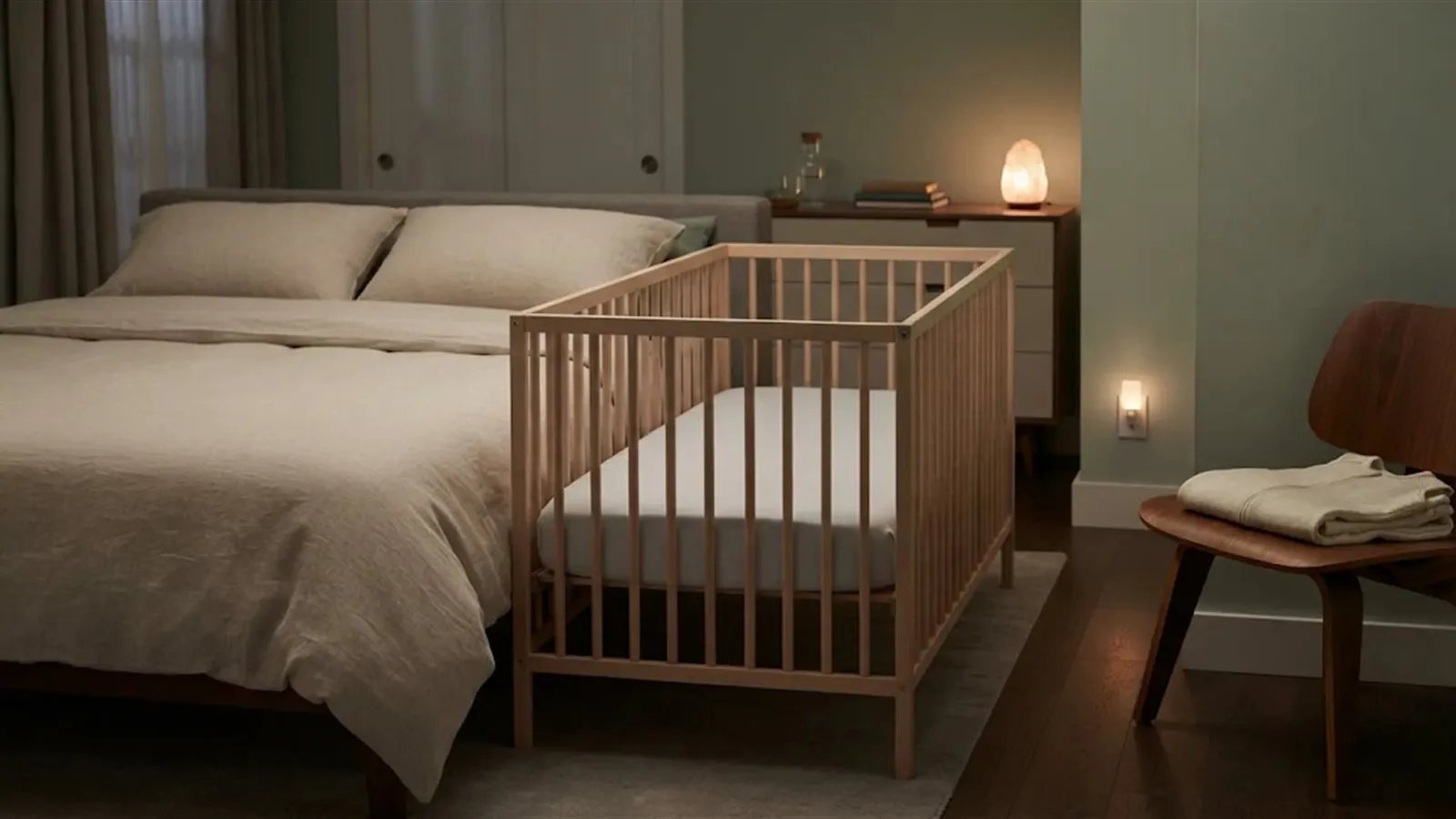
How long should my baby sleep in my room? The AAP recommends sharing a room, but not a bed, preferably for at least the first 6 months. Put the crib or bassinet close to your bed so night feeds are easy, and return your baby to their own sleep space after every feed.
The AAP is especially firm about couches and armchairs. Its HealthyChildren.org guide says the risk of death is up to 67 times higher when babies sleep with someone on a sofa, soft armchair or cushion. If you feel yourself nodding off during a night feed, put your baby back in their crib or bassinet first. If you do fall asleep with your baby in an adult bed, move them to their own sleep space as soon as you wake.
A bedside bassinet makes room-sharing easier in small bedrooms. Our best baby bassinets guide compares models, and our HALO BassiNest vs SNOO alternatives comparison looks at swivel and smart bassinets.
B for Back: every sleep, every time
Back sleeping is the single biggest change behind the drop in SIDS since the 1990s, and it applies to every sleep, including naps and naps at a grandparent's house. Side sleeping isn't a safe middle ground, because babies can roll from their side onto their tummy.
What about babies who roll? Keep placing your baby on their back. Once your baby can roll both ways, from back to tummy and tummy to back, you don't need to turn them back over if they roll during sleep. Stop swaddling as soon as your baby looks like they're trying to roll, because a swaddled baby who rolls onto their tummy may not be able to roll back. A wearable blanket with arms free is the next step; our HALO SleepSack Swaddle review and Kyte Baby Sleep Bag review cover two popular options.
Supervised tummy time while your baby is awake helps build neck and shoulder strength and can help prevent a flat spot on the back of the head. The AAP says an awake adult should always supervise it.
C for Crib: a firm, flat, bare sleep space
The CPSC's short version is "bare is best": nothing in the crib, bassinet or play yard but a fitted sheet. Check these points:
- A product meant for infant sleep. Use a crib, bassinet, portable crib or play yard that meets federal safety standards. Our best convertible cribs guide covers cribs that last into the toddler years.
- A firm, flat mattress that fits. The mattress shouldn't sag or curve to your baby's shape, and there should be no gaps between it and the crib sides. Our Newton Baby crib mattress review looks at one breathable option.
- A fitted sheet made for that mattress, and nothing else: no pillows, quilts, blankets, sleep positioners, wedges or stuffed animals.
- The right room temperature. The AAP says to dress your baby in only one layer more than you're wearing, and don't put a hat on your baby indoors once you're home from the hospital.
Is it safe for my baby to sleep in a car seat, swing or bouncer? Not for routine sleep. The AAP says sitting devices such as car seats, strollers, swings and infant carriers are not recommended for routine sleep, and if your baby falls asleep in one, you should move them to a firm, flat sleep surface on their back as soon as you can.
What federal law now bans
Two federal actions in 2022 turned parts of this advice into law.
The Safe Sleep for Babies Act. Signed on May 16, 2022, the law bans inclined sleepers for infants and padded crib bumpers. The CPSC says the ban took effect on November 12, 2022, regardless of when a product was made. The inclined sleeper ban covers products with a sleep surface angle greater than 10 degrees meant for babies up to 1 year old. The crib bumper ban covers padded bumpers, supported and unsupported vinyl bumper guards, and vertical crib slat covers; it does not cover non-padded mesh crib liners. The CPSC wrote both bans into its regulations in 2023, at 16 CFR parts 1309 and 1310.
Are crib bumpers and inclined sleepers legal? No. Under the Safe Sleep for Babies Act, padded crib bumpers and inclined sleepers for infants have been banned from sale in the US since November 12, 2022, no matter when they were made. Don't use one even if it was a gift or a hand-me-down.
The CPSC infant sleep products rule. Since June 23, 2022, infant sleep products made for babies up to 5 months old that aren't already covered by another federal sleep standard, such as in-bed sleepers, baby boxes and travel sleepers, must meet a federal standard that includes a sleep surface angle of no more than 10 degrees. Cribs, bassinets and play yards have their own mandatory standards.
Weighted sleep sacks and swaddles
Can my baby use a weighted sleep sack or swaddle? No. The AAP says weighted swaddles, weighted clothing and weighted objects on or near a baby are not safe and not recommended, and the CPSC tells parents not to use weighted blankets or weighted swaddles. Choose a regular, unweighted sleep sack in a size that fits.
A good sleep sack fits snugly at the neck and arms so it can't ride up over your baby's face, and is sized by your baby's weight and length. Our Woolino 4 Season Sleep Bag review covers a wool option for families who want one bag for warm and cool rooms.
White noise, monitors and other extras
White noise doesn't make sleep safer, but many parents find it helps babies settle. If you use a machine, put it across the room from the crib, not on the crib rail, and keep the volume moderate. Our best white noise machines for babies guide and Yogasleep Dohm vs Hatch Rest comparison cover the options.
Baby monitors can help you hear or see your baby from another room, but no monitor prevents SIDS, and the AAP says not to use home cardiorespiratory monitors as a way to reduce SIDS risk. Keep monitor cords well out of reach of the crib, following the distance in your monitor's manual, because cords are a strangulation risk. Our best baby monitors guide covers placement.
A quick nursery checklist
- Crib, bassinet or play yard that meets federal standards and hasn't been recalled; check CPSC.gov.
- Firm, flat, well-fitting mattress with only a fitted sheet.
- No bumpers, pillows, blankets, positioners, wedges or toys.
- Sleep space in your room, close to your bed, for at least the first 6 months.
- Baby on the back for every sleep, in a sleep sack instead of loose blankets.
- Swaddle stopped as soon as your baby shows signs of rolling.
- No weighted sleep products and no inclined sleepers.
- Cords from monitors, blinds and curtains well out of reach.
- A smoke-free home, and a room that's comfortable, not hot.
Our guides on safe sleep
How we researched this
This guide is research-based and is not medical advice; ask your pediatrician about your baby's situation. In November 2026 we read the AAP's June 2022 news release on its updated safe sleep recommendations, the AAP's family guide to safe sleep on HealthyChildren.org, the CPSC's Safe Sleep information page, the CPSC's Safe Sleep for Babies Act business guidance and inclined sleeper FAQ, and the CPSC's guidance on the infant sleep products rule. The ABCs are a common shorthand used by hospitals and state health departments; the recommendations behind them are the AAP's. The products we link to are covered in our own research-based reviews, which we did not hands-on test.
Sources
- AAP, Updates Safe Sleep Recommendations: Back is Best (June 2022)
- Pediatrics, Sleep-Related Infant Deaths: Updated 2022 Recommendations
- AAP HealthyChildren.org, How to Keep Your Sleeping Baby Safe
- CPSC, Safe Sleep
- CPSC, Safe Sleep for Babies Act business guidance
- CPSC, Inclined Sleeper FAQs
- CPSC, Crib Bumpers business guidance
- CPSC, infant sleep product rule news release
Questions parents ask
What are the ABCs of safe sleep?
Alone, Back, Crib. Your baby sleeps alone in their own sleep space, on their back for every sleep, in a crib, bassinet or play yard with a firm, flat mattress and only a fitted sheet. It's a memory aid used by hospitals and health departments to sum up the AAP's recommendations.
How long should my baby sleep in my room?
The AAP recommends sharing a room, but not a bed, preferably for at least the first 6 months. Put the crib or bassinet close to your bed so night feeds are easy, and return your baby to their own sleep space after every feed.
Is it safe for my baby to sleep in a car seat, swing or bouncer?
Not for routine sleep. The AAP says sitting devices such as car seats, strollers, swings and infant carriers are not recommended for routine sleep, and if your baby falls asleep in one, you should move them to a firm, flat sleep surface on their back as soon as you can.
Are crib bumpers and inclined sleepers legal?
No. Under the Safe Sleep for Babies Act, padded crib bumpers and inclined sleepers for infants have been banned from sale in the US since November 12, 2022, no matter when they were made. Don't use one even if it was a gift or a hand-me-down.
Can my baby use a weighted sleep sack or swaddle?
No. The AAP says weighted swaddles, weighted clothing and weighted objects on or near a baby are not safe and not recommended, and the CPSC tells parents not to use weighted blankets or weighted swaddles. Choose a regular, unweighted sleep sack in a size that fits.
More in Sleep & Nursery

Best Baby Swaddles (2026)
Six swaddles compared on fit, TOG, hip room and price, plus the AAP rule to stop at the first signs of rolling and why weighted swaddles…
Hatch Rest 2nd Gen Sound Machine Review
Hatch Rest 2nd Gen review: sounds, night light, Time-to-Rise, the app and Hatch+, safe volume and placement, and why Hatch now points…
Best Travel Cribs and Play Yards for Flying and Visits
Travel cribs and play yards compared by packed weight, fold size and limits, with five researched picks and the CPSC rule on never adding…