
In this guide
- The short list: what to keep out of the sleep space
- The Safe Sleep for Babies Act: inclined sleepers and padded bumpers
- Loungers, nests and pillows: the infant support cushion rule
- The infant sleep products rule: anything sold for sleep must be flat
- Weighted sleep sacks, swaddles and blankets
- Recall examples, verified on cpsc.gov
- What to use instead
- How we researched this
- Sources
- Questions parents ask
Reader-supported: SproutPicks may earn a commission from qualifying affiliate links, at no extra cost to you. Full disclosure.
Walk into a baby store or scroll a marketplace listing and you'll still see products that promise longer naps: cushy loungers, padded crib bumpers, "calming" weighted sleep sacks and inclined rockers sold as a place for a baby to doze. Some of these are now banned in the US. Others are legal to sell but not safe for sleep. This guide explains which products to skip and why, based on federal law, Consumer Product Safety Commission (CPSC) rules and the American Academy of Pediatrics (AAP) safe sleep policy, with recall examples verified on cpsc.gov.
How we put this together: this is a research-based guide, not a product test. We read the laws, rules and policy statements themselves and checked every recall on cpsc.gov in November 2026. It doesn't replace advice from your pediatrician, especially for babies born early or with medical conditions.
The short list: what to keep out of the sleep space
- Inclined sleepers. Banned. Any sleep surface inclined more than 10 degrees is unsafe for sleep.
- Padded crib bumpers. Banned, along with other padded products that cover the crib sides.
- Loungers, nests, positioners and nursing pillows used for sleep. Not made for sleep. A federal rule now requires a warning that using them for sleep or naps can kill.
- Weighted sleep sacks, swaddles, sleepers and blankets. The AAP says they aren't safe, and CPSC advises against weighted blankets and swaddles.
- Pillows, quilts, blankets and stuffed toys. Soft objects that can block a baby's airway.
- Swings, bouncers, rockers, car seats and strollers used for routine sleep. Fine for supervised awake time or travel, but move a sleeping baby to a flat surface.
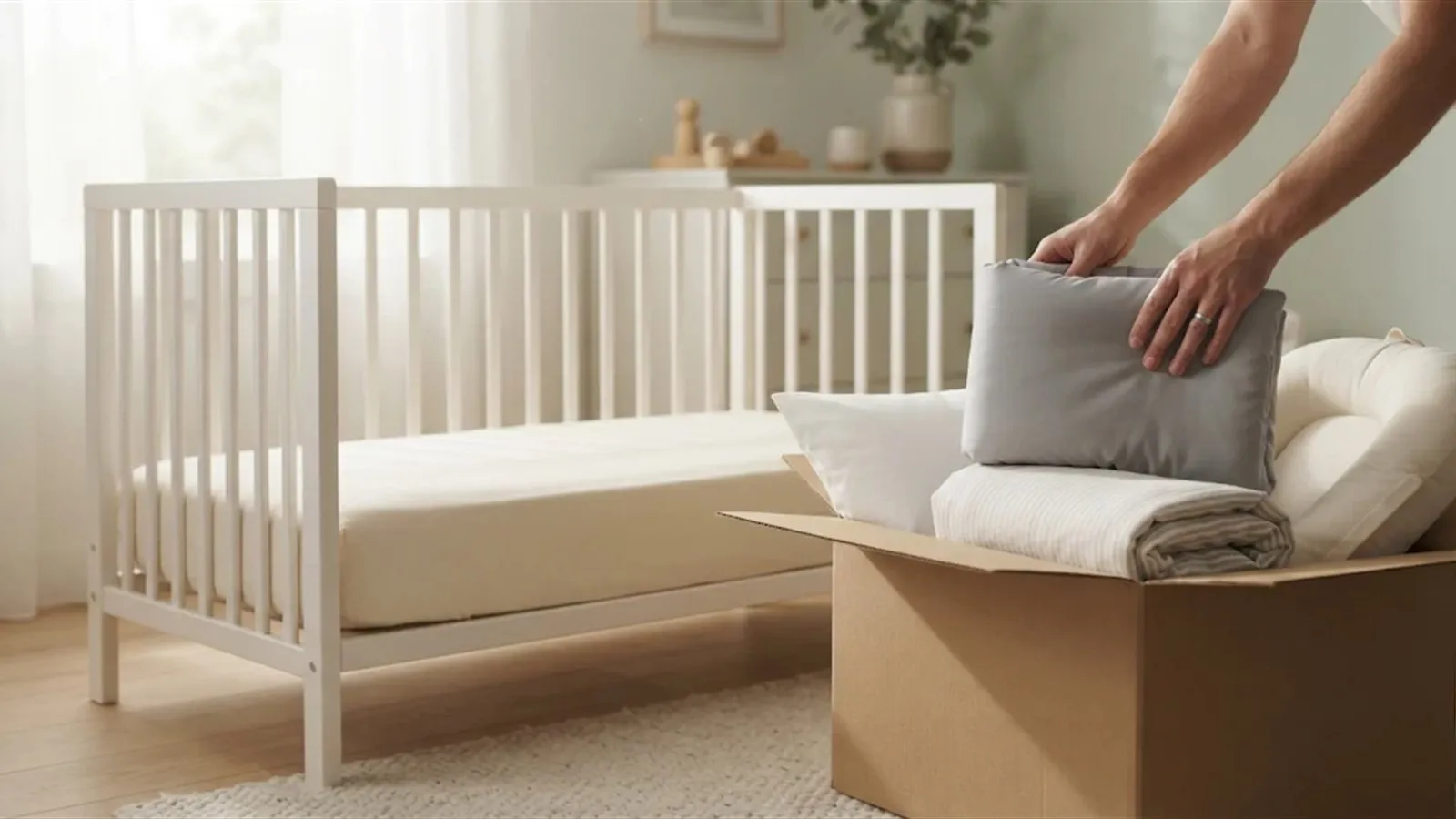
What a baby does need is simple. The AAP recommends placing babies on their back, on a firm, flat surface in a crib, bassinet or play yard that meets federal safety standards, with a fitted sheet only. CPSC calls this "Bare is Best."
The Safe Sleep for Babies Act: inclined sleepers and padded bumpers
The Safe Sleep for Babies Act of 2022 made two products banned hazardous products under the Consumer Product Safety Act. CPSC says it's illegal to make, sell, offer for sale, distribute or import either one, and that the bans took effect on November 12, 2022, no matter when a product was made. CPSC later approved rules adding the bans to its regulations.
Inclined sleepers
CPSC's definition of an inclined sleeper is a product with a sleep surface inclined more than 10 degrees that's intended for sleeping infants up to 1 year old. The problem is position. CPSC's safe sleep page explains that a seated or semi-reclined position can cause a baby's head to tip forward and block the airway, and babies who roll in a soft, angled product can end up face down. The AAP uses the same line: any surface inclined more than 10 degrees isn't safe for a baby to sleep on.
That also covers products that aren't sold as sleepers. CPSC says inclined products with an angle greater than 10 degrees, such as rockers, gliders, soothers and swings, should never be used for infant sleep. If your baby nods off in one, move them to their crib, bassinet or play yard.
Padded crib bumpers
The law defines a crib bumper as material meant to cover the sides of a crib to prevent impact injuries or to block openings where a body part could get trapped. That includes padded bumpers, so padded products sold to wrap the crib slats are covered no matter what they're called. Non-padded mesh crib liners are not covered by the ban.
Not banned doesn't mean recommended. The AAP's safe sleep guidance says there should be no blankets, pillows, stuffed toys or bumper pads in a baby's bed. Non-padded mesh crib liners are not covered by the bumper ban, but the AAP says to keep bumper pads and anything that attaches to the crib slats or sides out of the crib. A fitted sheet on a firm, flat mattress is all a baby needs.
Loungers, nests and pillows: the infant support cushion rule
Loungers look harmless. They're soft, low and often marketed for "supervised" use, which makes it easy to let a baby nap on one on the sofa or, worse, inside a crib. CPSC wrote a mandatory standard for these products, the Safety Standard for Infant Support Cushions, at 16 CFR part 1243. The rule was published in November 2024 and its effective date was May 5, 2025.
The rule covers products filled with foam, batting, beads, gel, liquid or air that are meant to support a reclining infant up to 12 months old. CPSC's examples include infant loungers, infant pillows, tummy time pillows, wedge pillows, sleep positioners, pads and mats, and nursing pillows that are also sold for lounging. Products already covered by other sleep standards, such as crib mattresses and infant sleep products under 16 CFR part 1236, are excluded.
The key requirements:
- No more than 10 degrees of incline on the surface where the baby lies.
- Firm enough that the surface is unlikely to conform to a baby's face.
- Limits on sidewalls, which CPSC estimates keeps side height to about 1.9 inches.
- No restraints. CPSC said a strap could suggest to parents that it's fine to leave a baby unattended.
- A permanent, strongly worded warning that using the product for sleep or naps can kill, plus soft bedding warnings.
CPSC's reason was the incident record. The agency counted at least 79 deaths involving infant support cushions from 2010 through 2022, and more than 80 percent of the babies who died were 3 months old or younger. Asphyxia or probable asphyxia was the official cause in more than 60 percent of them.
So can a baby nap on a lounger if you're watching? No. Loungers, nursing pillows and other infant support cushions are not made for sleep. CPSC's infant support cushion rule requires a warning that using these products for sleep or naps can kill. If your baby falls asleep on one, move them to a crib, bassinet or play yard on their back.
The infant sleep products rule: anything sold for sleep must be flat
A separate CPSC rule, the Safety Standard for Infant Sleep Products at 16 CFR part 1236, closed a gap that let novel sleep products reach the market without a federal standard. It covers products marketed or intended to provide sleeping accommodation for a baby up to 5 months old that aren't already covered by the rules for bassinets and cradles, full-size and non-full-size cribs, play yards or bedside sleepers. CPSC's examples include in-bed sleepers, baby boxes, compact and travel bassinets, baby nests and infant travel tents.
The headline requirement: an infant sleep product must not have a seat back or sleep surface angle above 10 degrees. Products made after June 23, 2022 must meet the standard, which is based on ASTM F3118-17a with CPSC's modifications. The practical takeaway is to check that anything you buy for sleep is a crib, bassinet, play yard or bedside sleeper that meets federal requirements, which is what CPSC's safe sleep page advises. Our guides to the best baby bassinets and best convertible cribs cover products sold for sleep.
Weighted sleep sacks, swaddles and blankets
Weighted sleep sacks and swaddles are sold as a way to calm babies and help them sleep longer. There's no federal ban on them, and no mandatory CPSC standard for them, but the medical and safety guidance is consistent:
- AAP. The AAP's 2022 policy statement on sleep-related infant deaths recommends that weighted blankets, weighted sleepers, weighted swaddles and other weighted objects not be placed on or near a sleeping infant. Its parent guidance on HealthyChildren.org says not to use weighted blankets, sleepers or swaddles.
- AAP letter, June 2023. In a letter to CPSC and ASTM International, AAP President Sandy Chung wrote that the evidence doesn't show weighted swaddle products are safe or that they help babies sleep longer. She added that impaired arousal is thought to contribute to SIDS risk, so a product that reduces arousal may raise it. The AAP opposed writing a voluntary standard because it could suggest the products are safe.
- CPSC. CPSC's Safe Sleep page says not to use weighted blankets or weighted swaddles and notes that the guidance is based on information from the CDC and NIH.
So, are weighted sleep sacks and swaddles safe? No. The AAP's 2022 safe sleep policy says weighted blankets, sleepers, swaddles and other weighted objects should not be placed on or near a sleeping infant, and CPSC's safe sleep page says not to use weighted blankets or weighted swaddles.
A regular, unweighted wearable blanket is the alternative. The AAP says you can use one for warmth instead of a loose blanket. Our Halo SleepSack Swaddle review and Kyte Baby Sleep Bag review cover two unweighted options. Stop swaddling once your baby shows signs of trying to roll, which the AAP says usually happens around 3 to 4 months.
Recall examples, verified on cpsc.gov
These recalls show why the rules exist. Each detail below comes from the CPSC recall notice.
- Fisher-Price Rock 'n Play Sleeper. Recalled in April 2019, about 4.7 million units. Infants died after rolling from their back onto their stomach or side while unrestrained. When CPSC and Fisher-Price reannounced the recall on January 9, 2023, the notice said about 100 deaths had reportedly occurred while infants were in the products, including at least 8 after the original recall.
- Boppy Newborn Loungers. Recalled on September 23, 2021, about 3.3 million units, after 8 reported infant deaths. CPSC said babies can suffocate if they roll, move or are placed on the lounger in a position that blocks breathing. In June 2023, CPSC and Boppy warned again after two more deaths were reported following the recall and asked online marketplaces to stop the resale of recalled loungers.
- BBWOO Baby Loungers. Recalled on January 15, 2026, about 11,900 units sold on Amazon by LSY Direct from July 2024 through November 2025. CPSC said they violate the mandatory infant sleep products standard: the sides are too low to contain an infant, the foot openings create an entrapment risk, and they can fall from raised surfaces.
Recalled products keep turning up secondhand, which is why CPSC's 2023 Boppy warning was aimed at online marketplaces as well as parents. To check a used sleep product, search the product name and model number at cpsc.gov/Recalls before you use it, and sign up for CPSC recall alerts. Skip any secondhand inclined sleeper or padded bumper, since both are banned from sale no matter when they were made.
What to use instead
- A crib, bassinet, play yard or bedside sleeper that meets federal standards, with the mattress made for it.
- A firm, flat mattress and a fitted sheet. Our Newton Baby crib mattress review covers one firm option.
- An unweighted wearable blanket instead of a loose blanket, with your baby dressed in no more than one layer more than you're wearing.
- Room-sharing without bed-sharing. The AAP recommends keeping your baby's sleep space in your room for at least the first 6 months.
- Skepticism toward sleep claims. The AAP says to avoid products that claim to reduce the risk of SIDS, since there's no evidence they work.
Use loungers and nursing pillows only while your baby is awake and you're watching, never in or near the crib. Our baby registry checklist lists what you actually need for safe sleep.
More on safe sleep: start with our guide to safe sleep rules.
How we researched this
This guide is research-based. We did not test products for it. In November 2026 we read CPSC's business guidance on the Safe Sleep for Babies Act and the infant sleep products rule, the Federal Register notice for the infant support cushion rule, CPSC's Safe Sleep page, the AAP's parent guide to its 2022 safe sleep policy on HealthyChildren.org, and the AAP's June 2023 letter on weighted infant products. We included only recalls we could confirm on cpsc.gov, with figures taken from the recall notices.
Sources
- CPSC, Safe Sleep for Babies Act Business Guidance
- CPSC, Infant Sleep Products business guidance (16 CFR part 1236)
- Federal Register, Safety Standard for Infant Support Cushions (16 CFR part 1243), November 4, 2024
- CPSC, Safe Sleep
- AAP HealthyChildren.org, How to Keep Your Sleeping Baby Safe: AAP Policy Explained
- AAP, Sleep-Related Infant Deaths: Updated 2022 Recommendations, Pediatrics
- AAP, letter to CPSC and ASTM International on weighted infant products, June 15, 2023
- CPSC, Fisher-Price Reannounces Recall of 4.7 Million Rock 'n Play Sleepers
- CPSC, The Boppy Company Recalls Over 3 Million Newborn Loungers
- CPSC, 2023 warning on recalled Boppy Newborn Loungers
- CPSC, BBWOO Baby Loungers Recalled
Questions parents ask
Are inclined sleepers banned?
Yes. Under the Safe Sleep for Babies Act, inclined sleepers for infants are banned hazardous products in the US. CPSC says the ban took effect on November 12, 2022, and applies no matter when the product was made. An inclined sleeper is a product with a sleep surface inclined more than 10 degrees, meant for infants up to 1 year old.
Are mesh crib liners safe?
Non-padded mesh crib liners are not covered by the bumper ban, but the AAP says to keep bumper pads and anything that attaches to the crib slats or sides out of the crib. A fitted sheet on a firm, flat mattress is all a baby needs.
Can my baby nap on a lounger or nursing pillow if I am watching?
No. Loungers, nursing pillows and other infant support cushions are not made for sleep. CPSC's infant support cushion rule requires a warning that using these products for sleep or naps can kill. If your baby falls asleep on one, move them to a crib, bassinet or play yard on their back.
Are weighted sleep sacks and swaddles safe?
No. The AAP's 2022 safe sleep policy says weighted blankets, sleepers, swaddles and other weighted objects should not be placed on or near a sleeping infant, and CPSC's safe sleep page says not to use weighted blankets or weighted swaddles.
How do I check if a used sleep product has been recalled?
Search the product name and model number at cpsc.gov/Recalls before you use it, and sign up for CPSC recall alerts. Skip any secondhand inclined sleeper or padded bumper, since both are banned from sale no matter when they were made.
More in Sleep & Nursery
Nanit vs Owlet: Which Smart Baby Monitor Is Right for You?
Nanit Pro vs Owlet Dream Sock compared: video vs pulse and oxygen readings, FDA status, subscriptions, ages and price, to choose a smart…
Woolino 4 Season Sleep Bag Review: Merino Wool, One Size
Woolino 4 Season sleep bag review: a one-size merino wool sleep sack. Room temps, layers and long-term value. Research-based, not tested.
Best Footed Pajamas and Sleepers for Winter (2026)
Five footed pajamas and sleepers for winter, with CPSC sleepwear rules (snug-fit vs flame-resistant), AAP layering advice, and zippers vs…