
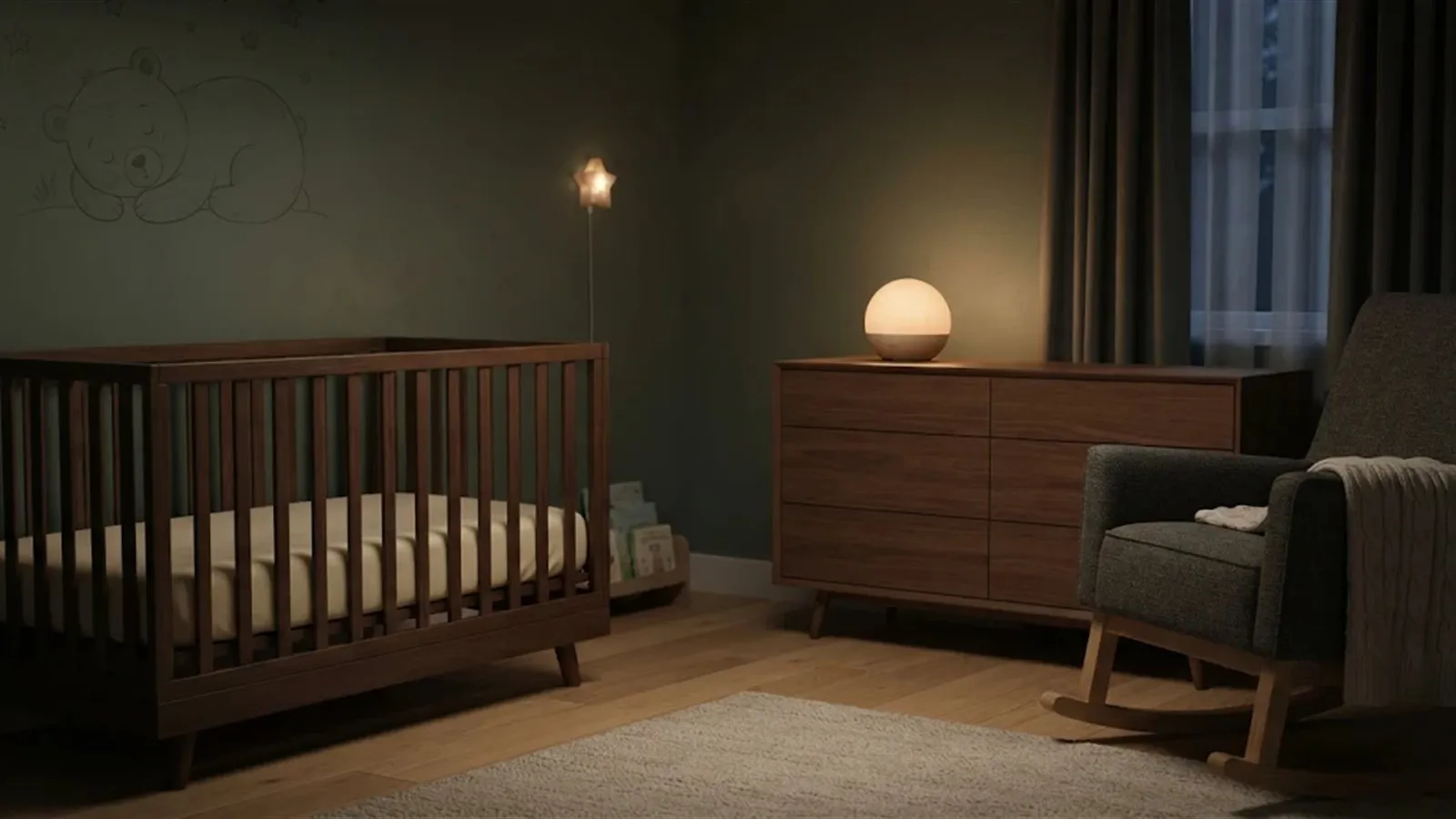
In this guide
- At a glance
- Is the Hatch Rest 2nd Gen still sold?
- What the Rest 2nd Gen does
- The Hatch Sleep app
- Hatch+ subscription: what's free and what isn't
- Safe volume and placement
- Night light color
- Safe-sleep reminders
- Hatch Rest 2nd Gen
- The current alternative: Hatch Baby
- Who should buy it
- How we researched this
- Sources
- Questions parents ask
Reader-supported: SproutPicks may earn a commission from qualifying affiliate links, at no extra cost to you. Full disclosure.
The Hatch Rest 2nd Gen became one of the best-known nursery gadgets because it combines three things parents usually buy separately: a sound machine, a color night light and an "OK to wake" clock for toddlers, all controlled from a phone. It's a good design. The catch, as of November 2026, is that Hatch has stopped making and selling it. Hatch's help center says it no longer manufactures or sells the Rest 2nd gen and points shoppers to a newer model, Hatch Baby, instead. Below we review what the Rest 2nd Gen does, how the app and the Hatch+ subscription work, how to use any sound machine at a safe volume, which light color to pick, and whether to buy leftover stock or the newer model.
At a glance
Hatch Rest 2nd Gen
How we score: SproutPicks Scores are our own editorial ratings out of 10. For sound machines they weigh sleep-relevant features (sound quality and range, night light control, toddler cues), ease of use at night, safety-relevant settings such as low volume and dim light, ongoing costs and availability. They are based on Hatch's information, retailer listings, expert reviews and owner-review patterns. They are not Amazon ratings, and we did not test the Rest 2nd Gen ourselves.
Is the Hatch Rest 2nd Gen still sold?
Is the Hatch Rest 2nd Gen discontinued? Yes. Hatch's help center says it no longer manufactures or sells the Rest 2nd gen and recommends Hatch Baby instead. You may still find leftover new stock at some retailers, but check the seller, the price and the return policy before you buy.
Hatch's old Rest product address now opens the Hatch Baby page, which listed Hatch Baby at $79.99 in November 2026. The Rest 2nd Gen launched in 2022 at a $69.99 list price, and the battery-backed Rest+ 2nd Gen sold for about $89.99. Hatch has also stopped selling the Rest+ 2nd Gen. If you see a Rest 2nd Gen for more than the price of a new Hatch Baby, buy the newer model.
One more thing to know if you're buying secondhand: in July 2024, CPSC announced a recall of about 919,400 power adapters sold with the Rest 1st Generation, because the adapter housing can come off and expose the prongs. CPSC says Rest 2nd Generation sound machines are not affected. The 1st Gen has no clock display, which is an easy way to tell the two apart, so check which model you're getting.
What the Rest 2nd Gen does
- Sound machine. Hatch and retailer listings describe a built-in library of around 18 to 19 sounds, including white noise, ocean, rain, wind, water, birdsong, a heartbeat and a dryer, plus a few lullabies. You set volume in the app or with the device buttons.
- Night light. You can pick preset colors or any color from the app's color wheel, and set brightness. A rainbow color-changing mode is included.
- Time-to-Rise and Time-for-Bed. You schedule a light color that tells a toddler when it's time to stay in bed and when it's OK to get up. This is the feature that keeps the Rest useful long after the newborn months.
- Clock. The 2nd Gen added a dimmable clock display that the 1st Gen lacked.
- Favorites ring. A touch ring on top starts your saved sound and light combination, which helps at 3 a.m. when you don't want to open an app. Other controls are hidden buttons on the back.
- Size and power. Hatch lists it at about 4 by 4 by 6.25 inches and 13 ounces. It plugs into the wall and has no battery.
Does the Hatch Rest 2nd Gen have a battery? No. The Rest 2nd Gen has to stay plugged in. The Rest+ 2nd Gen added a backup battery, but Hatch has also stopped selling that model, and the current Hatch Baby has no battery either. For trips or power cuts, a portable machine such as Hatch Go is the usual answer.
The Hatch Sleep app
The Rest 2nd Gen connects to Wi-Fi and is set up and controlled with the free Hatch Sleep app for iPhone and Android. From the app you can change the sound, light and volume from another room, build routines that switch everything on at bedtime, and set Time-to-Rise schedules. Without Wi-Fi you're limited to the device buttons and your saved favorite. Owner reviews often mention setup friction with home networks, and some parents dislike relying on a phone for a nursery device. If you'd rather have no app at all, a fan-based machine is simpler. Our Yogasleep Dohm vs Hatch Rest comparison covers that trade-off.
Hatch+ subscription: what's free and what isn't
Hatch+ is Hatch's paid membership. On the Rest 2nd Gen it adds a larger content library, which Hatch describes as curated channels of music, stories, soundscapes and guided rest. New devices came with a free trial, and after the trial Hatch+ renews automatically unless you cancel through the App Store, Google Play or Hatch.
Do you need Hatch+ to use the Hatch Rest 2nd Gen? No. The built-in sounds, night light colors, brightness, volume and Time-to-Rise schedules work through the free Hatch Sleep app. Hatch+ is an optional membership for extra content such as stories, music and guided sleep material. Apple's App Store lists Hatch+ plans at $4.99 a month or $49.99 a year.
The newer Hatch Baby leans harder on the subscription. Hatch's listing includes three months of its premium subscription with the device, which Babylist describes as adding stories and songs, predictive sleep schedules and 1:1 chat with certified sleep consultants. Budget for that, or set a reminder to cancel before the included period ends.
Safe volume and placement
Any sound machine can be loud enough to matter for a baby's hearing, and the Rest is no exception at its top settings. The guidance comes from the American Academy of Pediatrics (AAP) and research it published:
- The 50 dB figure. A 2014 study in Pediatrics, the AAP's journal, measured 14 infant sleep machines at maximum volume. At 30 cm (about a foot, like a crib rail), every one exceeded 50 dBA, the recommended noise limit for infants in hospital nurseries, and three exceeded 85 dBA. The authors advised placing machines as far from the infant as possible, never in the crib or on the rail, and keeping the volume low.
- AAP advice for families. The AAP's HealthyChildren.org says to place a sleep machine as far from the baby's head as possible and use it for a short time only, noting that some machines can produce hazardous noise levels. The AAP's 2023 policy statement on noise adds setting the volume as low as possible.
How loud should a sound machine be for a baby? Keep it low. Research in Pediatrics found that all 14 infant sleep machines tested at maximum volume exceeded 50 dBA, the recommended noise limit for hospital nurseries, when measured 30 cm away. The AAP advises placing a sleep machine as far from the baby's head as possible, using the lowest volume that works and limiting how long it runs.
In practice: put the Rest on a dresser across the room, not on the crib rail; start at a low setting; and, if you want a number, use a free sound-meter app held where your baby's head lies, aiming for 50 dB or less. Many families also use a sleep timer rather than running sound all night. Our guide to the best white noise machines for babies covers more models and placement tips.
Night light color
What night light color is best for baby sleep? A dim red or amber light. A Cleveland Clinic sleep expert says red light is best at bedtime because it doesn't disrupt melatonin, and suggests orange or amber for children who find red scary. Avoid bright white and blue light at night, and keep any light on the lowest setting.
The Rest makes this easy, because you can set both the color and the brightness. A dim warm glow is enough for night feeds and diaper changes. For a toddler's Time-to-Rise cue, many parents pick red or amber for "stay in bed" and green for "OK to get up", with the morning color set dim enough not to wake the child early.
Safe-sleep reminders
- Keep the machine and its cord out of reach of the crib. Cords are a strangulation hazard.
- Don't put a sound machine, or anything else, inside the crib. The AAP's safe-sleep advice is a bare crib with a fitted sheet.
- A sound machine doesn't replace the basics: baby on the back, on a firm, flat surface.
Hatch Rest 2nd Gen
On features alone, the Rest 2nd Gen would score higher. It does sound, a fully adjustable night light and toddler wake cues in one small unit, with a free app that covers everything most families need. We've marked it down because Hatch no longer makes or sells it, so new units are leftover stock with uncertain support and returns, it has no battery, and it depends on Wi-Fi for its best features. If you find a new one from a reputable seller for less than the $79.99 Hatch Baby, it's still a sensible buy. Otherwise, the newer Hatch Baby is the version Hatch supports today.
- ✓Sound machine, night light and Time-to-Rise clock in one
- ✓Any light color and brightness, set from another room
- ✓Core features work without Hatch+
- ✓Stays useful from newborn to preschool
- ✕Discontinued by Hatch; only leftover stock remains
- ✕No battery backup
- ✕Best features need Wi-Fi and the app
- ✕Hatch+ upsells in the app
The current alternative: Hatch Baby
Hatch Baby is the model Hatch now sells in its place. Hatch listed it at $79.99 with three months of its subscription, a 30-night trial and a one-year warranty, in Putty, Beechwood, Mint, Peach and Greige. Babylist lists it at 4.5 by 4.5 by 6.5 inches and 1.1 pounds, with sounds, a night light, a big top button, Time-for-Bed and Time-to-Rise cues, and app control over 2.4 GHz Wi-Fi with Bluetooth backup. Owners report that, like the Rest 2nd Gen, it has no battery and turns off in a power cut. Hatch also sells it in a bundle with the portable Hatch Go.
Who should buy it
- Buy a Rest 2nd Gen if you find it new, from a reputable seller, for less than a Hatch Baby, and you're happy using the free app.
- Buy Hatch Baby if you want the model Hatch currently sells and supports, or you'd use the included sleep-consultant features.
- Buy a fan-based machine if you only need steady white noise and don't want an app or a light.
More on sound machines and nursery setup: see Cloud b Sleep Sheep Review: Plush Sound Soother with Timer and Baby Shusher Review: Portable Shushing Sound Soother.
Also useful: a cool-mist humidifier for the nursery.
Part of our Sleep & Nursery section. Our main guide covers bedside bassinets.
How we researched this
This review is research-based. We did not test the Hatch Rest 2nd Gen ourselves. In November 2026 we checked Hatch's website and help center (which says the Rest 2nd gen is no longer sold), Hatch's indexed Rest 2nd Gen specs, retailer and expert listings from Babylist and Hip2Save, the Hatch Sleep app's App Store listing for Hatch+ prices, and CPSC's 2024 recall notice. Hatch's help center blocked our automated page reads, so its wording comes from Hatch's indexed help articles, and we say so. For volume and light, we read the AAP's HealthyChildren.org noise guidance, the AAP's 2023 noise policy statement, the 2014 Pediatrics study on infant sleep machines and a 2025 Cleveland Clinic article on night lights. Prices change often.
Sources
- Hatch help center, Do you still sell Rest 2nd gen?
- Hatch help center, Rest 2nd gen overview
- Hatch, Hatch Baby
- Babylist, Hatch Baby Sound Machine
- Hip2Save, Hatch Rest 2nd Gen review (2022)
- Apple App Store, Hatch Sleep
- CPSC, Hatch Baby recalls power adapters sold with Rest 1st Generation sound machines
- AAP / HealthyChildren.org, How Noise Affects Children
- AAP policy statement, Preventing Excessive Noise Exposure in Infants, Children, and Adolescents (2023)
- Hugh SC et al., Infant Sleep Machines and Hazardous Sound Pressure Levels, Pediatrics (2014)
- Cleveland Clinic, Can a nightlight impact your child's sleep?
Questions parents ask
Is the Hatch Rest 2nd Gen discontinued?
Yes. Hatch's help center says it no longer manufactures or sells the Rest 2nd gen and recommends Hatch Baby instead. You may still find leftover new stock at some retailers, but check the seller, the price and the return policy before you buy.
Do you need Hatch+ to use the Hatch Rest 2nd Gen?
No. The built-in sounds, night light colors, brightness, volume and Time-to-Rise schedules work through the free Hatch Sleep app. Hatch+ is an optional membership for extra content such as stories, music and guided sleep material. Apple's App Store lists Hatch+ plans at $4.99 a month or $49.99 a year.
How loud should a sound machine be for a baby?
Keep it low. Research in Pediatrics found that all 14 infant sleep machines tested at maximum volume exceeded 50 dBA, the recommended noise limit for hospital nurseries, when measured 30 cm away. The AAP advises placing a sleep machine as far from the baby's head as possible, using the lowest volume that works and limiting how long it runs.
What night light color is best for baby sleep?
A dim red or amber light. A Cleveland Clinic sleep expert says red light is best at bedtime because it doesn't disrupt melatonin, and suggests orange or amber for children who find red scary. Avoid bright white and blue light at night, and keep any light on the lowest setting.
Does the Hatch Rest 2nd Gen have a battery?
No. The Rest 2nd Gen has to stay plugged in. The Rest+ 2nd Gen added a backup battery, but Hatch has also stopped selling that model, and the current Hatch Baby has no battery either. For trips or power cuts, a portable machine such as Hatch Go is the usual answer.
More in Sleep & Nursery
Diaper Genie Classic Review: Refill-Bag Diaper Pail
Diaper Genie Classic review: a refill-bag diaper pail. Capacity, odor control and the real cost of refills over time. Research-based, not…
SlumberPod Review: Blackout Sleep Tent for Playards
SlumberPod review: a blackout sleep tent for playards. Fit, age limits, airflow guidance and travel use. Research-based, not tested.
Ubbi Steel Diaper Pail Review: Regular Bags, Odor and Capacity
Ubbi steel diaper pail review: uses regular trash bags. Odor control, capacity and long-term value. Research-based, not tested.