
In this guide
- Quick picks
- Kids' headphones side by side
- What WHO and the AAP say about safe listening
- Why an 85 dB cap isn't a guarantee
- Puro Sound Labs BT2200-Plus
- JLab JBuddies Studio 2 Wireless
- Puro Sound Labs PuroQuiet Plus
- BuddyPhones Cosmos+
- BuddyPhones Explore+
- How to choose kids' headphones
- Our guides on kids' headphones and hearing
- How we researched this
- Sources
- Questions parents ask
Reader-supported: SproutPicks may earn a commission from qualifying affiliate links, at no extra cost to you. Full disclosure.
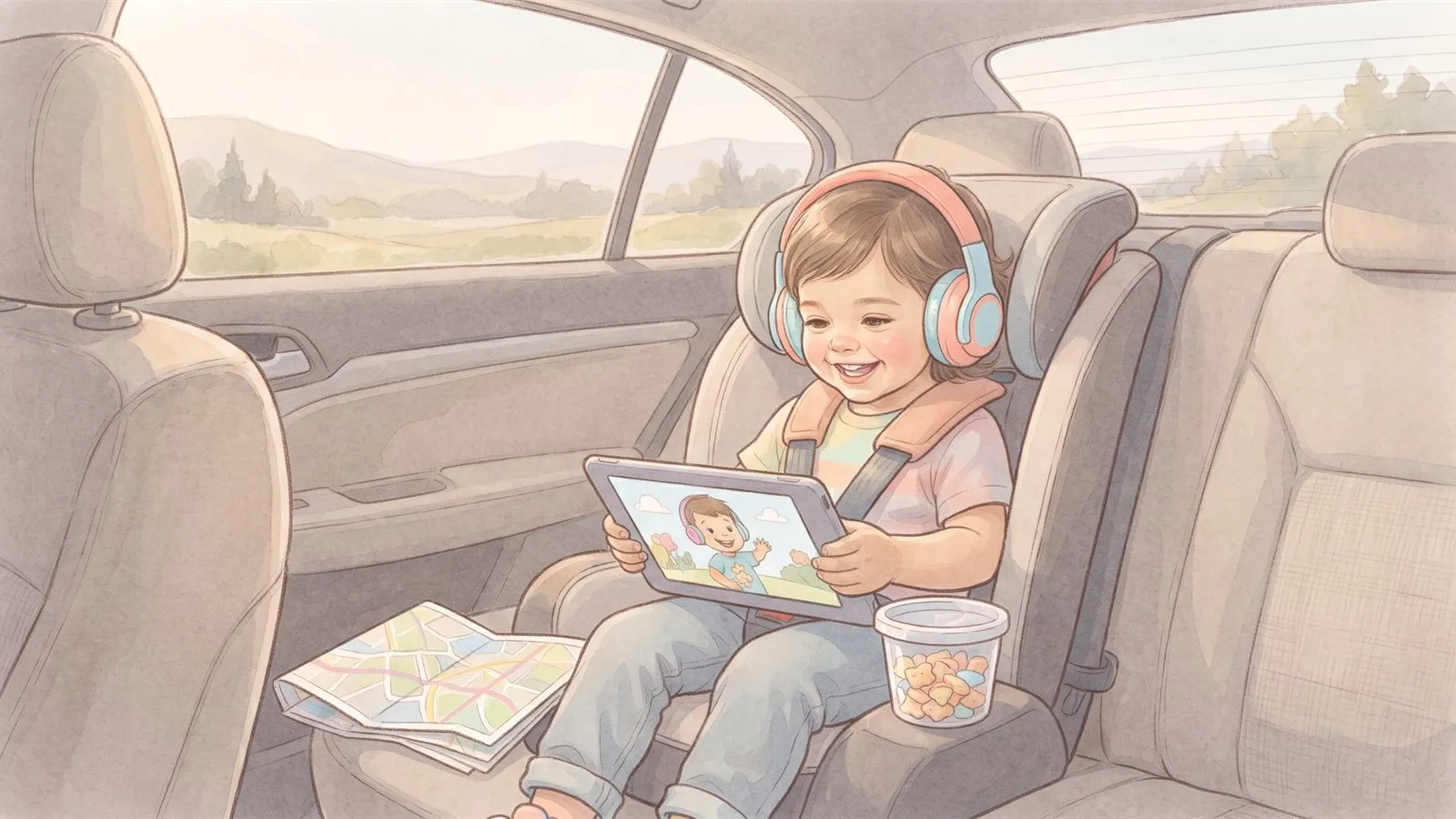
The best kids' headphones do two jobs: they let your child watch a movie on a long drive or flight, and they cap the volume so a child can't crank it to a level that harms their hearing. Most volume-limited kids' headphones advertise an 85 dB limit, and a few add a quieter 75 dB setting for younger children. Those caps help, but they aren't perfect. Some can be switched to a louder mode, some can be bypassed with a different cable, and independent testing has found real output above the number on the box. Below are five volume-limited headphones sold in the US in November 2026, compared on their limits, battery, noise canceling and price, plus what the World Health Organization (WHO) and the American Academy of Pediatrics (AAP) say about safe listening.
Quick picks
Puro Sound Labs BT2200-Plus
JLab JBuddies Studio 2 Wireless
Puro Sound Labs PuroQuiet Plus
BuddyPhones Cosmos+
BuddyPhones Explore+
How we score: SproutPicks Scores are our own editorial ratings out of 10. For kids' headphones they weigh the volume-limiting design (how low the cap is, whether a child can switch it off, and how clearly the maker explains it), published independent measurements where they exist, battery life and wired backup, noise isolation, build and value. They are based on maker and retailer specifications, published reviews, WHO and AAP guidance and patterns in owner reviews. They are editorial ratings from research, not lab tests, and we did not test or measure these headphones.
Kids' headphones side by side
| Headphones | Volume limit (maker's spec) | Connection | Noise canceling | Typical price (Nov 2026) |
|---|---|---|---|---|
| Puro BT2200-Plus | 85 dB | Bluetooth, plus 3.5 mm limiting cable | No (passive only) | About $80 to $100 |
| JLab JBuddies Studio 2 Wireless | 85 dB default, 95 dB switch | Bluetooth, plus USB-C wired | No | About $20 to $30 |
| Puro PuroQuiet Plus | 85 dB | Bluetooth and wired | Yes | About $120 to $140 |
| BuddyPhones Cosmos+ | 75, 85 or 94 dB modes | Bluetooth and 3.5 mm | Yes | About $100 to $120 list |
| BuddyPhones Explore+ | 85 dB | 3.5 mm wired only | No | About $20 to $30 |
Specs are the makers' own figures as reported on their pages, retailer listings and published reviews. Prices change often, and every brand here runs frequent sales.
What WHO and the AAP say about safe listening
Hearing damage from noise depends on two things: how loud the sound is and how long it lasts. The National Institute on Deafness and Other Communication Disorders (NIDCD) says long or repeated exposure to sounds at or above 85 dBA can cause hearing loss, and it lists music through headphones at maximum volume among sounds in the 94 to 110 dBA range. That's why 85 dB became the default cap for kids' headphones.
The WHO and the International Telecommunication Union (ITU) went further in their 2019 safe listening standard for personal audio devices, known as H.870. Instead of a single cap, it measures a weekly sound dose. Its standard mode allows a dose equal to 80 dB for 40 hours a week, and a stricter mode for sensitive listeners, such as children, allows 75 dB for 40 hours a week. The standard also calls for automatic volume reduction when someone has listened loudly for too long, and for parental volume controls that can be locked.
What decibel level is safe for kids' headphones? There's no single safe number, because risk depends on level and time together. Most kids' headphones cap at 85 dB, a common reference point for long exposure. The WHO-ITU safe listening standard is stricter for sensitive listeners such as children: it allows a weekly dose equal to 75 dB for 40 hours a week.
The AAP's 2023 policy statement on noise warned that noise-induced hearing loss in children is permanent but preventable. How long can kids safely wear headphones? It depends on the volume. HealthyChildren.org advises keeping devices at half volume or lower and taking a break about every hour. Many families use a 60/60 rule of thumb: no more than about 60 percent volume for about 60 minutes at a time.
Why an 85 dB cap isn't a guarantee
Are volume-limited headphones safe for kids? They're safer than regular headphones, but they aren't a guarantee. A cap limits how loud the headphones are meant to get, yet real output can run higher with some devices, cables and recordings, and how long a child listens matters as much as how loud. Pair the cap with lower device volume and regular breaks.
Independent testing shows why. Headphones Addict measured the Puro BT2200-Plus on a calibrated test rig and reported white noise reaching about 100 dB over Bluetooth, 15 dB above the 85 dB target, while music peaked around 89 dB. With the included limiting cable, readings stayed close to 85 dB on a laptop but rose to about 95 dB with a high-output digital-to-analog converter. With a third-party cable that skips the built-in limiter, readings ran from about 96 to 112 dB. These are one reviewer's measurements of one model, but they show that the number on the box depends on the source, the signal and the cable.
Can kids bypass volume-limiting headphones? Sometimes. Some models have a louder setting a child can switch on, such as JLab's 95 dB mode, and swapping the included cable for an ordinary audio cable can skip a limiter built into the cable. Device volume settings and parental controls add a second layer of protection.
In practice, that means:
- Keep the included cable. If a pair limits volume through its cable, a replacement cable from the junk drawer may not.
- Check the louder modes. JLab's 95 dB switch and BuddyPhones' 94 dB travel mode are meant for noisy places, not everyday use. Set the lower mode and check it now and then.
- Set the device limit too. iPhones, iPads and Android devices have headphone volume limits in their settings or parental controls. Use them alongside the headphones' cap.
- Do the arm's-length check. If you can hear the audio from an arm's length away, it's too loud.
- Cut background noise. Kids turn the volume up to drown out engines. Noise canceling or a better seal reduces that urge.
We compared the two best-known picks in depth in our JLab JBuddies vs Puro BT2200-Plus comparison.
Puro Sound Labs BT2200-Plus
The BT2200-Plus is the pair many parents start with because it has one fixed 85 dB limit, with no louder setting for a child to find. Puro includes a volume-limited 3.5 mm cable for plane seat-back screens, plus on-ear and over-ear cushions so you can trade a smaller fit for a better seal. Puro lists up to 20 hours of playback. Published reviews describe metal parts in the frame, which helps with kids who drop things. As noted above, independent measurements found it can exceed 85 dB with some signals and with a third-party cable, so keep the original cable and watch device volume. It sold for about $80 to $100 in November 2026. Our Puro BT2200-Plus review has more detail.
- ✓Single 85 dB limit, per Puro
- ✓Volume-limited 3.5 mm cable included
- ✓Two cushion styles in the box
- ✕Independent tests measured peaks above 85 dB
- ✕Shorter battery than the JLab
- ✕No active noise canceling
JLab JBuddies Studio 2 Wireless
For about $20 to $30, the JBuddies Studio 2 Wireless delivers a lot: an 85 dB default limit, more than 65 hours of wireless playtime per JLab, USB-C charging and wired listening, a microphone and a Share Mode that lets two JLab headsets play from one device. The catch is a switch that raises the limit to 95 dB for noisy places. That's useful on a loud bus, but it's also easy for a child to flip, so check it. Wired mode uses USB-C rather than a standard headphone jack, so you may need an adapter for a plane screen. JLab recommends it for ages 6 and up. Our JLab JBuddies Studio 2 review goes deeper.
- ✓Low price
- ✓Very long battery life, per JLab
- ✓Share Mode for siblings
- ✕95 dB setting a child can switch on
- ✕Wired mode needs USB-C
- ✕On-ear fit lets in more noise
Puro Sound Labs PuroQuiet Plus
The PuroQuiet Plus is Puro's noise-canceling model, and it's the pick for long flights. Reviews and retailer listings describe an 85 dB limit and active noise canceling that cuts ambient noise by about 22 dB, which matters because a quieter background means a child is less tempted to push the volume up. One review lists the battery at about 35 hours with noise canceling off and 23 hours with it on. Prices we found ranged from about $120 to $140, and listings don't always agree, so check the current price.
- ✓Active noise canceling
- ✓85 dB limit, per listings
- ✓Long battery life, per reviews
- ✕Most expensive pick here
- ✕Specs vary between listings
- ✕No independent volume measurements we could find
BuddyPhones Cosmos+
The Cosmos+ from Onanoff's BuddyPhones line is one of the few kids' headphones with a 75 dB setting, which lines up with the WHO-ITU level for sensitive listeners. Android Central's review lists three modes: 75 dB for toddlers, 85 dB for kids and 94 dB for travel. It adds active noise canceling, a boom microphone, Bluetooth and a 3.5 mm cable, with up to 24 hours of battery listed. The trade-off is that changing modes takes a button combination with no clear indicator of the current level, so it's easy to lose track. It launched at $99.99, and listings we saw ran up to about $120; we couldn't confirm a current US price on BuddyPhones' site.
- ✓75 dB mode for younger children
- ✓Active noise canceling
- ✓Wired and wireless
- ✕94 dB travel mode is louder than most
- ✕No clear indicator of the current mode
- ✕Current US price hard to pin down
BuddyPhones Explore+
The Explore+ is a simple, foldable wired pair with a fixed 85 dB limit and no battery to charge. Its cable has a built-in sharing port, so a second pair can plug in for two kids watching one tablet. It launched at $29.99, and listings in 2026 showed it around $25. Because it's wired only, it works with any device that has a headphone jack or adapter and with most plane seat-back screens. There's no noise canceling, so it's better for quiet car rides and school than for a loud cabin.
- ✓Fixed 85 dB limit, per BuddyPhones
- ✓No charging needed
- ✓Sharing port in the cable
- ✕Wired only
- ✕No noise canceling
- ✕Basic sound and build
How to choose kids' headphones
- Look at the lowest setting, not just the headline number. A 75 dB mode is gentler for preschoolers. A switchable 94 or 95 dB mode is louder than the WHO guidance for children.
- Match the connection to your trips. Planes often need a 3.5 mm cable. Bluetooth is easier in the car.
- Think about noise. On flights, noise canceling helps a child hear at lower volume.
- Check the fit. On-ear cushions are small and cool. Over-ear cushions seal better but can feel warm.
- Plan the tablet setup. Our best car headrest tablet holders guide covers mounts.
For fireworks, races and other loud events, kids need hearing protection, not audio headphones. See our BANZ kids' earmuffs review.
Our guides on kids' headphones and hearing
- JLab JBuddies Studio 2 vs Puro BT2200-Plus Kids' Headphones
- JLab JBuddies Studio 2 Review: Budget Volume-Limited Headphones
- Puro BT2200-Plus Review: 85 dB Kids Headphones for Travel
- BANZ Kids Earmuffs Review: Fireworks, Concerts and Fit
Part of our Car & Road-Trip Gear section. Our main guide covers road-trip gear for kids.
How we researched this
This guide is research-based. We did not test or measure these headphones. In November 2026 we read the WHO-ITU H.870 safe listening standard and WHO's announcement of it, the NIDCD's page on noise-induced hearing loss, the AAP's 2023 noise policy announcement and HealthyChildren.org's hearing tips. For products, we used maker pages and retailer listings for JLab and Puro, Android Central's review of the BuddyPhones+ line for its volume modes, and published reviews for PuroQuiet Plus battery figures. Independent volume measurements come from Headphones Addict's review of the BT2200-Plus; we didn't find comparable published measurements for the other picks. Several maker sites limited our automated access, so some details and prices come from retailer listings, and we note where they disagree. Prices change often.
Sources
- WHO, Safe listening devices and systems: a WHO-ITU standard
- WHO, New WHO-ITU standard aims to prevent hearing loss among 1.1 billion young people (2019)
- NIDCD, Noise-Induced Hearing Loss
- AAP, Sounds the alarm on excessive noise and risks to children's hearing (2023)
- HealthyChildren.org (AAP), Tips to preserve your child's hearing
- Headphones Addict, Puro Sound Labs BT2200-Plus review (volume measurements)
- Puro Sound Labs, BT2200-Plus
- JLab, JBuddies Studio 2 Wireless
- Android Central, BuddyPhones+ review (Explore+, Play+, Cosmos+)
- Future Audiophile, PuroQuiet Plus review
Questions parents ask
Are volume-limited headphones safe for kids?
They're safer than regular headphones, but they aren't a guarantee. A cap limits how loud the headphones are meant to get, yet real output can run higher with some devices, cables and recordings, and how long a child listens matters as much as how loud. Pair the cap with lower device volume and regular breaks.
What decibel level is safe for kids' headphones?
There's no single safe number, because risk depends on level and time together. Most kids' headphones cap at 85 dB, a common reference point for long exposure. The WHO-ITU safe listening standard is stricter for sensitive listeners such as children: it allows a weekly dose equal to 75 dB for 40 hours a week.
Can kids bypass volume-limiting headphones?
Sometimes. Some models have a louder setting a child can switch on, such as JLab's 95 dB mode, and swapping the included cable for an ordinary audio cable can skip a limiter built into the cable. Device volume settings and parental controls add a second layer of protection.
How long can kids safely wear headphones?
It depends on the volume. HealthyChildren.org advises keeping devices at half volume or lower and taking a break about every hour. Many families use a 60/60 rule of thumb: no more than about 60 percent volume for about 60 minutes at a time.
More in Car & Road-Trip Gear
How Long Can a Baby Stay in a Car Seat? The 2-Hour Rule
Where the 2-hour car seat rule comes from, what the AAP and Lullaby Trust say about breaks, why car seats aren't for sleep, and long-drive…
Holiday Travel with a Baby: Planes, Trains and Long Drives
Holiday travel with a baby by car, plane or train: AAP winter coat and drive-break advice, FAA car seat rules, TSA baby liquids, Amtrak…
Best Winter Car Seat Covers (Shower-Cap Style)
Shower-cap winter covers that go over an infant car seat, never behind baby or under the harness, plus AAP and NHTSA rules on coats and…