
In this guide
- Why puffy coats and harnesses don't mix
- The coat test: check any coat at home
- Harness fit basics
- How to keep kids warm without the puffy coat
- Babies in infant car seats
- Car seat covers, bundle bags and other add-ons
- Toddlers, big kids and boosters
- A winter morning routine that works
- Read the manuals and get your seat checked
- How we researched this
- Sources
- Questions parents ask
Reader-supported: SproutPicks may earn a commission from qualifying affiliate links, at no extra cost to you. Full disclosure.
Every winter, pediatricians and child passenger safety technicians repeat the same message: take off the puffy coat before you buckle your child into the car seat. It sounds like a small thing, and on a freezing morning it can feel like a bad idea. But a thick coat can hide a loose harness, and a loose harness can fail in a crash. This guide explains the puffy coat rule in plain language, shows you a quick test to check any coat at home, and walks through warm alternatives recommended by the American Academy of Pediatrics (AAP) and the National Highway Traffic Safety Administration (NHTSA). It's general guidance, not a substitute for your car seat and vehicle manuals, and if you're unsure about your setup, a certified child passenger safety technician (CPST) can check it for free in most areas.
Why puffy coats and harnesses don't mix
Why can't my child wear a puffy coat in a car seat? In a crash, the air and padding in a puffy coat squash flat, which leaves the harness loose. The AAP warns that a child can then slip through the straps and be thrown from the seat. A harness that felt snug over the coat may not be snug at all.
A car seat harness works by holding your child firmly against the seat so the seat's shell and padding absorb crash forces. That only works if the straps are snug against your child's body. A winter coat, snowsuit or puffy bunting is mostly trapped air. When you tighten the harness over it, the straps press against the coat, not your child. In a crash, crash forces compress that padding almost instantly. The AAP puts it this way on HealthyChildren.org: the padding "immediately flattens out from the force." The gap that's left is slack in the harness, and slack lets a child move much farther forward than the seat was designed for.
NHTSA makes the same point: too much bulk creates extra room in the harness, which can lead to a loose fit and a higher risk of injury. The AAP's short version is that nothing bulky should go underneath your child or between their body and the harness straps.
The coat test: check any coat at home
How do I know if a coat is too puffy for the car seat? Do the coat test. Buckle your child in wearing the coat and tighten the harness until it passes the pinch test. Take your child out without loosening the straps, remove the coat and buckle them back in. If you can now pinch extra webbing at the shoulder, the coat is too bulky to wear under the harness.
Step by step:
- Buckle up with the coat on. Put your child in the seat wearing the coat, buckle the harness and chest clip, and pull the harness tight.
- Do the pinch test. Try to pinch a horizontal fold in the harness strap at your child's shoulder, around collarbone level. NHTSA says the harness is snug enough when you can't pinch any extra material. Tighten until you can't.
- Unbuckle without loosening. Undo the buckle and chest clip, but don't loosen the harness. Lift your child out.
- Take the coat off and rebuckle. Put your child back in without the coat and buckle the harness at the same setting.
- Pinch again. If you can now pinch slack at the shoulder, the coat added bulk under the straps, and it shouldn't be worn under the harness.
Safe Kids Worldwide describes the same idea in reverse for a coat that passes: adjust the harness with the coat off using the pinch test, then put the coat back on and rebuckle without changing the setting. If the harness still buckles and lies flat, the coat is thin enough. If you have to loosen the straps to buckle it, the coat is too bulky.
Do this test once per coat, at home, before the cold snap. It takes two minutes and saves you guessing in a dark parking lot.
Harness fit basics
A coat-free child still needs a well-fitted harness. Follow your car seat manual for your seat's exact rules, but the general checks from NHTSA and the AAP are:
- Snug at the shoulder. The harness passes the pinch test at the collarbone every ride.
- Chest clip at armpit level. The chest clip holds the straps in place on the shoulders. Too low and the straps can slide off.
- Harness height. For rear-facing seats, the straps usually come from slots at or below your child's shoulders. For forward-facing seats, they usually come from at or above the shoulders. Your manual has the final word.
- Snug installation. The seat itself shouldn't move more than an inch side to side or front to back at the belt path, per NHTSA.
Retighten the harness every time you buckle up in winter. Kids wear different layers from day to day, and a setting that was right over a sweater on Monday may be loose over a T-shirt on Tuesday.
How to keep kids warm without the puffy coat
The good news is that you don't have to choose between warm and safe. The AAP and NHTSA suggest these approaches:
- Thin, close-fitting layers. The AAP suggests starting with tight-fitting layers such as leggings, tights or a long-sleeved bodysuit, then pants and a warmer top, and a thin fleece jacket if it's very cold. Long underwear is a good base layer in deep cold.
- One more layer for babies. The AAP says babies generally need one more layer than an adult would wear in the same conditions.
- Hats, mittens and socks. These keep kids warm without touching the harness. For a thumb-sucker, the AAP suggests half-gloves with open fingers, or a spare pair of mittens, since wet mittens make hands colder.
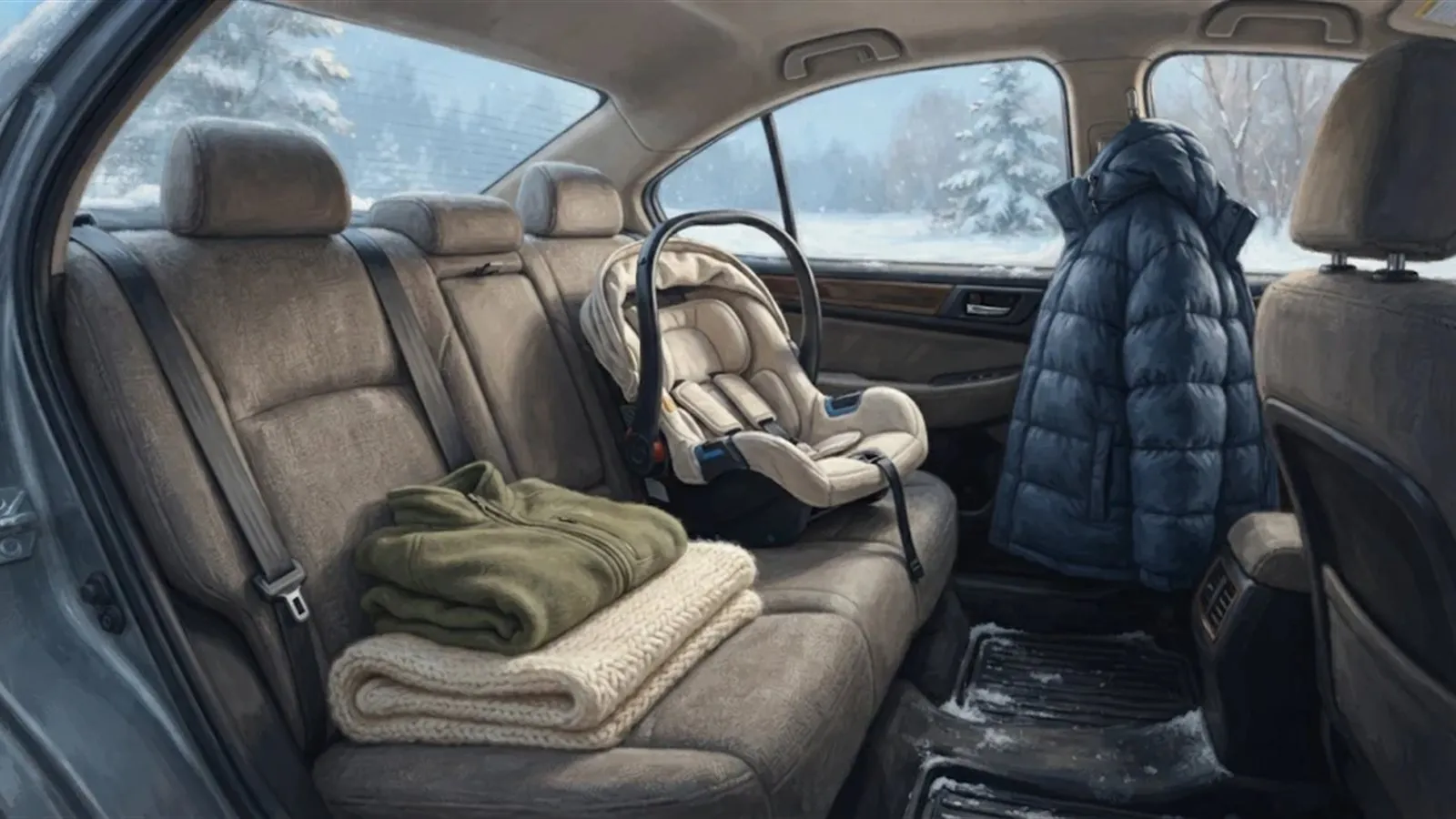
- Coat or blanket over the straps. Buckle your child in first, then lay a blanket over them or put their coat on backwards over the buckled harness, with their arms through the sleeves. NHTSA recommends the same order: buckle first, then add coats or blankets over the harness.
- Car seat ponchos. The AAP mentions poncho-style coats, which drape over the harness, and jackets that unzip at the sides. The poncho should lie on top of the harness, not under it, and you should still do the pinch test underneath it.
Are thin fleece jackets OK in a car seat? Usually, yes. NHTSA suggests thin, lightweight fleece layers instead of puffy materials. Thick fleece can still add too much bulk, so check any jacket with the coat test, and follow your car seat manual.
Once the car warms up, take off the top blanket or coat so your child doesn't overheat. The AAP points out that the outer layer should be easy to remove for exactly this reason.
Babies in infant car seats
Babies are the hardest to keep warm and the easiest to bundle too much. A few habits help:
- Keep the carrier indoors. The AAP suggests storing the carrier part of an infant seat inside the house between trips. A room-temperature seat pulls less heat from your baby than one that sat in a cold car overnight.
- Dress in a thin layer, then cover. Dress your baby in a bodysuit and footed pajamas or thin fleece, buckle them in snugly, then put a blanket over the buckled harness. Remove the blanket once you're inside or the car is warm.
- Keep the face clear. Never drape a blanket over the top of the carrier to block wind. It can trap warm air and reduce airflow around your baby's face.
- Skip the snowsuit in the seat. A snowsuit or bunting bag that goes under the harness has the same problem as a puffy coat.
Car seats are for travel, not routine sleep. The AAP advises moving a baby who falls asleep in a car seat to a firm, flat sleep surface once you arrive. For seat choices, see our guide to the best infant car seats and our Chicco KeyFit 35 review.
Car seat covers, bundle bags and other add-ons
Are car seat covers and bundle bags safe? Only some. Anything that goes behind or under your baby, or between your baby and the harness straps, hasn't been crash tested with your seat unless it came with it or your car seat maker approves it. A cover that stretches over the top of the seat like a shower cap, with your baby's face uncovered, doesn't interfere with the harness, but check your car seat manual first.
The AAP is direct about this: if an item didn't come with the car seat, it hasn't been crash tested with it, and it may make the seat less protective. That includes thick inserts, bunting bags with slots for the harness to pass through, and stroller accessories. Stroller footmuffs are a good example. They're great on a stroller walk, and our guide to the best stroller footmuffs covers them, but don't use one in a car seat unless your car seat maker says that specific product is approved for your seat.
Some car seat makers sell their own winter covers or inserts that have been tested with particular seats. If you want one, check your manual or the maker's website for accessories approved for your exact model, and use it only as the instructions describe.
Toddlers, big kids and boosters
Does the puffy coat rule apply to booster seats? Yes. The AAP notes that a puffy coat adds space between the body and the seat belt, even for adults, and the same logic applies to kids in boosters. Have older kids take off bulky coats so the lap belt sits low on the hips and the shoulder belt lies flat across the chest.
Older kids can usually manage this themselves with a routine: coat off at the car door, toss it on the seat, buckle up, then use the coat as a blanket over the belt. In a belt-positioning booster, a thick coat can also push the lap belt up onto the soft belly, where it doesn't belong. Our Chicco KidFit review explains good booster belt fit.
For forward-facing toddlers in a harnessed seat, the same coat test applies. Our best convertible car seats guide covers seats that keep kids harnessed longer.
A winter morning routine that works
- Start the car first, if it's safe to do so. Never run a car in a closed garage, and clear snow away from the tailpipe.
- Dress in thin layers indoors. Hat and mittens on, puffy coat off or carried.
- Bring the infant carrier from indoors.
- Buckle, tighten and pinch test. Chest clip at armpit level.
- Cover up. Coat on backwards, a poncho over the harness or a blanket over the straps.
- Uncover when it's warm. Take off the top layer once the car heats up.
The AAP also recommends leaving earlier on winter mornings, since getting kids and gear ready takes longer, and driving more slowly on snowy roads. Keep an emergency kit in the car with extra blankets, dry clothes, hats, mittens and snacks in case you're stuck or a child gets wet. For longer winter drives, our guide to holiday travel with a baby has more tips.
Read the manuals and get your seat checked
Your car seat manual and your vehicle owner's manual are the final word on how your seat should be installed and how the harness should fit. Some car seat manuals also have specific advice about winter clothing, so look for it. If anything is unclear, a certified child passenger safety technician can check your seat and harness fit, usually for free. NHTSA's website has a car seat inspection station locator, and Safe Kids Worldwide lists certified technicians and checkup events by ZIP code. If your area has a fire station, hospital or police department that offers car seat checks, ask whether the technician is currently certified.
Also register your car seat with the maker so you hear about recalls, and check NHTSA's recall lookup before you use a hand-me-down seat.
More on car seat safety rules: see How Long Are Car Seats Good For? Expiration by Brand and Best Winter Car Seat Covers (Shower-Cap Style).
Also useful: our car seat stage checker.
How we researched this
This guide is research-based and is not a substitute for your car seat and vehicle manuals or a hands-on check by a certified technician. In November 2026 we read the AAP's HealthyChildren.org winter car seat safety tips, NHTSA's guidance on keeping children warm and safe in car seats and its car seat installation tips, and Safe Kids Worldwide's advice on winter coats and car seats. NHTSA's winter car seat page blocked our automated reads, so NHTSA's points here come from its indexed page and installation tips, and we say so. We paraphrased the guidance in our own words, with one short quote from the AAP. We don't recommend specific aftermarket car seat products, because they aren't crash tested with your seat unless your car seat maker approves them.
Sources
- AAP / HealthyChildren.org, Winter Car Seat Safety Tips
- NHTSA, Keep Your Little Ones Warm and Safe in Their Car Seats
- NHTSA, Car Seat Installation Tips
- NHTSA, Car Seats and Booster Seats (inspection station locator and recalls)
- Safe Kids Worldwide, Ask an Expert: Winter Coats and Car Seats
- Safe Kids Worldwide, Right Fit for Your Child's Car Seat
- AAP / HealthyChildren.org, How to Keep Your Sleeping Baby Safe
Questions parents ask
Why can't my child wear a puffy coat in a car seat?
In a crash, the air and padding in a puffy coat squash flat, which leaves the harness loose. The AAP warns that a child can then slip through the straps and be thrown from the seat. A harness that felt snug over the coat may not be snug at all.
How do I know if a coat is too puffy for the car seat?
Do the coat test. Buckle your child in wearing the coat and tighten the harness until it passes the pinch test. Take your child out without loosening the straps, remove the coat and buckle them back in. If you can now pinch extra webbing at the shoulder, the coat is too bulky to wear under the harness.
Are thin fleece jackets OK in a car seat?
Usually, yes. NHTSA suggests thin, lightweight fleece layers instead of puffy materials. Thick fleece can still add too much bulk, so check any jacket with the coat test, and follow your car seat manual.
Are car seat covers and bundle bags safe?
Only some. Anything that goes behind or under your baby, or between your baby and the harness straps, hasn't been crash tested with your seat unless it came with it or your car seat maker approves it. A cover that stretches over the top of the seat like a shower cap, with your baby's face uncovered, doesn't interfere with the harness, but check your car seat manual first.
Does the puffy coat rule apply to booster seats?
Yes. The AAP notes that a puffy coat adds space between the body and the seat belt, even for adults, and the same logic applies to kids in boosters. Have older kids take off bulky coats so the lap belt sits low on the hips and the shoulder belt lies flat across the chest.
More in Car Seats & Boosters

Chicco NextFit Max ClearTex Convertible Car Seat Review
Chicco NextFit Max ClearTex review: verified 50 lb rear-facing limit, 26.5 lb seat weight, ClearTex fabric facts, install notes, recalls…
Best High-Back Booster Seats (2026): Picks and Fit Rules
Five high-back boosters compared by weight and height limits, LATCH, width and price, plus booster readiness, the 5-step test and what…
Best Rotating Car Seats (2026)
Seven rotating car seats that swivel toward the door, with maker limits, weights and prices, plus AAP and NHTSA rules on rear-facing,…