
In this guide
- The short answer
- Why flange fit matters
- How to measure your nipple
- How Medela, Spectra and others size flanges
- Signs of a good fit, too big and too small
- Flange inserts: when they help
- Your size can change
- When to get help
- Sizing tools and parts worth having
- How we researched this
- Sources
- Questions parents ask
Reader-supported: SproutPicks may earn a commission from qualifying affiliate links, at no extra cost to you. Full disclosure.
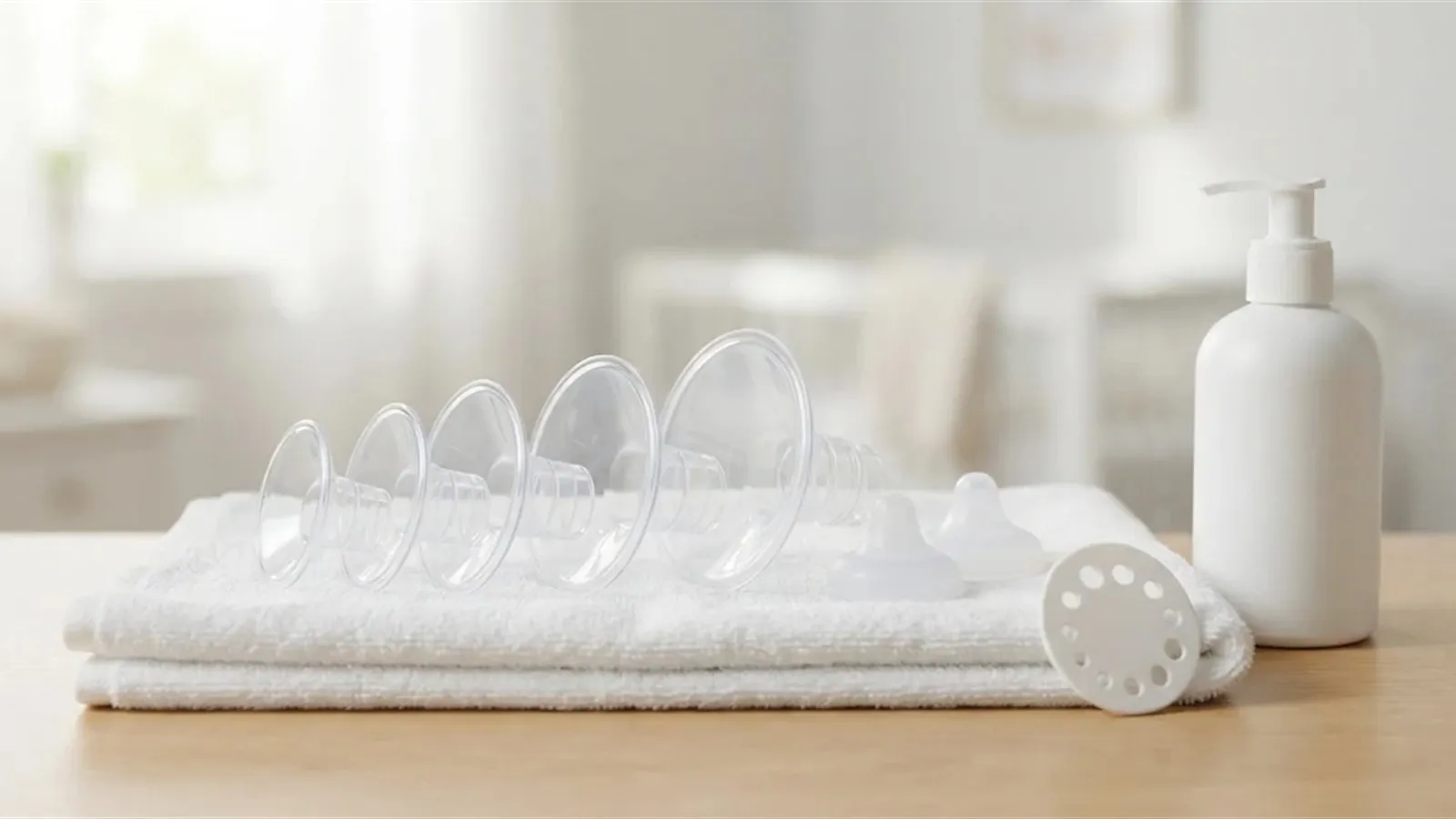
The flange, also called a breast shield, is the funnel-shaped part of a breast pump that sits over your nipple. Most pumps ship with a 24 mm flange, and plenty of people pump for weeks with that size before they learn it doesn't fit. A flange that's the wrong size can make pumping painful, damage the nipple and leave milk behind. The good news is that sizing is mostly a matter of one measurement, a quick look while you pump, and sometimes an inexpensive insert. This guide walks through how to measure, how Medela and Spectra each turn that measurement into a flange size, the fit signs that La Leche League and lactation consultants describe, and when inserts help.
The short answer
- Measure the nipple only, at its base, in millimeters. Don't include the areola.
- Use your pump maker's chart. Medela adds 4 mm to the measurement; Spectra's US guide adds 2 to 3 mm.
- Confirm it while pumping. The nipple should move freely in the tunnel, with little or no areola pulled in, and pumping shouldn't hurt.
- Measure each side, and check again over time. Size can differ between breasts and change after birth.
Why flange fit matters
La Leche League GB says flanges that are too large or too small may cause pain or nipple damage, and that finding the right size can take some trial and error. Fit can also change how much milk you get. In a 2024 crossover pilot study in the Journal of Human Lactation (36 participants, published online in November 2024), pumping with a smaller, individually fitted flange yielded more milk per session on average (153 g against 138 g) and was rated more comfortable than a standard 21 or 24 mm fit. The authors cautioned against blanket advice to size down, and one co-author developed the fitting method tested, so treat it as early evidence that fit matters, not proof that smaller is always better.
How to measure your nipple
How do I measure my nipple for a breast pump flange? Measure the width of your nipple at its base in millimeters, not including the areola. Medela and Spectra's US guide say to measure at rest, before pumping. Use a printed sizing tool or ruler, measure each nipple separately, then use your pump maker's chart to pick a flange.
- Pick your moment. Medela, Lansinoh, Elvie and Spectra's US printable guide all point to measuring at rest, before pumping or feeding, because the nipple swells during a session. Spectra's Australian site says the opposite and suggests measuring after pumping, so if you use that method, follow Spectra Australia's own chart. Spectra also says not to measure while pregnant.
- Find the base. Measure straight across where the nipple meets the areola. Don't include the areola, and don't measure the tip, unless the sizing method you're following says so.
- Use millimeters. A printable nipple sizing tool with cut-out circles is easiest. Print it at 100% scale and check one circle against a real ruler. A flat ruler or a tailor's tape also works.
- Measure both sides. Write each number down.
- Convert with your brand's chart (see below), then check the fit during a real pumping session.
Not everyone likes rulers. An IBCLC at The Pump Station & Nurtury warns that nipple skin is very stretchy and can grow more than 50% in diameter and length while pumping, so a ruler can point some people to a flange that's too small. Treat the number as a starting point, and let the fit during pumping decide.
How Medela, Spectra and others size flanges
Brands don't agree on how much room to add, so use the chart from the maker of your pump.
| Brand or method | Rule | Flange sizes |
|---|---|---|
| Medela | Nipple base at rest + 4 mm, then the closest size | PersonalFit Flex: 18, 21, 24, 27, 30, 36 mm; inserts 15, 18, 21 mm |
| Spectra (US) | Nipple base + 2 to 3 mm (16 mm nipple = 19-20 mm flange) | 16, 20, 24, 28, 32 mm; pumps ship with 24 mm |
| Elvie (wearable) | Own chart, measured at rest | Shields 21, 24, 28 mm; cushions 15, 17, 19 mm |
| Flange FITS (study method) | Starts near the nipple tip size, then adjusts while pumping | Often 13-19 mm in the 2024 study |
Medela's example: a 15 mm nipple plus 4 mm is 19 mm, so it suggests an 18 mm shield. Medela's guidance for lactation professionals calls the 4 mm a "clinical floor", noting that the nipple swells on average about 2 to 3 mm during pumping and that undersized shields carry clinical risk. Spectra's US guide adds 2 to 3 mm, so a 16 mm nipple maps to a 19-20 mm flange. Elvie's chart, for example, puts a 17-19 mm nipple in its 21 mm shield and a 13-15 mm nipple in a 24 mm shield with the 17 mm cushion. If you're between sizes, try both and let comfort and drainage decide.
Shopping for a pump as well? Our guide to the best electric breast pumps notes which flange sizes come in the box.
Signs of a good fit, too big and too small
| Fit | What you see and feel while pumping |
|---|---|
| Good | Nipple centered and moving freely in the tunnel; little or no areola pulled in; no pain; milk flows after let-down and the breast feels softer after |
| Too big | A lot of areola pulled into the tunnel; nipple reaching the back of the tunnel; pain or swelling; breast still feels full |
| Too small | Nipple rubbing or dragging on the tunnel walls or looking squashed; redness, soreness, a white ring at the base; weak suction |
How do I know if my breast pump flange is too big? A flange is likely too big if a lot of your areola is pulled into the tunnel while you pump. La Leche League GB also says that if your nipple reaches the back of the tunnel, you may need to go down a size. Too-big flanges can cause pain, swelling and poor drainage.
How do I know if my breast pump flange is too small? A flange is likely too small if your nipple rubs or drags along the tunnel walls, looks squashed, or comes out red, sore or with a white ring at the base. La Leche League USA compares a too-small fit to a nipple squashed into the tunnel like a sausage.
Brands differ a little on the ideal. Medela and Spectra say the nipple should move freely without rubbing. Lansinoh's guide says the sides can lightly touch the tunnel walls. Every source agrees on one point: Medela says plainly that pumping should never be painful. Start each session on low suction, and turn suction down if it hurts, since high suction can make a fit look worse than it is.
Flange inserts: when they help
If your measurement is well below the smallest flange your pump maker sells, an insert is the usual fix. Inserts are soft silicone sleeves that sit inside a standard flange and narrow the tunnel.
- Medela Breast Shield Inserts come in 15, 18 and 21 mm and fit 24 mm PersonalFit shields. Medela says they only work with selected compatible pumps and shields.
- Maymom flange inserts come in 13, 15, 17, 19 and 21 mm and resize a 24 mm flange. Aeroflow lists them for Spectra, Willow, Lansinoh, some Medela, Momcozy and Motif pumps, and 25 mm Ameda and Freemie flanges, at $13.99 for two.
- Willow Breast Pump Sizing Kit includes 13, 15, 17, 19 and 21 mm insert sets and a nipple sizing tool, and fits most 24 mm flanges. Kohl's listed it at $24.99.
- Wearable pump inserts. Elvie sells 15, 17 and 19 mm cushions for its 24 mm shield. Momcozy sells 17, 19 and 21 mm inserts for the S9 and S12 Pro. Our Momcozy S12 Pro review covers that pump.
Do breast pump flange inserts work? They can. Inserts are silicone sleeves that sit inside a standard flange, usually 24 mm, and narrow the tunnel to sizes such as 15, 17, 19 or 21 mm. They only fit certain flanges, can slip or affect suction, and won't help if the flange is already too tight. Use ones made for your pump where possible.
Willow puts the last point bluntly: adding an insert to an already tight fit will make the problem worse. IBCLC Jessica Anderson notes that inserts can slide into the tunnel, compromise the air seal or be too short for very elastic nipples. If an insert feels wrong, a true smaller flange, such as Spectra's 16 mm or Medela's 18 mm, is often the better option. Lansinoh suggests replacing inserts every three to four weeks and flanges every three to four months.
Your size can change
Can each breast need a different flange size? Yes. La Leche League USA says it's possible to need a different size flange for each breast, and Medela and Spectra both say to measure each nipple separately. Size can also change in the weeks after birth, so check again if pumping becomes uncomfortable.
Spectra says size may change around 10 weeks postpartum, Elvie suggests rechecking every couple of weeks, and Medela says nipples change from the third trimester through the pumping months. Swelling in the first days after birth can also throw off an early measurement.
When to get help
See an International Board Certified Lactation Consultant (IBCLC) if pumping hurts after you've tried two sizes, if your nipples are cracked, blistered or bleeding, or if your output drops. A consultant can watch you pump, which several IBCLCs say is the most reliable way to judge fit. Many insurers cover lactation visits, and La Leche League leaders offer free support. If you use a Spectra or a Medela, our Spectra S1 Plus review and Medela Pump in Style MaxFlow review list the flanges each one supports.
Sizing tools and parts worth having
These are tools and parts, not ranked picks, so we haven't scored them.
| Item | What it does | Typical price (Nov 2026) | Buy |
|---|---|---|---|
| Willow Breast Pump Sizing Kit | Sizing tool plus 13-21 mm inserts for 24 mm flanges | $24.99 (Kohl's) | Check price |
| Maymom Flange Inserts | Resize a 24 mm flange to 13-21 mm | $13.99 for 2 (Aeroflow) | Check price |
| Medela PersonalFit Flex shields | True flange sizes from 18 to 36 mm for Medela pumps | About $16-18 a pair (retailers) | Check price |
| Spectra wide flanges | 16, 20, 28 and 32 mm sizes for Spectra pumps | $14.99 single, 16 mm (Target) | Check price |
More on breast pumps: see Best Breast Pump Bags (2026) and Haakaa Silicone Breast Pump Review: One-Piece Suction Collector.
How we researched this
This guide is research-based. We did not test flanges or inserts ourselves, and it isn't medical advice. In November 2026 we read La Leche League USA's and La Leche League GB's pumping pages, Medela's fitting guide and its guidance for lactation professionals, Spectra USA's flange sizing guide and Spectra Australia's measuring guide, Lansinoh's, Elvie's and Willow's sizing pages, an IBCLC article from The Pump Station & Nurtury and the 2024 Journal of Human Lactation pilot study. Spectra's product page limited our automated checks, so flange prices come from Target, and insert prices from Aeroflow, Kohl's and other retailers. Prices change often.
Sources
- La Leche League USA, Pumping: Tips for Beginning
- La Leche League GB, Exclusively expressing breastmilk for your baby
- Medela, Choosing your Medela breast shield size
- Medela, Fitting guide
- Medela, Breast shield sizing: why we recommend starting at 4 mm larger
- Spectra USA, Flange sizing guide
- Spectra Australia, Measuring your nipple for the correct flange size
- Lansinoh, Breast pump flange fit and sizing guidance
- Elvie, Perfecting size and fit
- Willow, What size flange insert do I need?
- The Pump Station & Nurtury, Why we don't recommend nipple measuring tools
- Anders LA et al., Flange Size Matters, Journal of Human Lactation (2025)
- Aeroflow, Maymom Flange Inserts
- Kohl's, Willow Breast Pump Sizing Kit
- Target, Spectra 16 mm wide breast shield
Questions parents ask
How do I measure my nipple for a breast pump flange?
Measure the width of your nipple at its base in millimeters, not including the areola. Medela and Spectra's US guide say to measure at rest, before pumping. Use a printed sizing tool or ruler, measure each nipple separately, then use your pump maker's chart to pick a flange.
How do I know if my breast pump flange is too big?
A flange is likely too big if a lot of your areola is pulled into the tunnel while you pump. La Leche League GB also says that if your nipple reaches the back of the tunnel, you may need to go down a size. Too-big flanges can cause pain, swelling and poor drainage.
How do I know if my breast pump flange is too small?
A flange is likely too small if your nipple rubs or drags along the tunnel walls, looks squashed, or comes out red, sore or with a white ring at the base. La Leche League USA compares a too-small fit to a nipple squashed into the tunnel like a sausage.
Do breast pump flange inserts work?
They can. Inserts are silicone sleeves that sit inside a standard flange, usually 24 mm, and narrow the tunnel to sizes such as 15, 17, 19 or 21 mm. They only fit certain flanges, can slip or affect suction, and won't help if the flange is already too tight. Use ones made for your pump where possible.
Can each breast need a different flange size?
Yes. La Leche League USA says it's possible to need a different size flange for each breast, and Medela and Spectra both say to measure each nipple separately. Size can also change in the weeks after birth, so check again if pumping becomes uncomfortable.
More in Nursing & Pumping
Lansinoh Lanolin Review: The Long-Running Nipple Cream
Lansinoh lanolin review: the long-running nipple cream. When it helps and when soreness signals a latch or medical issue. Research-based,…

Elvie vs Willow Go: Wearable Breast Pumps Compared
Elvie vs Willow Go: suction, 5 oz cups, apps, noise, insurance and price compared, plus what Willow's 2025 purchase of Elvie means for US…

Best Nursing Covers (2026)
Five nursing covers compared on style, fabric, airflow and price, plus how to keep your baby cool and visible underneath and your right to…