
In this guide
- Quick picks
- When sterilizing is actually needed
- Recall alert: Baby Brezza SuperFast Sterilizer Dryer
- Baby Brezza One Step Sterilizer Dryer Advanced
- Philips Avent Premium Baby Bottle Sterilizer and Dryer
- Philips Avent Microwave Steam Sterilizer
- Dr. Brown's All-in-One Sterilizer and Dryer
- Medela Quick Clean Micro-Steam Bags
- Wabi Baby UVC LED Sanitizer and Dryer
- What we left out
- Tips for using any sterilizer
- How we researched this
- Sources
- Questions parents ask
Reader-supported: SproutPicks may earn a commission from qualifying affiliate links, at no extra cost to you. Full disclosure.
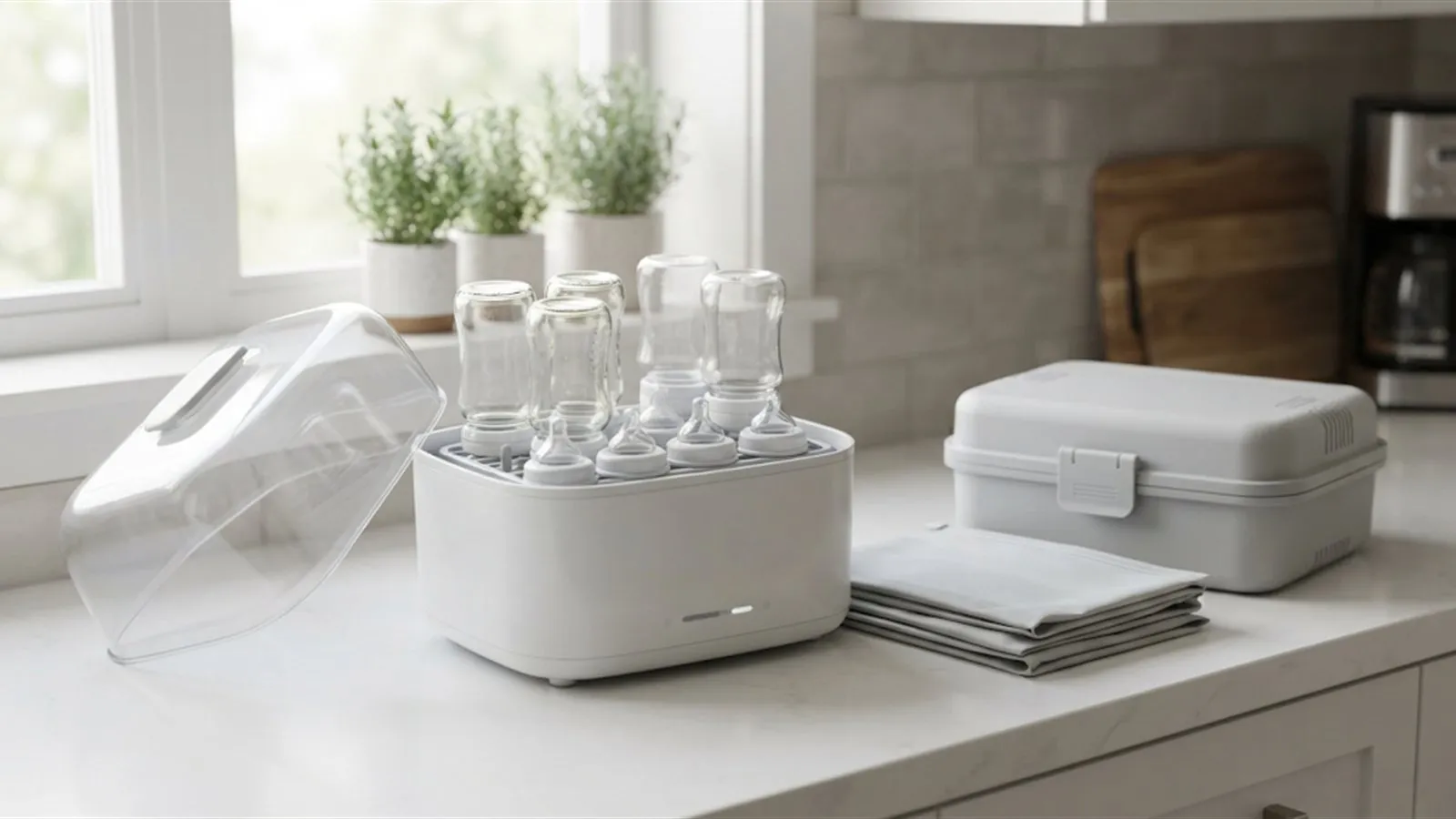
Bottle sterilizers range from a box of reusable microwave steam bags to countertop machines that sanitize, dry and store a full day of bottles. Before you buy one, it helps to know that the CDC does not say every family needs to sterilize every bottle forever. Daily sanitizing matters most for young, premature or medically fragile babies. This guide explains when sanitizing is actually needed, then compares six options across electric steam, microwave and UV, and flags a recall that was announced this month.
Quick picks
Baby Brezza One Step Sterilizer Dryer Advanced
Philips Avent Premium Baby Bottle Sterilizer and Dryer
Philips Avent Microwave Steam Sterilizer
Dr. Brown's All-in-One Sterilizer and Dryer
Medela Quick Clean Micro-Steam Bags
Wabi Baby UVC LED Sanitizer and Dryer
How we score: SproutPicks Scores are our own editorial ratings out of 10, based on published specs (capacity, cycle times, drying and storage), how clearly makers explain use and care, safety signals such as recalls, and patterns in owner reviews. We did not test these units ourselves, and the scores are not Amazon ratings.
When sterilizing is actually needed
The CDC's guidance on cleaning infant feeding items breaks down into three steps: clean, sanitize, and store.
- Clean after every feed. Take bottles and pump parts apart, rinse, and wash them in a basin used only for feeding items, not directly in the sink. A sterilizer does not replace washing.
- Sanitize daily if your baby is under 2 months old, was born premature, or has a weakened immune system. For older, healthy babies, the CDC says daily sanitizing may not be necessary if items are carefully cleaned after each use.
- A good dishwasher can count. If your dishwasher uses hot water and a heated drying cycle or a sanitize setting, the CDC says a separate sanitizing step is not necessary.
- Other methods work too. The CDC lists boiling disassembled items in water for 5 minutes, using a microwave or plug-in steam system according to the maker's instructions, or, if you can't boil or steam, soaking in a bleach solution of 2 teaspoons of unscented bleach per gallon of water for at least 2 minutes without rinsing.
- Air-dry, don't towel-dry. The CDC advises against rubbing or patting items dry with a dish towel because it can transfer germs, and it considers air-drying on a clean towel more hygienic than a drying rack, which can trap moisture.
So who benefits most from a sterilizer? Parents of newborns and preemies, families without a sanitizing dishwasher, and anyone pumping several times a day. A built-in dryer is the real convenience, because it handles the air-drying step in a closed, clean space.
Recall alert: Baby Brezza SuperFast Sterilizer Dryer
On November 5, 2026, CPSC announced a recall of about 29,000 Baby Brezza SuperFast Sterilizer Dryers (model numbers BRZ0083, BRZ0154 and BRZ0156, printed on the bottom label), plus about 4,500 in Canada. The units can overheat while operating, posing a burn hazard; Baby Brezza received 32 reports of overheating or melting housing and no injuries. They were sold from January 2024 through October 2026. Stop using a recalled unit and contact Baby Brezza for a free replacement. This recall does not cover the One Step Sterilizer Dryer Advanced we recommend below, but check the model number on any Baby Brezza unit you own or are offered secondhand.
1. Baby Brezza One Step Sterilizer Dryer Advanced
Type: Electric steam with dryer. Best for: Families sterilizing a full day of bottles and pump parts at once.
Baby Brezza lists this as its largest-capacity sterilizer dryer, holding 8 bottles and 2 sets of pump parts. It filters drying air through a HEPA filter, Baby Brezza says it dries 33% faster than other sterilizer dryers, and its modular design can be used four ways. It was marked down from $149.99 to $99.99 on Baby Brezza's site when we checked, though prices change often.
- Why we like it: Big capacity, a filtered dryer, and flexible setup for different bottle sizes.
- Trade-offs: It takes up real counter space, and HEPA filters are an ongoing cost. Like any steam unit, it needs regular descaling if you have hard water.
- Skip it if: You have a sanitizing dishwasher and a healthy baby over 2 months, or a small kitchen.
2. Philips Avent Premium Baby Bottle Sterilizer and Dryer
Type: Electric steam with dryer. Best for: Families using Philips Avent bottles.
Philips says the Premium model holds up to six Philips Avent bottles plus nipples and pacifiers, completes a full sterilize-and-dry cycle in about 40 minutes, and keeps contents sterile for up to 24 hours if the lid stays closed. It uses steam only, no chemicals.
- Why we like it: One-button sterilize-and-dry with 24-hour storage, sized around Avent bottles.
- Trade-offs: Capacity is lower than the Baby Brezza, and other brands' taller bottles may not stand upright. Availability varies by region, so confirm the US model before buying.
- Skip it if: You feed with several bottle brands or need more than six bottles per cycle.
Using Avent bottles? See our Philips Avent Natural Response review.
3. Philips Avent Microwave Steam Sterilizer
Type: Microwave steam. Best for: Small kitchens, budgets, and parents who already have a microwave.
You add 200 ml of water, load the bottles, and microwave. Philips says cycle time depends on your microwave's wattage: about 2 minutes at 1200-1850 W, 4 minutes at 850-1100 W, and 6 minutes at 500-800 W. It holds up to four Philips Avent bottles, and contents stay sterile for up to 24 hours if the lid stays closed.
- Why we like it: Fast, inexpensive, no counter space when stored, no filters.
- Trade-offs: No drying, so you'll still need to air-dry. The container and steam are very hot right after the cycle; let it cool before opening. Your microwave must be large enough to hold it.
- Skip it if: You want a hands-off dry cycle or need to do more than four bottles at a time.
4. Dr. Brown's All-in-One Sterilizer and Dryer
Type: Electric steam with dryer. Best for: Families using Dr. Brown's vented bottles, which have more small parts to dry.
This unit holds up to six bottles plus accessories in a removable basket designed around Dr. Brown's bottles, and it includes two HEPA filters. The manual lists a 600 W rating and tells you to wait 10 minutes after sterilizing before carefully opening the lid because of residual steam. Retail listings put a combined sterilize-and-dry run at roughly 45 to 60 minutes depending on the load.
- Why we like it: The basket handles the vent inserts and reservoirs that make Dr. Brown's bottles fiddly to dry.
- Trade-offs: One owner reported that taller 8 oz bottles had to lie on their sides. Cycle-time figures vary between listings, so plan for about an hour.
- Skip it if: You don't use Dr. Brown's bottles; the Baby Brezza holds more for similar counter space.
Our Dr. Brown's Options+ review explains the vent parts this basket is built for.
5. Medela Quick Clean Micro-Steam Bags
Type: Microwave steam bags. Best for: Pumping at work, travel, and backup.
Each box has five reusable bags, and Medela says each bag can be used up to 20 times. A bag holds two breastshield and valve assemblies or two 5 oz collection bottles with caps, and the cycle takes about three minutes in the microwave. Medela says not to use them for the pump's tubing or internal parts, and only for microwave-safe items.
- Why we like it: Light, cheap per use, and easy in an office microwave.
- Trade-offs: Small capacity, the bags get hot, and owners say they become brittle toward the end of their life. You'll need to track how many uses each bag has had.
- Skip it if: You're sanitizing a full day of bottles at home every day.
Pumping daily? Our Spectra S1 Plus review covers which parts need cleaning.
6. Wabi Baby UVC LED Sanitizer and Dryer
Type: UV-C light with dryer. Best for: Households that want to sanitize bottles alongside toys, pacifiers and phones without steam.
Wabi Baby's UVC LED units use mercury-free UV-C LEDs and can sanitize and dry in as little as 30 minutes, per the product listing. The larger Ultra model is listed at 11.5 x 14.5 x 16.75 inches and 14 lb, and it was listed at about $350 at the time of writing; Wabi also sells smaller versions.
- Why we like it: No water, no descaling, and it can hold non-washable items such as electronics.
- Trade-offs: UV light only treats surfaces it reaches directly, so crowded racks and the insides of narrow parts can be shadowed. Check your bottle maker's care instructions before using UV, since repeated exposure may discolor some plastics and silicone over time. It is also the most expensive pick here, and model availability changes often.
- Skip it if: Your pediatrician has asked you to sterilize for a preemie or medically fragile baby; steam or boiling is the more established method.
What we left out
Papablic is a popular Amazon brand, but we couldn't confirm consistent specs for its sterilizer dryers. Retail listings disagree on capacity and cycle times across its models, so we didn't include it rather than guess. We also left out the Baby Brezza SuperFast because of the recall above.
Tips for using any sterilizer
- Wash and rinse first. Residue blocks steam and UV.
- Check that each bottle, nipple and pump part is rated for steam, microwave or UV use.
- Use distilled water or descale regularly if your water is hard.
- Let units cool before opening; steam burns are the main hazard.
- Store dry items in a closed, clean place, as the CDC recommends.
More on bottles and formula: start with our guide to best high chairs, then Best Bottle Warmers (Home and Portable) and Comotomo Baby Bottle Review: Soft Silicone and Wide Nipple.
How we researched this
These picks are research-based; we did not hands-on test them. We read the CDC's guidance on cleaning, sanitizing and storing infant feeding items, CPSC recall notices, manufacturer product pages and comparison pages (Baby Brezza, Philips), the Dr. Brown's owner's manual, retailer specification listings where maker pages were not accessible, and patterns in owner reviews. Where specs conflicted or could not be confirmed, we said so or left them out.
Sources
- CDC, How to clean, sanitize, and store infant feeding items
- CPSC recall: Baby Brezza SuperFast Sterilizer Dryers
- Baby Brezza, Which sterilizer should I buy?
- Philips Avent sterilizer and dryer SCF293
- Philips Avent microwave steam sterilizer SCF281
- Dr. Brown's All-in-One Sterilizer and Dryer (AC177) manual
- Dr. Brown's All-in-One Sterilizer and Dryer listing
- Medela Quick Clean Micro-Steam Bags listing
- Wabi Baby UVC LED Sanitizer and Dryer Ultra listing
Questions parents ask
Do I need to sterilize baby bottles every time?
No. The CDC says to clean feeding items after each use and to sanitize at least daily if your baby is under 2 months old, was born premature or has a weakened immune system. For older, healthy babies, daily sanitizing may not be necessary if items are cleaned carefully after each use.
Is a dishwasher enough to sanitize bottles?
According to the CDC, if your dishwasher uses hot water and a heated drying cycle or a sanitizing setting, a separate sanitizing step is not necessary. Check that your bottles and pump parts are labeled dishwasher-safe.
Are UV bottle sterilizers as effective as steam?
UV light only treats surfaces it reaches directly, so parts stacked or shadowed by other items may not be fully treated. Steam reaches every surface in the chamber. UV units can work, but load them loosely and follow the maker's instructions.
Do I have to wash bottles before sterilizing?
Yes. Sterilizers and steam bags are not cleaners. Wash and rinse every part first, because milk residue can protect germs from steam or UV light.
Which Baby Brezza sterilizer was recalled?
In November 2026 CPSC announced a recall of about 29,000 Baby Brezza SuperFast Sterilizer Dryers, model numbers BRZ0083, BRZ0154 and BRZ0156, because they can overheat. Stop using one and contact Baby Brezza for a free replacement. Other Baby Brezza models were not part of that recall.
More in Feeding & Mealtime
How to Start Solids: Purees vs Baby-Led Weaning
How to start solids around 6 months: readiness signs, purees vs baby-led weaning, allergens, choking hazards and gagging vs choking, per…
Stokke Tripp Trapp vs Abiie Beyond Junior: Which High Chair to Buy?
Stokke Tripp Trapp vs Abiie Beyond Junior Y on price, what's included, newborn use, adjusting, weight limits and warranty, and which…
Best Formula Maker Machines (2026)
The best formula maker machines compared on accuracy, cleaning and price, plus CDC and WHO 70°C mixing advice, Cronobacter risk and the…